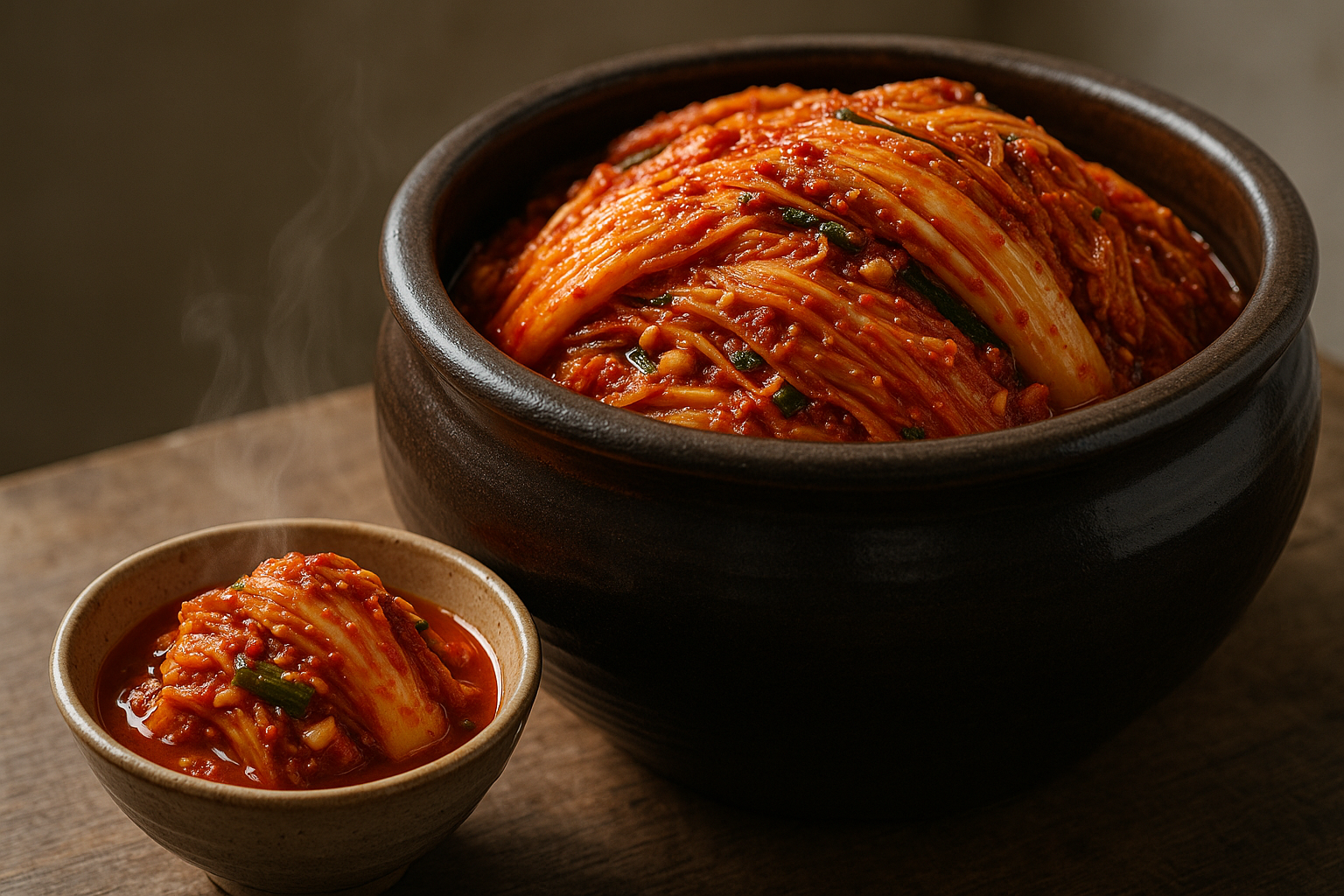
There is a good chance that kimchi is the first Korean word most people outside Korea learn to say, and once they try it, one of the first flavors they can never un-taste. It is spicy, sour, funky, garlicky, cold, and alive — a fermented cabbage side dish that shows up on almost every Korean table, at almost every meal, from breakfast noodles to late-night stew.
This guide walks through what this iconic Korean ferment actually is, the varieties worth knowing, the winter-long tradition of kimjang that makes it possible, how it stacks up against other ferments, whether the health hype holds up, and how to buy a jar you will actually finish — plus a basic method for making a small batch at home. It sits at the center of Korean food for good reason.
What is kimchi?
At its core, kimchi is a traditional Korean side dish of salted and lacto-fermented vegetables, most often napa cabbage or Korean radish, seasoned with red pepper, garlic, ginger, scallions, and a splash of fermented seafood for depth. It has been eaten on the peninsula for well over a thousand years, though the fiery red version most people picture today only became possible after chili peppers arrived in Korea in the 17th century.
There is no single recipe. Every household, every region, and honestly every grandmother has a slightly different version — mildly sour or aggressively funky, chunky or delicate, seafood-heavy or almost vegan. What they share is the fermentation: raw vegetables salted, seasoned, packed tight, and left to develop under the work of naturally occurring lactic acid bacteria until they are tangy, effervescent, and shelf-stable in a cold place.
What does it actually taste like?
The short version: sour, salty, spicy, and umami all at once, with a fizzy crunch when it is fresh and a mellower, funkier depth as it ages. A young jar tastes almost like a peppery salad — bright, sharp, herbal. A month later, the same jar tastes like something you would want in a stew.
The heat comes from gochugaru, the sun-dried Korean chili flakes that give the classic red version its color. Gochugaru is not a scorching spice — it lands at roughly 1,500 to 10,000 on the Scoville scale, closer to smoky sweet than to habanero heat. For most spice-tolerant eaters that reads as pleasantly warming, not painful. If gochugaru is new to you, it is the same chili flake that shows up in Korean stews, dry rubs, and the fiery paste behind gochujang — worth keeping a bag of on hand.
The main varieties you should know
Korean sources recognize more than a hundred and eighty varieties. In practice, a handful cover most of what you will meet in restaurants and at Korean grocery stores:
- Baechu-kimchi — the classic. Whole or quartered napa cabbage salted and packed with a red seasoning paste. This is the default, and the one Koreans mean if they say “kimchi” with no qualifier.
- Kkakdugi — cubed Korean radish (mu), seasoned the same way. Juicy, crunchy, sweet, and the traditional partner for beef bone soups like seolleongtang.
- Chonggak-kimchi — whole ponytail radishes, greens and all, fermented in a spicy paste. Named for the little topknot the radish looks like.
- Oi-sobagi — Korean cucumbers stuffed with a chive-and-red-pepper filling. A crisp, refreshing summer style, best eaten young.
- Yeolmu-kimchi — young summer radish greens, brothier and lighter, often made into a fast, barely fermented water kimchi.
- Baek-kimchi (white kimchi) — the chili-free one. Napa cabbage seasoned with garlic, chives, radish, chestnut, Korean pear, and jujube, served in a lightly sweet, fruit-tinged brine. This is the version to try if you cannot handle red pepper heat.
- Mul-kimchi — a chilled brine “water” kimchi that gets ladled into bowls; more soup than side dish, and lovely with noodles in summer.
- Mugeun-ji — aged for months to years until it is deeply sour and soft. Not eaten fresh — used almost exclusively as the base for stews and braises.
Most first-timers start with baechu, quickly graduate to kkakdugi, and then discover baek-kimchi on a summer menu and realize the category is much bigger than one recipe.
Kimjang: the tradition behind the jar
Every late autumn, families and neighbors across Korea gather to make and share massive quantities of the winter’s supply — pounds and pounds of cabbage, tubs of chili paste, a small assembly line of aunts. That collective ritual is called kimjang, and it was inscribed on UNESCO’s Representative List of the Intangible Cultural Heritage of Humanity in December 2013 as “Kimjang, making and sharing kimchi in the Republic of Korea.”
UNESCO’s citation goes out of its way to note that kimjang is less about the food itself than the shared act of making it — a rolling potluck that reaffirms community identity and passes recipes from a mother-in-law to a newly married daughter-in-law. Traditionally, the finished jars were buried in the ground in dark earthenware onggi crocks so the ferment could hold at a steady cold temperature through the winter. Modern apartments swapped the yard for the invention of the dedicated kimchi refrigerator — a separate fridge that holds a very stable, very cold temperature so a family’s kimchi ages the way it is supposed to.
You can read UNESCO’s full listing for Kimjang if you want the primary source, and if you ever make it to Seoul, Museum Kimchikan in Insadong walks visitors through the whole history and craft in one afternoon.
Kimchi vs. sauerkraut and other ferments
If you already like sauerkraut, this ferment is not going to feel like a total leap — both are lacto-fermented cabbage, both are cold and tangy, both are alive with the same broad family of lactic acid bacteria. But the flavor rules are very different: sauerkraut is essentially just cabbage and salt, while the Korean version leans on a whole paste of chili, garlic, ginger, scallions, and often fish sauce or salted shrimp. The result is spicier, more aromatic, and much more savory — more “seasoned meal component” than “clean pickled cabbage.”
Compared to Japanese tsukemono, most kimchi is more aggressive and more sour; compared to Chinese suan cai, it is spicier and more herbal; compared to German pickles, it is warmer and funkier. If you find sauerkraut a little one-note, the Korean version is very likely to convert you.
Is it actually good for you?
The short answer is: broadly yes, with sensible caveats. A properly refrigerated jar teems with lactic acid bacteria — mainly Lactobacillus, Leuconostoc, and Weissella species, with Lactiplantibacillus plantarum often called out as the workhorse strain. Recent peer-reviewed reviews and small human trials have linked regular consumption to better gut microbial diversity, favorable effects on inflammation markers, and possible cardiometabolic benefits, though the studies are still small and the effects modest.
Two honest caveats worth knowing. First, it is high in sodium — a couple of forkfuls is fine, half a jar in one sitting is a lot of salt. Second, if a jar has been heat-treated to make it shelf-stable at room temperature, the live cultures are largely killed off; you get the flavor but not the probiotics. If gut health is the reason you are buying, stick to the refrigerated section.
How to buy kimchi you will like
A short field guide for the Korean grocery aisle:
- Refrigerated vs. shelf-stable. Fresh, refrigerated jars still have live cultures; the pouches and cans on the ambient shelf have been heat-treated for a long shelf life and no longer do. Both taste good; only the first is a probiotic.
- Trusted brands. Jongga is the top-selling brand in Korea and one of the easiest to find abroad in refrigerated jars, pouches, and shelf-stable cans. Bibigo (from CJ) is widely stocked at big-box supermarkets and skews a little sweeter and milder. Wang and Sempio are two more solid, easy-to-find options.
- Read the label. Look for napa cabbage as the first ingredient, real chili, real garlic, and a fermentation date. Brands often list a “produced” date rather than a use-by — younger jars are milder and crunchier, older jars are sourer and softer.
- Vegan-friendly? Many traditional recipes use fish sauce or salted shrimp. Vegan formulas exist, but you have to check the label.
- Where to shop. Korean chains like H Mart carry the widest selection in the U.S., but plenty of major supermarkets stock at least Bibigo and Jongga. You can also compare formats and read reviews on Amazon before you commit to a case.
How to make napa cabbage kimchi at home
A small batch is not hard, and the basic method has not changed in generations:
The number one home mistake is skimping on the salt-and-rest step in stage one. That salt draw is what makes the cabbage bendy, seasoned, and safe to ferment.
How to eat and cook with it
Straight out of the jar is perfectly correct — a few forkfuls next to steamed rice and grilled meat is the default Korean meal. Beyond that, a few classics worth learning:
- Kimchi-jjigae — a hearty stew of aged kimchi, pork belly, tofu, and stock. This is what mugeun-ji was invented for.
- Kimchi-bokkeumbap — fried rice with chopped kimchi and a fried egg on top. Weeknight dinner in one pan.
- Kimchi-jeon — a savory pancake of kimchi, flour, and scallions, crisp at the edges.
- Kimchi ramen and instant noodles — a spoon of kimchi in almost any bowl of instant noodles is an upgrade; some Korean instant noodles even use it as the marquee flavor.
- Alongside grilled meat — the classic pairing is a Korean barbecue spread with grilled pork or beef, banchan bowls, and jars of Korean BBQ sauce to dip with.
A general rule of thumb: fresh, snappy jars go on the table cold; older, sourer jars belong in a hot pot.
Kimchi FAQ
What is kimchi in one sentence?
It is a traditional Korean side dish of salted and lacto-fermented vegetables — most often napa cabbage — seasoned with chili, garlic, ginger, scallions, and fermented seafood.
How spicy is it?
The classic red style is medium — pleasantly warm rather than punishing, because the gochugaru Korean chili flake sits at roughly 1,500 to 10,000 Scoville. If you cannot do chili at all, try baek-kimchi, the white, chili-free version.
Is it always vegan?
No. Traditional recipes usually include a splash of fish sauce or salted shrimp. Vegan versions exist and are labeled as such.
How long does it last?
Refrigerated, an opened jar keeps developing for weeks and holds up for months, getting more sour over time. Very aged jars are the star of stews.
How is it different from sauerkraut?
Both are lacto-fermented cabbage, but the Korean version is aggressively seasoned — chili, garlic, ginger, scallions, and often fish sauce — so it tastes spicy, funky, and umami-savory rather than plainly tart.
Does shelf-stable kimchi have probiotics?
Probably not many. Shelf-stable jars, pouches, and cans have been heat-treated to make them safe at room temperature, which kills off most of the live cultures. The refrigerated section is the one you want if gut health is the point.
🛒 Buy Kimchi Online
Can’t get to a Korean convenience store? Get Kimchi shipped to your door on Amazon — compare top-rated imports, check real reviews, and stock up on the real thing without leaving home.
Disclosure: SeoulScope is a participant in the Klook and Agoda affiliate programs and the Amazon Associates Program. As an Amazon Associate we earn from qualifying purchases. We may earn a small commission when you book or buy through links in this post, at no extra cost to you. We only recommend experiences and products we believe will genuinely help your trip.
3 thoughts on “Kimchi: What It Is, the Varieties & How to Buy or Make It”