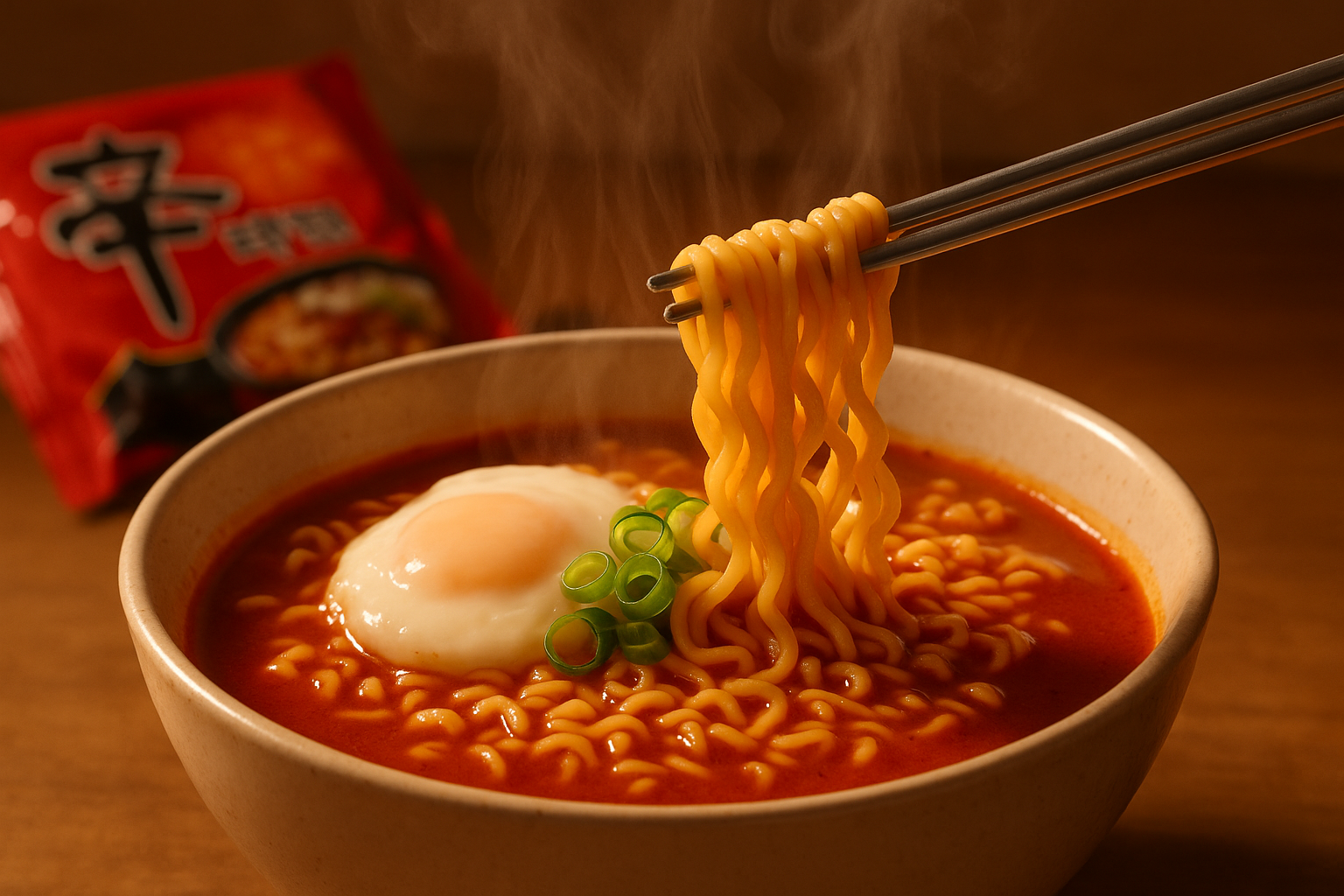
If you have ever stood in the instant noodle aisle of an Asian grocery and reached for the red bag with the bold black character on the front, you have already met Shin Ramyun. It is the best-selling instant noodle in Korea, it has held the number one spot there since the early 1990s, and for millions of people it is the gateway ramyun that opens the door to Korean food in general.
But there is more to that red bag than a quick spicy lunch. This guide explains what actually makes Shin Ramyun what it is, how hot it really runs, the varieties worth knowing, how to cook it the way the package intends, and where to buy it once you are hooked.
What is Shin Ramyun?
Shin Ramyun is a spicy instant noodle made by the Korean food company Nongshim, first sold on October 1, 1986. It was Korea’s first mass-market spicy ramyun, and it reshaped the whole category — within a few years it had taken the number one position in the Korean market, and it has held that lead for decades since.
The name is the tell. “Shin” comes from the Hanja character 辛, which means “spicy” — and it also happens to be the surname of Nongshim’s founder, so the brand reads on two levels. The flavor is built around a rich, savory beef broth amped up with red pepper, the kind of spicy-but-tasty balance Koreans call umakara. Inside the bag you get a brick of springy wheat noodles, a powdered soup base, and a packet of dried vegetable flakes with mushroom, scallion, and chili.
If you are working your way through the broader category of Korean instant noodles, Shin Ramyun is the baseline everything else gets measured against — the one a Korean friend hands you first.
How spicy is it, really?
Here is the honest answer: Shin Ramyun is spicy, but it is not punishing. For most people raised on Korean, Thai, or Sichuan heat, it sits at a comfortable medium — warming, peppery, and savory rather than tear-inducing. For someone whose spice ceiling is mild salsa, it will read as genuinely hot, so ease in.
What makes it feel balanced is that the heat rides on top of a deep beef-and-garlic base, so you taste savory richness before the burn catches up. That is very different from a pure “fire noodle” experience. If you want something that actually fights back, the famously brutal buldak fire noodles sit several levels above Shin — Shin is the everyday spicy, buldak is the dare. A good rule for first-timers: if the original feels like too much, use only two-thirds of the soup packet next time.
The varieties you’ll see
Part of the fun is that “Shin” is now a whole family, not a single product. The ones you are most likely to run into:
- Shin Ramyun (original) — the classic red pack with the powdered soup base. This is the one people mean by default.
- Shin Black — introduced in 2011, with a second soup packet flavored like seolleongtang, a rich beef-bone broth. The result is creamier, deeper, and a little less sharp than the original.
- Shin Cup and Shin Bowl — the same flavor in microwave-and-go cup and bowl formats, in several sizes, built for the convenience-store counter.
- Super Spicy (Shin Red) — a hotter version released in 2019 for people who find the original too tame.
- Shin Gold and Shin Green — newer spinoffs, including a chicken-broth take and a vegetable-based version aimed at vegetarians.
You will also see regional exclusives — a shrimp flavor sold mainly in China and Singapore, plus rotating limited editions — but the original and Shin Black are the two you actually need to know.
Shin Black vs. the original red pack
This is the question that splits fans. The original red pack is the sharp, clean, spicy one — fast, punchy, nostalgic. Shin Black adds that second soup base and a bigger vegetable packet, sometimes with dried beef, and the seolleongtang bone-broth note makes it taste richer and rounder, almost like a slow-simmered soup rather than a quick snack.
So which should you buy? If you want the iconic spicy hit, reach for the red. If you want something that eats more like a full meal — and you do not mind paying a bit more — Shin Black is worth it. Plenty of people keep both in the pantry for different moods, treating the red as a weeknight default and the black as the upgrade.
How it went global
The reach is genuinely staggering. Shin Ramyun has been the best-selling ramyun in Korea for more than three decades, and it is now sold in roughly a hundred countries — Nongshim’s flagship noodle has piled up cumulative sales into the trillions of won. It is the single product most responsible for turning “ramyun” into a word non-Koreans recognize on sight.
Part of that reach is cultural. In Korea, ramyun is not only a pantry staple — people cook it at convenience-store counters, at the coin-operated machines along the Han River, and in shared late-night stews. International visitors now buy stacks of Shin packets home as souvenirs, and convenience-store “ramyun libraries” stocking hundreds of varieties have become tourist stops in their own right. It sits at the center of all of it: the default, the benchmark, the one almost everyone tries first.
How to cook it the right way
Shin Ramyun is forgiving, but a few details separate a good bowl from a great one. The package method is simple:
- Stovetop (best): Bring about 550 mL of water (a little over two cups) to a boil, add the noodles, the soup powder, and the vegetable flakes, and cook for 4–5 minutes, stirring now and then. Many Koreans add the soup base early so it infuses the whole broth.
- Microwave: Put the soup base and flakes in a microwave-safe bowl, lay the noodles on top, add roughly 500 mL of water, and heat for about 7 minutes (less if the water is already hot).
- Don’t overcook. The noodles are meant to stay springy with a little chew; pull them while they still have bite, because they keep softening in the hot broth.
A common Korean move is to cook it slightly soupier than you think you want, since the spicy broth is half the reason you are eating it in the first place.
How to make it better
The plain bowl is great, but small additions turn it into a real meal:
- An egg — crack one in during the last minute and either stir it into a silky swirl or let it poach whole.
- A slice of cheese — melted on top, it tames the heat and adds a creamy, almost carbonara richness.
- Scallions, kimchi, or leftover protein — fresh scallions, a spoon of kimchi, dumplings, or thin-sliced beef all belong here, and they are exactly the kind of add-ons you can grab alongside Korean convenience store food.
- A spoon of rice at the end — the most Korean finish of all: tip leftover rice into the last of the spicy broth and eat it down like a soup.
Where to buy Shin Ramyun
Shin Ramyun is one of the easiest Korean products to find outside Korea. Korean and Asian grocery chains like H Mart stock it by the case, warehouse clubs often carry big multipacks, and most large supermarkets now keep at least the original in the international aisle. For multipacks, the cup format, and harder-to-find versions like Shin Black, you can also compare options and read real reviews on Amazon before you commit to a case.
And if you ever make it to Korea, do not just eat it at home. Convenience stores there have self-service ramyun cookers right on the counter, and cooking a pack at the riverside machines of Yeouido Hangang Park — then eating it outdoors by the water — is one of Seoul’s small, perfect rituals.
Shin Ramyun FAQ
What does “Shin” mean in Shin Ramyun?
It comes from the Hanja character 辛, meaning “spicy.” It is also the surname of Nongshim’s founder, so the name works on two levels at once.
Is it very spicy?
It is a medium heat for most spice-tolerant eaters — warming and peppery rather than extreme. If you are sensitive to spice, start with half the soup packet; if you want serious heat, look at the Super Spicy version or step up to buldak.
What is the difference between Shin Ramyun and Shin Black?
Shin Black adds a second, seolleongtang beef-bone soup base and a larger vegetable packet, which makes it richer and a little less sharp than the original red pack.
Is it vegetarian?
The original is built on a beef-flavored broth, so no. Nongshim has released a vegetable-based Shin Green aimed at vegetarians, so check the specific pack you are buying.
How do I make it taste better?
Add an egg, a slice of cheese, and some scallions or kimchi, and cook it a touch soupier than the directions suggest. Finishing the broth with a spoon of rice is the classic Korean move.
🛒 Buy Shin Ramyun Online
Can’t get to a Korean convenience store? Get Shin Ramyun shipped to your door on Amazon — compare top-rated imports, check real reviews, and stock up on the real thing without leaving home.
Disclosure: SeoulScope is a participant in the Klook and Agoda affiliate programs and the Amazon Associates Program. As an Amazon Associate we earn from qualifying purchases. We may earn a small commission when you book or buy through links in this post, at no extra cost to you. We only recommend experiences and products we believe will genuinely help your trip.
3 thoughts on “Shin Ramyun: What It Is, the Varieties & How to Cook It Right”