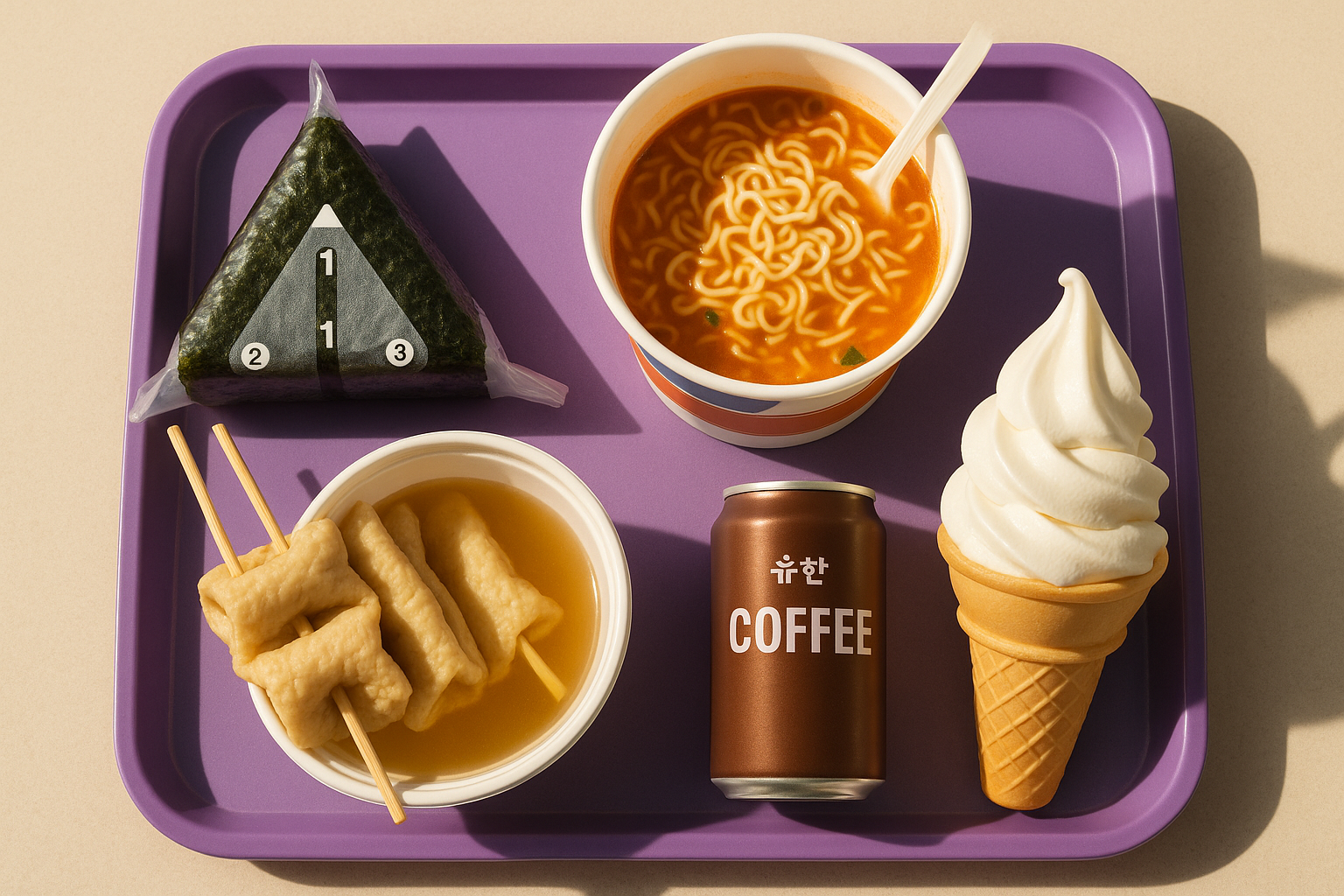
If you’ve watched almost any K-drama, you’ve seen it: a character ducks into a brightly lit GS25 or CU, peels open a triangle of seaweed-wrapped rice, and slurps a cup of ramyeon at a window counter at midnight. That scene isn’t set dressing. Korean convenience store food is a real, beloved part of everyday Korean eating — cheap, fast, genuinely good, and far more ambitious than the gas-station fare most of the world associates with the words “convenience store.”
This guide explains what it actually is, the iconic items worth trying, and how the whole experience works — whether you’re planning a trip to Seoul or just curious about the snack culture you keep seeing on screen. It’s also a tasty window into Korean food as a whole — our complete guide maps out the dishes, snacks, and where to buy them.
—
Quick Answer: Why Korean Convenience Store Food Is Worth Knowing About
Korean convenience store food stands apart from Western equivalents because the hot-food section is genuinely fresh, the prices are very low, and the stores are open 24/7 with a product range that turns over fast enough that locals shop daily. The two dominant chains — GS25 and CU — compete hard on food quality, which keeps standards high. Under one very small roof you’ll find triangle kimbap, hot fish-cake skewers, tteokbokki, cup ramyeon (with a free hot-water dispenser on-site), fresh sandwiches, banana milk, and soft-serve ice cream. It is, by a wide margin, the cheapest good meal in Korea.
—
The Big Three: GS25, CU, and 7-Eleven Korea
Korea has tens of thousands of convenience stores — there’s one within a two-to-three-minute walk of nearly every subway station in Seoul. Three chains dominate:
| Chain | Operator | Known for |
|---|---|---|
| GS25 | GS Retail | Widest hot-food selection, popular soft-serve |
| CU | BGF Retail | Strong bakery, sandwiches, loyalty-app deals |
| 7-Eleven Korea | Korea Seven (Lotte) | Large stores near transit hubs, more seating |
Korean 7-Eleven is a completely different experience from its American namesake — independently stocked, with a hot-food counter that has nothing to do with the Slurpee-and-hot-dog model abroad. A fourth chain, Emart24 (Shinsegae), rounds out the field.
> Tip: The GS25 and CU loyalty apps run frequent “1+1” (buy-one-get-one) and “2+1” promotions that are app-exclusive. Over a week of daily snacking, the savings add up fast.
—
The Best Korean Convenience Store Food to Try
Hot Foods — the real reason locals stop in
The heated glass case near the register is the heart of any Korean convenience store. The lineup rotates, but you’ll almost always find:
- Eomuk (fish-cake) skewers — soft, lightly seasoned, eaten with a soy dip. The broth pot they sit in is free to drink.
- Tteokbokki (spicy rice cakes) — sold in a small container, moderately spicy by Korean standards but real. Grab a triangle kimbap to cut the heat.
- Steamed buns (jjinppang / hoppang) — sweet red-bean or savory fillings, a winter staple sold from a warming case.
- Fried chicken pieces — GS25 and CU both sell individual crispy pieces. Not gourmet, but surprisingly satisfying.
Samgak kimbap (triangle rice balls)
Samgak kimbap (삼각김밥) is the single most iconic convenience store item in Korea — a triangular rice ball wrapped in seaweed and filled with tuna mayo, bulgogi, kimchi, or spam. The wrapper uses a numbered pull-tab system (1 → 2 → 3) that keeps the seaweed crisp until you open it; peel it in order and the nori wraps the rice perfectly. Full kimbap rolls (sold whole or in halves) are a more filling option in tuna, cheese, kimchi, or vegetable versions.
Cup ramyeon — a Korean ritual
Every Korean convenience store has a free boiling-water dispenser and a small seating counter, which turns a cup of noodles into a legitimate late-night meal for millions of Koreans. The shelves carry the country’s best instant brands — Shin Ramyun, Buldak, and more. Fill to the line, wait three minutes, eat. If you want to go deeper on which packets and cups are worth seeking out (and which to buy back home), see our guide to the best Korean instant noodles.
One thing to avoid: don’t fill cup ramyeon past the marked water line — it makes the broth thin and the noodles mushy.
Sandwiches and bread
CU leads here. Its egg-salad sandwich has a genuine cult following and often sells out by mid-morning near universities. GS25’s in-store bakery section typically stocks croissants, red-bean pastries, and cream-filled breads with same-day freshness dates, so quality is reliably good.
Drinks you won’t find at home
- Banana Milk (Binggrae) — the icon. Launched by Binggrae in 1974, this sweet, faintly artificial milk drink in its distinctive pot-bellied bottle is a national institution and the single most photographed convenience store item.
- Canned barista-style coffee — cold brews and lattes that are markedly better than most Western canned coffee.
- Sikhye — a traditional sweet rice drink, cloudy and served cold; non-alcoholic and refreshing.
- Makgeolli in a carton — lightly fizzy rice wine, best paired with something salty from the hot case.
Snacks and sweets
The packaged-snack aisle is where convenience store snacking overlaps with what you can buy abroad — many of these now sit on H Mart and Asian-grocery shelves worldwide:
- Honey Butter Chips — the salty-sweet potato chip that became a nationwide phenomenon in 2014 and never faded.
- Pepero — Korea’s chocolate-coated biscuit sticks, in far more flavors than the Japanese original it’s compared to.
- Choco Pie — the marshmallow-filled snack cake that’s a genuine cultural touchstone.
For a full rundown of the packaged treats worth packing or ordering online, see our guide to the best Korean snacks.
Desserts: soft-serve and more
GS25 is known for soft-serve ice cream dispensed at the counter — one of the best-value treats in Seoul, with flavors that rotate seasonally (sweet potato, matcha, and black sesame are common). Larger stores sometimes add mini shaved-ice cups in summer.
—
How It Works: Paying, Microwaves, and Seating
You almost never need to speak Korean to eat well at a Korean convenience store. Here’s the practical side.
Paying. All three major chains accept tap-to-pay credit and debit cards (Visa and Mastercard work reliably; Amex at most locations), cash, and — usefully — your T-money transit card, the same card you tap on the subway. Samsung Pay and Apple Pay are accepted at most stores in major cities. Point, nod, tap.
Microwaves. Most stores keep a microwave on the counter, free to use with no time limit. Boxed meals (dosirak) print their heating time on the label, and there’s usually a diagram on the machine itself. Staff are busy and won’t operate it for you, but it’s self-explanatory.
Seating. Counter seats along the window are fair game — this is exactly where the K-drama ramyeon scenes happen. If the store is packed, eat at a reasonable pace; there’s no formal limit, just shared courtesy in a small space.
Hours. Virtually every GS25, CU, and 7-Eleven in Seoul runs 24 hours, 365 days a year, which is why they’re a lifeline for late arrivals and pre-dawn departures.
—
The K-Drama Connection
Part of why Korean convenience store food travels so well as a topic is that it’s woven into the entertainment the world already watches. The midnight ramyeon counter, the banana milk shared between characters, the triangle kimbap eaten on a park bench — these are visual shorthand in K-dramas precisely because they’re so ordinary in real Korean life. One of the most beloved real-world versions of the experience plays out along the Han River, where people buy cup ramyeon and snacks from riverside convenience stores and eat outdoors on summer nights; our Han River night activities guide covers that scene. For the street-stall food that complements the convenience-store baseline, the Myeongdong street food guide maps the outdoor markets.
—
FAQ: Korean Convenience Store Food
What is the most popular Korean convenience store food?
Samgak kimbap — triangle rice balls — is consistently the top-selling single item across all chains, with tuna-mayo and bulgogi the most popular fillings. It’s a complete light meal for very little money.
Are Korean convenience stores open 24 hours?
Yes. Essentially every GS25, CU, and 7-Eleven in Seoul operates 24 hours a day, year-round, including public holidays — which makes them invaluable for late-night and early-morning eating.
Is convenience store food good for vegetarians?
Options are limited but exist: plain vegetable kimbap, seaweed snacks, banana milk, yogurt drinks, and most breads and pastries are vegetarian. Fish cake (eomuk) is not. Check the packaging, which often carries a fish/seafood allergen symbol.
What’s the difference between GS25 and CU?
Both are excellent. GS25 has a slight edge in hot food and ice cream; CU leads on sandwiches and pastries. In practice, whichever is closer is the right answer — quality is comparable.
Can I pay with a foreign credit card?
Yes. Visa and Mastercard tap-to-pay work reliably at all three major chains, and Amex at most locations. Tell your bank you’re traveling so small, frequent purchases don’t trigger fraud flags.
What should I try first?
A solid starter set: one tuna-mayo samgak kimbap, one eomuk fish-cake skewer, one Binggrae banana milk, and a GS25 soft-serve cone if the store has the machine. That’s your Korean convenience store orientation in a single, very cheap visit.
—
For official tourism information about Seoul’s food culture, see VisitSeoul.net, the city’s English-language tourism portal.
🛒 Buy Korean Convenience Store Food Online
Can’t get to a Korean convenience store? Get Korean Convenience Store Food shipped to your door on Amazon — compare top-rated imports, check real reviews, and stock up on the real thing without leaving home.
Disclosure: SeoulScope is a participant in the Klook and Agoda affiliate programs and the Amazon Associates Program. As an Amazon Associate we earn from qualifying purchases. We may earn a small commission when you book or buy through links in this post, at no extra cost to you. We only recommend experiences and products we believe will genuinely help your trip.
8 thoughts on “Korean Convenience Store Food: What to Try at GS25, CU & 7-Eleven”