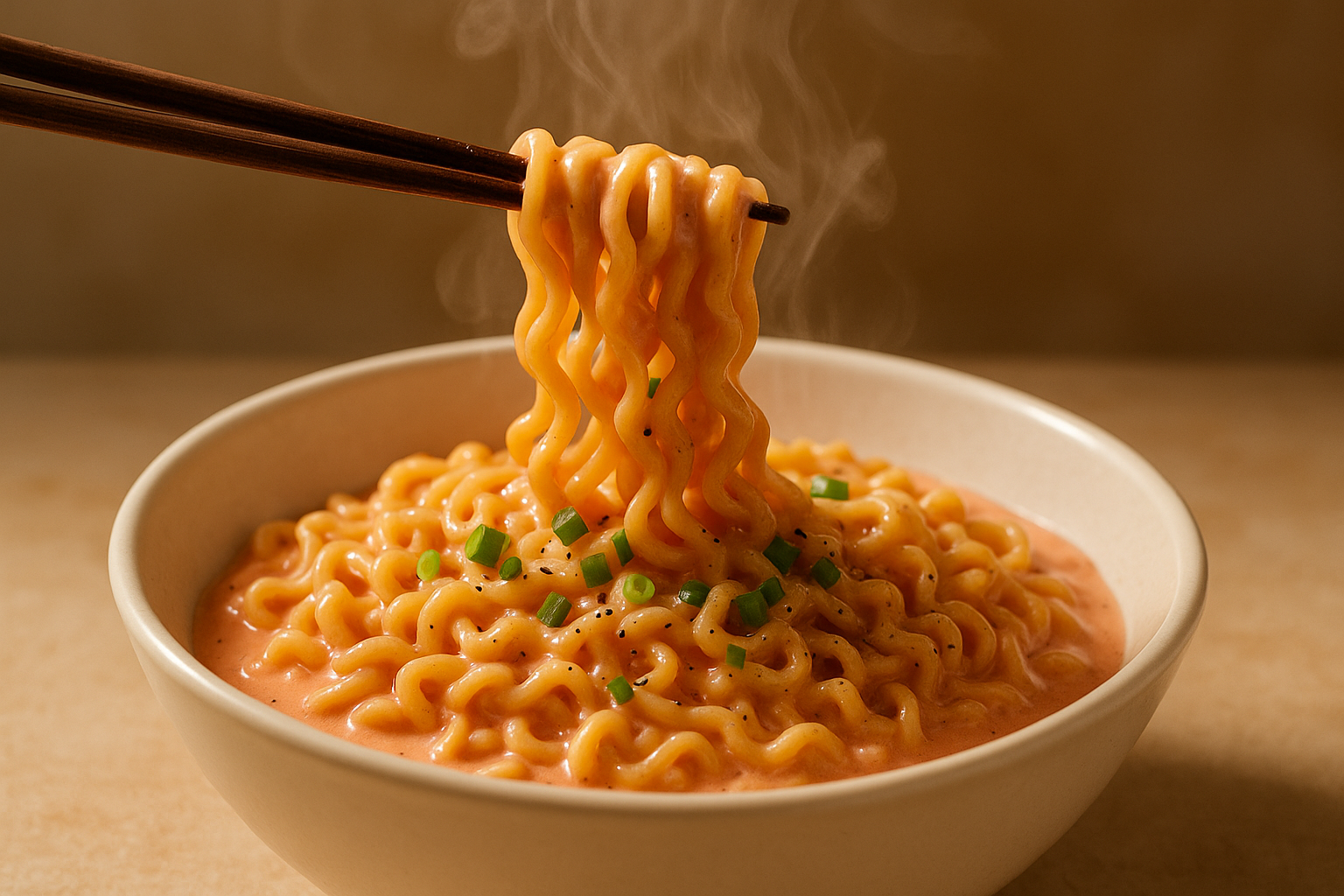
At some point in the last few years, a bubblegum-pink packet of Korean fire noodles became one of the most recognizable foods on the internet. Buldak carbonara — the creamy, cheesy spin on Samyang’s infamous fire chicken noodles — is the flavor that people who “don’t do spicy” still finish, the one that keeps selling out at Korean groceries, and the reason a whole generation met Korean instant noodles through a glossy pink bowl on their feed.
This guide covers what it actually is, how hot it really is, why it went viral, how to cook it so the sauce turns properly creamy instead of clumpy, and where to buy it without overpaying. If you are still getting oriented in the wider world of Korean food, this pink packet is one of the most fun places to start.
What is buldak carbonara?
Buldak carbonara is a flavor of buldak bokkeum-myeon — literally “fire chicken stir-fried noodles” — the famously spicy instant noodle line from Korean maker Samyang Foods. Unlike most instant ramen, buldak is not a soup. You boil the noodles, pour off almost all of the water, and stir what is left through an intensely spicy chicken-flavored sauce, so the heat clings to every strand instead of dissolving into a broth.
The carbonara version, added to the lineup in 2017, tempers that firepower with a second packet of cream and cheese powder. Stirred together with the fire sauce and a little of the cooking water, it turns into a glossy, pale-pink coating that is rich, slightly sweet, peppery, and still very much spicy. The name winks at the Italian pasta, but nobody is pretending this is carbonara in the Roman sense — it is Korean fire noodles wearing a cream sauce, and that is exactly why it works.
You cannot miss it on a shelf, either: while the original comes in black-and-red packaging, the carbonara lives in a pink packet that has become a badge of its own. The buldak line dates back to 2012, and the carbonara has grown into arguably its most famous member. For how it stacks up against all of its siblings, see our ranking of every buldak flavor.
How hot is buldak carbonara, really?
Short answer: about 2,600 SHU — roughly 60% of the original buldak’s 4,404 SHU, and the cream and cheese powder soften it further. Milder than the original, then, but “milder” is doing a lot of work in that sentence.
The original buldak sauce is commonly measured at around 4,404 Scoville heat units (SHU), and the carbonara is usually cited at roughly 2,600 SHU — a little more than half the burn on paper. The cream and cheese powder do real work beyond the numbers, too: fat blunts capsaicin, so the perceived heat lands gentler, arriving as a slow build rather than an immediate slap.
For context, that still puts it in the neighborhood of Tabasco sauce (about 2,500–5,000 SHU) — except it is coating every noodle rather than dabbed on the side of the plate. If your spice ceiling is a medium salsa, expect to sweat. If you regularly eat hot wings or a bowl of shin ramyun, the carbonara will read as pleasantly warm rather than punishing.
That balance is the whole trick. It is the easiest on-ramp into the buldak lineup: enough fire to feel like an event, enough cream to keep you eating instead of reaching for milk after every bite.
Why the pink noodle took over the internet
The carbonara’s rise is, at heart, a social media story. The sauce is glossy, the pink pops on camera, and the creamy texture is practically engineered for short video. Cooking it, ranking it, daring a friend to survive it — every format works, and creators noticed.
Then came the moment that pushed it fully into the mainstream: a TikTok of a young girl in Texas tearfully unwrapping a pink multipack — her favorite noodles — as a birthday present. The clip drew millions of views, and Samyang leaned all the way in, famously showing up with a pink truck and a buldak-themed birthday party for her. The flavor was already popular before that; afterward, finding it in stock became its own small victory, and the pink packet cemented itself as the face of the entire line.
Virality alone does not explain the staying power, though. Plenty of foods go viral once and vanish. The carbonara stayed because the flavor actually delivers — the internet just got more people to try it.
How to cook it so it is actually creamy
Buldak carbonara lives or dies by water management. The difference between a gluey mess and the glossy bowl you have seen online comes down to four steps:
Easy upgrades, in ascending order of indulgence: a splash of milk for extra silkiness, a handful of shredded mozzarella, a raw egg yolk stirred in at the very end, and chopped green onion for contrast. The cup version follows the same logic — keep a little of the soaking water back before you stir in the packets.
Two mistakes to avoid. First, draining the pot bone-dry: the powder will clump and the sauce never comes together. Second, reaching for water when the burn hits: capsaicin is fat-soluble, so milk, cheese, or ice cream will rescue you — water just spreads the fire around.
Carbonara vs. the original buldak
Same chewy noodle, same fire-chicken sauce base — the difference is that packet of cream and cheese powder, and it changes everything:
- Heat: the original is a straight slap of spice; the carbonara is roughly half as hot and builds slowly instead of hitting instantly.
- Texture: the original’s sauce is thin and clingy; the carbonara’s is thick and glossy, coating the noodles like a pasta sauce.
- Flavor: the original is sharp, smoky-sweet heat with little else; the carbonara layers in buttery, cheesy, black-pepper notes that make it taste like an actual dish.
If you want the badge-of-honor burn, start with the original. If you want the one you will actually crave on a random Tuesday night, it is the pink packet — which is exactly how most people end up here.
Cream carbonara and the pink family
Success breeds variants. The cream carbonara, in a paler pink packet, dials the heat down further and the cream up — aimed at people who found the regular carbonara approachable and want something even gentler. Samyang also rotates limited editions and regional exclusives, so the pink shelf can look a little different from month to month and market to market.
If you spot a variant you have never heard of, that is normal. The one to start with is the standard bubblegum-pink packet; branch out from there once you know your heat tolerance.
Where to buy buldak carbonara
A few years ago this meant a trip to a Korean grocery. Today the options are much wider:
- Korean and Asian markets like H Mart remain the most reliable bet, usually stocking single packets, five-packs, and the cup version side by side.
- Mainstream supermarkets increasingly carry it in the international aisle, though the shelf tends to empty fast.
- In Korea, it is everywhere — on every corner store shelf, right alongside the rest of the Korean convenience store food canon.
- Online, the easiest route is a quick search on Amazon, where you can compare single packs, multipacks, and variety boxes and read reviews before you commit.
A single packet is the cheapest way to find out where you stand; a multipack is the smarter buy once you know you are hooked. And if you do get hooked, the wider world of Korean instant noodles runs deep — the carbonara is many people’s gateway, and it is rarely their last stop.
Buldak carbonara FAQ
Do I use both packets?
Yes. The liquid packet is the fire; the powder packet is the cream and cheese. The powder goes in last, off the heat, with a few spoonfuls of cooking water saved to loosen it into a sauce.
How hot is buldak carbonara compared to the original?
Roughly half: it is commonly cited at around 2,600 SHU versus about 4,404 for the original, and the cream mutes the perceived burn further. It is still genuinely spicy — just an approachable kind of spicy.
Can I make it milder?
Yes. Use half to two-thirds of the fire sauce packet, then add a splash of milk or extra cheese. You can always stir in more sauce afterward; you cannot take it out.
Is it a soup?
No. Buldak is a stir-fried-style noodle: you drain the water and eat the noodles coated in sauce. If you leave it soupy, the sauce never thickens and the flavor washes out.
What is the difference between carbonara and cream carbonara?
Cream carbonara is the milder, creamier sibling in a lighter pink packet — same idea, less fire, more cream. It is a good pick if the standard version still sounds intimidating.
🛒 Buy Buldak Carbonara Online
Can’t get to a Korean convenience store? Get Buldak Carbonara shipped to your door on Amazon — compare top-rated imports, check real reviews, and stock up on the real thing without leaving home.
Disclosure: SeoulScope is a participant in the Klook and Agoda affiliate programs and the Amazon Associates Program. As an Amazon Associate we earn from qualifying purchases. We may earn a small commission when you book or buy through links in this post, at no extra cost to you. We only recommend experiences and products we believe will genuinely help your trip.
1 thought on “Buldak Carbonara: How Spicy It Is, How to Cook It & Where to Buy”