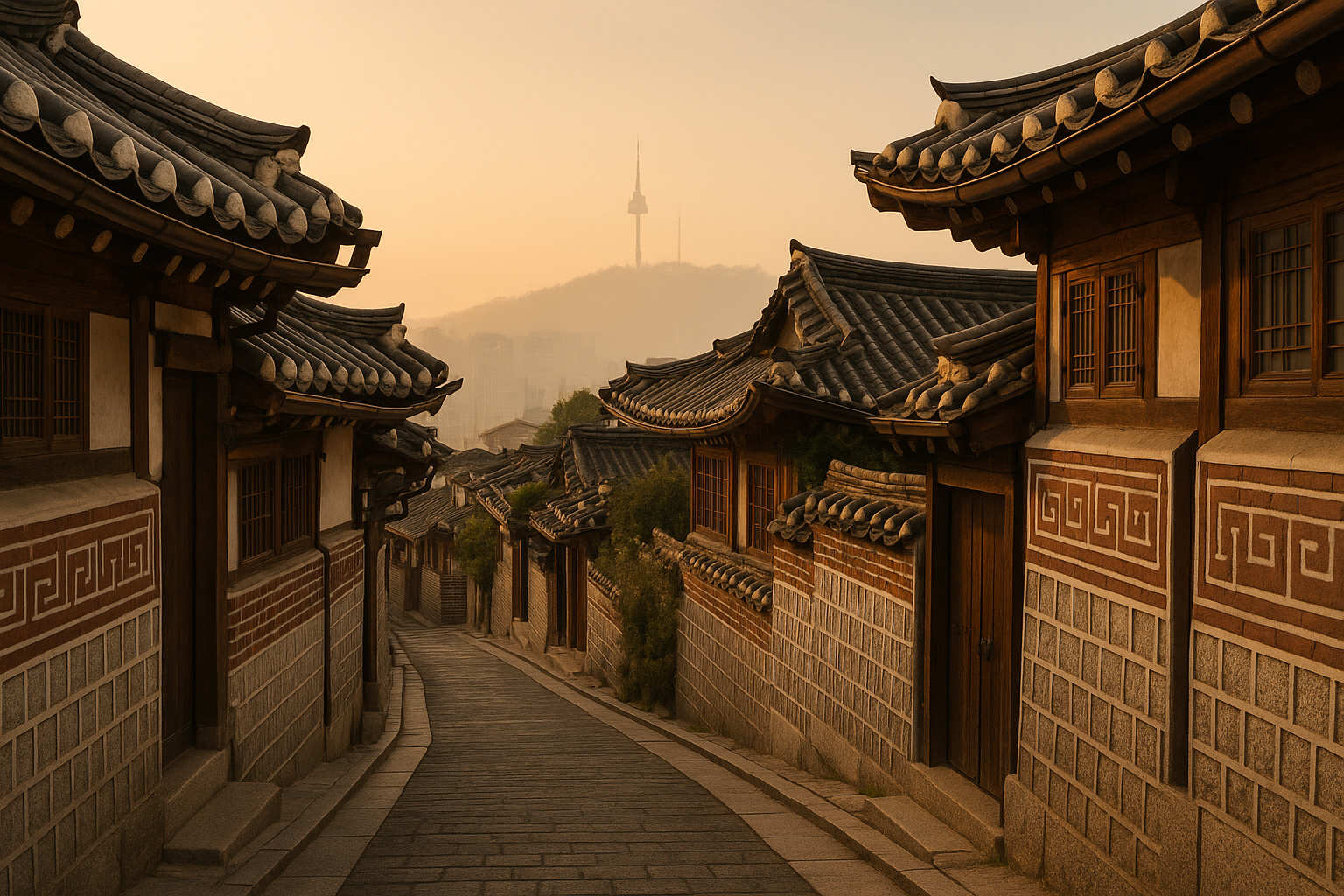
This Bukchon Hanok Village Seoul guide starts with the timing mistake most visitors make: arriving between 11 AM and 2 PM, snapping the same photo at the same alley, and leaving thinking they saw it. They didn’t. The real Bukchon — the one that’s actually a residential neighborhood, not a film set — reveals itself before 9 AM and after 5 PM, when the tour groups are gone and you can hear the wind moving through the giwa (clay-tile) roofs.
This Bukchon Hanok Village Seoul guide is the version I give friends visiting Seoul for the first time. It covers when to go, where the eight “signature” photo spots actually are, how to rent a hanbok without overpaying, and the etiquette rules that have made locals so frustrated that the district now enforces quiet hours with fines.
Bukchon Hanok Village Seoul Guide: Quick Answer
🎟️ Book Your Bukchon Hanok Village Seoul Guide Experience
Skip the queues and language barriers. Compare verified tours, tickets, and rentals for Bukchon Hanok Village Seoul Guide on Klook — instant mobile vouchers, English support, free cancellation on most activities.
Go on a weekday and plan around the official visitor hours: the main photo alley (Bukchon-ro 11-gil, the designated Red Zone) is open to tourists 10 AM to 5 PM only. Arrive at 10 AM sharp for the quietest Red Zone shots — or come 7:30–9:30 AM for the photo spots outside the restricted alley, then enter 11-gil when it opens. Start from Anguk Station Exit 2 and pair Bukchon with Gyeongbokgung or Changdeokgung afterward. Budget 60-90 minutes for the village itself and add hanbok rental only if you are also visiting a palace.
Where Bukchon Actually Is (and Isn’t)
Bukchon Hanok Village (북촌한옥마을) is not a single attraction with a gate and a ticket booth. It’s a residential neighborhood of about 900 traditional hanok houses spread across the hillside between Gyeongbokgung Palace to the west and Changdeokgung Palace to the east, in Seoul’s Jongno-gu district.
The nearest subway station is Anguk Station (Line 3, Exit 2). From there, walk north uphill for about five minutes and you’ll be in Bukchon proper.
Key thing to understand: people still live here. The houses you photograph are someone’s living room. That single fact is the reason for almost every rule below.
When to Go: The Quiet-Hours Strategy
On weekends after 10 AM, the main photo alley (Bukchon-ro 11-gil) fills up faster than you’d expect. By noon you’re queueing to take a photo of a queue. Here’s the schedule that actually works:
- Best window: Weekday at 10 AM sharp, when the Red Zone (Bukchon-ro 11-gil) opens to tourists. You get the photo alley at its emptiest without risking the restricted-hours fine.
- Early-bird option: Weekday 7:30–9:30 AM works beautifully for the photo spots outside the Red Zone — soft light, empty lanes — but stay out of Bukchon-ro 11-gil until 10 AM, since tourist access there is restricted before then.
- Second best: Weekday afternoon, 3:30–4:45 PM, giving yourself time to clear the Red Zone before the 5 PM cutoff.
- Avoid: Saturday between 10 AM and 4 PM, and Sundays — Sunday is officially designated a “rest day for the alleyways.” Tuesday is the slowest weekday.
Quiet hours are real and enforced: Bukchon has a designated “resting time” from 5 PM to 10 AM during which loud talking, group photography with reflectors, and commercial filming are restricted. Signs are posted in English. Fines apply.
Bukchon Hanok Village Official Visiting Hours (2026)
Most of Bukchon is a public residential neighborhood with no gate or ticket, but the core photo alley — Bukchon-ro 11-gil (the designated “Red Zone”) — now has official visiting hours of 10 AM to 5 PM. To protect residents, tourist access is restricted from 5 PM to 10 AM the next morning, and visiting, photographing, or lingering for sightseeing during those restricted hours can draw a ₩100,000 fine (enforced since March 2025). So in practice the visitor hours are 10 AM–5 PM. Two more rules from the official Seoul city notice: Sunday is designated a “rest day for the alleyways” — plan your visit Monday to Saturday — and from January 1, 2026 a chartered-bus restriction zone covers the area, with fines from ₩300,000 for tour buses that enter. The free Bukchon Traditional Culture Center (worth 20 minutes) opens 9 AM–6 PM and is closed Mondays.
If keeping the Red Zone hours, the Sunday closure, and the fine windows straight sounds like more admin than holiday, a guided walk takes the timing off your plate: a Gyeongbokgung + Bukchon + Gwangjang walking day tour is timed to enter the alleys within visiting hours and most include hanbok rental.
The Eight Photo Spots (Numbered on Maps as “Bukchon 8 Gyeong”)
The Jongno-gu district office officially designated eight viewpoints. Most visitors only know spot #5 because it’s the one on Instagram. The others are quieter and, in my opinion, better.
If you only have 90 minutes, do spots #1 → #3 → #4 → #5 in that order. It’s a loop of about 1.3 km, mostly uphill on the way in and downhill on the way out.
Add this to your Seoul itinerary →
Hanbok Rental: What It Actually Costs in 2026
Wearing a hanbok (traditional Korean dress) gets you free admission to Gyeongbokgung Palace next door, which is reason enough to consider it. Most rental shops cluster around Anguk Station Exit 1 and along Samcheong-dong-gil.
Typical 2026 pricing:
- 2-hour basic rental: ₩15,000–25,000 (about $11–18 USD)
- 4-hour standard rental: ₩25,000–40,000
- Full-day premium (silk, accessories, hair styling): ₩50,000–80,000
Walk-in rates at the shops are higher and the selection at peak times is whatever’s left. Most experienced travelers pre-book.
For a deeper rental breakdown, compare our hanbok rental near Gyeongbokgung guide before choosing a shop around Anguk.
For pre-booking, book a Bukchon hanbok rental at Hanboknam on Klook — packages typically bundle the rental with optional photographer add-ons and free hair accessories.
Sizing tip: If you’re taller than 180 cm or wear above a US size 14, message the shop ahead. The rental inventory is mostly standard Korean sizing and “large” options sell out fast on weekends.
How to Visit Without Being That Tourist
The Jongno-gu government has, in the past three years, considered restricting tourist access to Bukchon entirely because of resident complaints. Don’t make that necessary. Three rules:
Combining Bukchon With Nearby Sights
The smart play is to pair Bukchon with one or two adjacent areas, since you’re already in the historic core of Seoul.
Gyeongbokgung Palace (5 min walk west)
Gyeongbokgung opens at 9 AM. Do Bukchon at 7:30 AM, then walk down to the palace for the 10 AM changing-of-the-guard ceremony. If you’re in hanbok, entry is free; otherwise it’s ₩3,000.
Samcheong-dong Cafe Street (immediately west of Bukchon)
A stretch of indie cafes and small galleries running south from the village. Good for a late breakfast after your early Bukchon visit. Look for our Seoul cafes spring guide for specific recommendations. If you are visiting in June, July, or August, cool down afterward with the best bingsu Seoul summer 2026 guide.
Changdeokgung Palace (10 min walk east)
Less crowded than Gyeongbokgung and home to the Huwon (Secret Garden), which uses timed, language-specific entry. Use the Changdeokgung Secret Garden booking guide for the official reservation window, separate palace ticket, and current English slots.
Insadong (15 min walk south)
Souvenir shopping, traditional teahouses, and one of the better introductions to Korean craft if you have an afternoon. Pair with Gwangjang Market’s food alleys for dinner.
Jongmyo Shrine (10 min walk southeast)
The Joseon royal ancestral shrine, UNESCO-listed since 1995 and ₩1,000 to enter. On weekdays you cannot wander it alone — entry is timed and guided, with English sessions at 10:00, 12:00, 14:00 and 16:00, while weekends and the last Wednesday of the month allow free self-guided viewing. See the Jongmyo Shrine tour guide for hours, the ₩6,000 integrated palace ticket, and pairing options. One nearby palace sits outside that pass entirely: Gyeonghuigung is free to enter, which makes it the cheapest palace stop if your budget is already committed to Bukchon and hanbok.
Guided Tours: Are They Worth It?
For most travelers, no — Bukchon is small enough to self-navigate, and the official tourist map (free at the Anguk Station information desk) covers the eight photo spots.
A guided tour starts to make sense if:
- You want context on hanok architecture beyond “old houses, pretty roofs.”
- You’re combining Bukchon with multiple palaces in one efficient half-day.
- You’d rather not navigate alone with kids in tow.
Book a Gyeongbokgung + Bukchon + Gwangjang walking day tour on Klook — most include hanbok rental and run 3–4 hours from a central Seoul pickup point.
Where to Stay Nearby
If you want to stay within walking distance of Bukchon, the Jongno / Insadong / Samcheong-dong triangle is the obvious zone. Hanok-style guesthouses are clustered inside the village itself (atmospheric but expect thin walls and shared bathrooms), while modern hotels sit along Jong-ro and Samil-daero.
Jongno hotels near Bukchon — sort by “distance from Bukchon Hanok Village” to keep walks under 10 minutes.
What to Skip
A few things online guides recommend that aren’t worth your time:
- “Bukchon Octopus” restaurant marketing themselves as the only place to eat in Bukchon. Plenty of better options in Samcheong-dong.
- Costume rental that isn’t hanbok (some shops rent “Joseon prince” outfits that are basically Halloween costumes). Stick with reputable hanbok shops.
- Paid photography “packages” that include only 10 photos for ₩100,000+. Either bring a friend or book a proper professional via Klook.
Practical Information
- Address: Bukchon-ro 12-gil, Jongno-gu, Seoul
- Subway: Anguk Station (Line 3), Exit 2
- Admission: Free (it’s a neighborhood)
- Best time: Weekday at 10 AM (Red Zone opening) or 7:30–9:30 AM outside the Red Zone
- Red Zone visitor hours: 10 AM – 5 PM (Bukchon-ro 11-gil; tourist access restricted 5 PM – 10 AM, ₩100,000 fine)
- Wheelchair accessibility: Limited — many alleys are steep and cobblestoned
- Official map: Available free at the Anguk Station tourist information desk, or download from VisitSeoul.net.
How Long to Spend at Bukchon Hanok Village: 30 Minutes, 1 Hour, or Half a Day
The right answer is not “as long as the village is open.” It depends on whether you want one roofline photo, a coherent walk, or a historic-district morning. Bukchon rewards a route with a purpose; wandering every side lane usually means more climbing, more crowd friction, and more time spent in front of private homes.
Thirty minutes: make it a focused architecture stop. Begin near the Bukchon Traditional Culture Center, use Gyedong-gil as your approach, and choose one public Gahoe-dong viewpoint rather than chasing every numbered photo spot. Keep moving instead of waiting for an empty-alley shot. This version works when Bukchon is a bridge between a palace and lunch, but it is too short for a museum, craft stop, or hanbok session.
One hour: do a one-way neighborhood walk. Move from the culture-center side toward the higher Gahoe-dong lanes, pause at one viewpoint, then descend toward Jeongdok Public Library and Samcheong-dong. You get the change from working neighborhood to hanok roofscape without retracing the steepest section. Use the posted signs to stay inside the current visitor-access area and window.
Half a day: add one experience, not five more alleys. Pair the one-way walk with either Gyeongbokgung, a pre-booked hanbok rental, or a small public museum or workshop. A half-day is useful because it adds context and rest time; it should not become permission to linger in residential lanes. If your only goal is the famous downhill photograph, half a day is unnecessary.
What a Residential Neighborhood Means for Visitors
Bukchon is not an open-air museum. Seoul’s official visitor guidance describes it as a residential area first, and that changes the boundary between a public street and an invitation to explore. Stay on public lanes. Enter a courtyard, hanok interior, workshop, cafe, museum, or guesthouse only when it is clearly signed as a visitor-facing place and you are using that place. An open residential gate is not public access.
Photography needs the same distinction. A quick exterior photograph from a public lane is different from staging a shoot outside someone’s door. Do not point a camera into a home, even when the door is open; the official Visit Seoul etiquette notice explicitly asks visitors not to photograph or film house interiors. Keep voices low, keep groups compact, and move aside rather than turning a narrow lane into a set.
The Red Zone has a stricter rule outside its posted tourist-access window. Jongno-gu’s official enforcement notice defines tourist activity there to include taking photos or video, lingering to look around, and wandering for sightseeing. Passing through, visiting an open business, and sightseeing are not treated as the same thing. Check the current signs and official notice on the day you go; if a steward asks you to move, do so without debating the boundary.
A Walking Order That Uses the Hill Instead of Fighting It
Use a one-way route: Bukchon Traditional Culture Center → Gyedong-gil → the Chung-Ang school edge → Gahoe-dong public lanes → Jeongdok Public Library → Samcheong-dong. This follows the logic of Seoul’s official Bukchon walking route while ending where cafes, wider pavements, and onward transport make a natural break.
The first half trends uphill. Take that climb while you are fresh and resist detours down narrow lanes that force you to climb back to the same ridge. Around Gahoe-dong, choose one marked viewpoint and continue; the famous roofline section is the part most likely to bottleneck when groups stop in the middle of the lane. The western descent toward Jeongdok and Samcheong-dong is easier on tired legs and avoids a second pass through the same residential core.
If the main viewpoint is crowded, do not wait for the neighborhood to become an empty photo set. Keep the hanok roofline as part of the walk, use the quieter transition streets near the library, and save your seated break for Samcheong-dong. The route is successful when it feels continuous, not when you collect every map number.
Bukchon Hanok Village Seoul Guide: Is It Worth Your Time Versus Ikseondong or Seochon?
These three neighborhoods are not interchangeable. Choose by the experience you want, not by which one has the most hanok photos online.
| Choose | Best for | Main tradeoff |
|---|---|---|
| Bukchon | A sloped architecture walk, palace pairing, and broad hanok roof views | It is a living neighborhood, so access, noise, and photography require restraint |
| Ikseondong | A compact cafe, restaurant, and shopping stop in adapted hanok buildings | Easier for eating and browsing, but more commercial and often congested |
| Seochon | A slower neighborhood day with markets, small galleries, cafes, and side streets | More spread out and less visually concentrated than Bukchon’s ridge |
Choose Bukchon if palace context and the shape of a historic residential district matter more than shopping. Choose Ikseondong if your group wants food and interiors with minimal route planning. Choose Seochon if you prefer an unhurried neighborhood mix and do not need one signature viewpoint. If steep lanes, crowd management, or resident etiquette sound like burdens rather than part of the visit, Bukchon may not be the best use of your limited Seoul time.
A Gyeongbokgung and Hanbok Half-Day Without Backtracking
Build the half-day around elapsed time instead of trying to squeeze every nearby sight into a checklist:
- First 30 minutes: collect a reserved hanbok near the palace and confirm the return deadline, weather layer, shoes, and storage before leaving the shop. The hanbok rental near Gyeongbokgung guide explains how rental length, fitting, and palace entry affect the choice.
- Next 90 minutes: give Gyeongbokgung the largest uninterrupted block. Palace courtyards need more attention than a rushed photo lap, and this is where wearing hanbok changes the experience most.
- Next 15 minutes: move toward Anguk and the Bukchon culture-center side. Confirm that the Red Zone portion of your route still fits the posted visitor window before walking uphill.
- Next 60–75 minutes: follow the one-way Bukchon route through one viewpoint and descend toward Jeongdok or Samcheong-dong. Do not return through the residential core just to recreate a missed photo.
- Final 30 minutes: keep a return buffer for the rental shop or use it for a cafe only after you know the outfit is back on time.
If your palace visit is a seasonal evening program, reverse the priorities: complete Bukchon earlier, return the hanbok if required, then follow the current booking and entry instructions in the Seoul palace night tour Gyeongbokgung guide. Do not use an evening palace ticket as a reason to remain in Bukchon’s restricted residential lanes after the posted cutoff.
FAQ
What are the official visiting hours for Bukchon Hanok Village?
The core photo alley, Bukchon-ro 11-gil (the designated “Red Zone”), has official visiting hours of 10 AM to 5 PM. Tourist access is restricted from 5 PM to 10 AM the next morning to protect residents, and sightseeing during those restricted hours can draw a ₩100,000 fine (enforced since March 2025). Sunday is officially a “rest day for the alleyways,” so visit Monday–Saturday. The wider residential neighborhood has no gate or fixed hours, and the free Bukchon Traditional Culture Center is open 9 AM–6 PM, closed Mondays.
How much time should I spend at Bukchon Hanok Village?
Plan for 60–90 minutes if you’re walking the eight photo spots without entering museums. Add 30–45 minutes if you stop at the Bukchon Traditional Culture Center or one of the hanok museums.
Is Bukchon Hanok Village free?
Yes. Bukchon is a public residential neighborhood with no admission fee. Some museums inside the village charge small entry fees (₩3,000–5,000), and hanbok rental is optional and separate.
What is the best time of day to visit Bukchon?
Weekday at 10 AM sharp, when the Red Zone photo alley opens to tourists and is at its emptiest. If you come earlier (7:30–9:30 AM has the softest light), stick to the photo spots outside Bukchon-ro 11-gil until 10 AM, and skip Sunday — it’s the alleyways’ official rest day.
Can you wear hanbok at Bukchon Hanok Village?
Yes, and many visitors do. Hanbok rental shops cluster around Anguk Station and Samcheong-dong. Wearing hanbok also grants free admission to Gyeongbokgung Palace, a five-minute walk west.
Is Bukchon Hanok Village worth visiting in 2026?
Yes, if you go during quiet hours and treat it as a residential neighborhood rather than a theme park. The combination of preserved Joseon-era architecture, free entry, and proximity to two royal palaces makes it one of the highest value-for-time stops in central Seoul.
Final Word
This Bukchon Hanok Village Seoul guide rewards the early riser. Get there before the tour buses arrive, stick to the public alleys, and pair it with Gyeongbokgung next door for a single, efficient morning in Seoul’s historic core. The neighborhood has been here for 600 years; treat it like you’d want your own neighborhood treated by visitors.
Disclosure: SeoulScope is a participant in the Klook and Agoda affiliate programs. We may earn a small commission when you book through links in this post, at no extra cost to you. We only recommend experiences we believe will genuinely help your trip.
17 thoughts on “Bukchon Hanok Village Seoul Guide: Official Visitor Hours & Quiet Routes (2026)”