A DMZ tour from Seoul becomes real when the first checkpoint hits you about 45 minutes north of Seoul — a soldier boards the bus, checks passports, and suddenly the trip feels very real.
The Demilitarized Zone (DMZ) is one of the most visited and most misunderstood day trip destinations in South Korea. It’s not a theme park. It’s not a war zone. It’s something far stranger: a heavily fortified strip of land separating two countries in a conflict that technically never ended — and a place where thousands of tourists show up every morning to get a look at it.
This 2026 guide cuts through the confusion: what the DMZ actually is, whether you should book a DMZ tour from Seoul or a JSA tour (they’re different), what to expect hour by hour, and how to book without overpaying.
—
What Is the DMZ and Why Visit?
🎟️ Book Your DMZ Tour From Seoul Experience
Skip the queues and language barriers. Compare verified tours, tickets, and rentals for DMZ Tour From Seoul on Klook — instant mobile vouchers, English support, free cancellation on most activities.
The Korean Demilitarized Zone (DMZ) is a 250-kilometer-long buffer zone running across the Korean Peninsula, created after the 1953 Korean War Armistice. At 4 kilometers wide, it’s one of the most militarized borders on Earth — and paradoxically, one of the most biodiverse wildlife corridors in Asia, since almost no humans have entered it for 70 years.
Visiting is possible only through authorized tours. You cannot drive or walk there independently. Everything on the South Korean side is managed by the United Nations Command and the Republic of Korea military, and tour operators must be pre-approved.
Why go?
It’s the most visceral way to understand the Korean Peninsula. The history here isn’t abstract — the propaganda loudspeakers still operate, the observation telescopes still point north, and soldiers still face each other across a line 300 meters wide. Most visitors say it’s the most memorable day of their entire Korea trip.
—
DMZ Tour from Seoul vs JSA Tour: Which Should You Book?
This is the question every first-timer asks — and the answer depends on what you want to see.
DMZ Tour (South Side Only)
The standard DMZ tour covers sites on the South Korean side of the border:
- Imjingak Park: A riverside area with war artifacts, a steam locomotive bombed during the war, and the “Bridge of Freedom” where POWs returned after the armistice
- 3rd Infiltration Tunnel: A tunnel dug by North Korea (discovered 1978) — you descend 73 meters underground to walk toward the actual border
- Dora Observatory: The southernmost observation deck — clear days give you a view into North Korean territory, including Kaesong Industrial Complex and Propaganda Village
- Dorasan Station: South Korea’s northernmost train station, designed to connect to Pyongyang — but never used
Cost: ₩65,000–90,000 per person (includes transport from Seoul, English guide, entry fees)
Duration: 7–9 hours round trip from Seoul
JSA Tour (Joint Security Area) — Suspended
The JSA (Joint Security Area), also called Panmunjom, is the compound where North and South Korean soldiers stand face to face — the blue UN buildings straddling the Military Demarcation Line, and the site of the armistice negotiations.
Civilian JSA tours are not running. Access was suspended in July 2023 after a US soldier crossed into North Korea, and as of 2026 it has not resumed on any published schedule. Entry is limited to military personnel, official visitors, and media.
What this means for your booking:
- Do not pay a premium for a “JSA” product without checking what it actually visits. Some listings use “JSA” to mean the JSA Museum or an exhibition hall in the southern controlled area — not the conference compound.
- Nationality restrictions that used to block some travellers from the JSA do not apply to the standard DMZ tour, which is one reason operators now route everyone to it.
- If access ever reopens it will be short-notice and cancellable. Even when JSA tours ran normally, they were cancelled at short notice for reasons no operator controlled.
If the blue huts were the whole reason for the trip, plan around the fact that you probably cannot see them, and decide whether the DMZ itself still interests you. For most visitors it does — the tunnel and Imjingak carry the day on their own.
Which Is Right for You?
| DMZ Tour | JSA / Panmunjom | |
|---|---|---|
| Bookable in 2026 | Yes | No — suspended since July 2023 |
| Booking lead time | 24–48 hours | n/a |
| What you see | Tunnel, observatory, Imjingak, exhibition hall | Border buildings, soldiers up close |
| Kid-friendly | Generally yes — the tunnel descent is the limiting factor | n/a |
| Who can go now | Anyone, via an approved operator | Military, official visitors, media |
The call: there is only one choice available in 2026 — the standard DMZ tour. Book it for the tunnel, Imjingak, and the observatory, and treat any product advertising Panmunjom access as something to interrogate before you pay.
—
What to Expect: Hour by Hour
Here’s a realistic breakdown of a standard DMZ day trip from Seoul:
07:30 — Pickup from central Seoul hotels or Hongik University Station. Join the bus, meet your English-speaking guide.
08:45 — Military checkpoint. Passports checked by a soldier. The guide will have briefed you on this already.
09:30 — Imjingak Park. Walk the Bridge of Freedom. See the bombed locomotive, which has become a symbol of Korea’s divided families. The guard post here still faces north.
10:30 — 3rd Infiltration Tunnel. Helmets required — the ceiling is low. The descent is steep at about 11 degrees. At the bottom, you’ll walk toward the actual border through a tunnel North Korea dug to invade the South. Your guide won’t need to dramatize it.
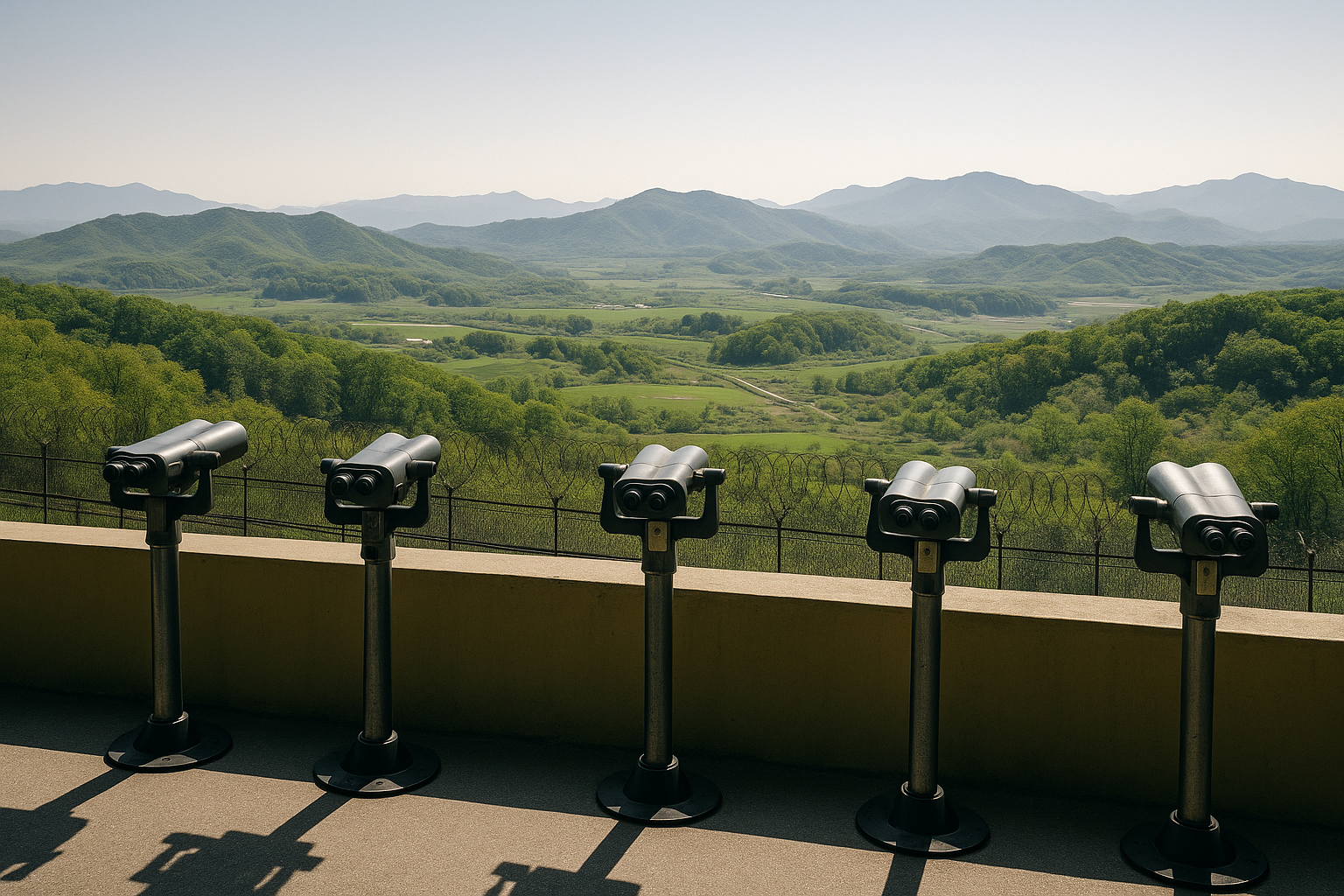
12:00 — Dora Observatory. On clear days, you can see into North Korean territory through the fixed telescopes. Your camera must stay behind the yellow line. The guides point out the features: the Propaganda Village, the giant North Korean flagpole (one of the tallest in the world), and on very clear days, the city of Kaesong.
12:45 — Dorasan Station. A train station built for reunification — complete with a waiting area, ticket windows, and a platform to nowhere. The departure board reads “Pyongyang.” No trains have run here since 2008.
13:30 — Lunch break near Imjingak (not included — budget ₩10,000–15,000 for a meal at the nearby food court)
15:30 — Back in central Seoul
—
Best DMZ Tour Operators for 2026
Most operators offering a DMZ tour from Seoul run the same route with comparable quality. The differences come down to group size, guide quality, and pickup flexibility.
For English-speaking travelers:
Klook DMZ Tours — Best overall value, large daily inventory, and flexible cancellation up to 24 hours before departure. English-language priority groups available. Book on Klook →
Klook DMZ & JSA Tours — Strong option for JSA-specific bookings and combo packages. More thorough confirmation process, which is necessary for JSA access anyway. Compare options on Klook →
Practical notes for 2026:
- North Korean diplomatic events can suspend JSA tours on short notice — book with a cancellation policy you’re comfortable with
- Spring (March–May) and fall (September–November) are peak seasons; book 3–5 days ahead for weekends
- Solo travelers and small groups: shared bus tours offer the best cost-to-experience ratio
- Private tours exist but cost 3–5x more; only worth it for specialized research or large groups
—
Before You Go: Rules and What to Bring
The DMZ is a military zone. These rules are enforced, not suggested.
Dress code (strictly enforced for JSA; advisory for standard DMZ):
- No torn jeans, shorts above the knee, or sleeveless tops
- No clothing with political symbols or imagery
- Closed-toe shoes recommended — you’ll walk through the tunnel and over uneven ground
Documents:
- Passport required for all nationalities, including Korean-Americans (Korean national ID not accepted for foreign nationals at military checkpoints)
- Tour booking confirmation on your phone or printed
What to bring:
- Water — the tunnel descent gets warm
- Compact daypack (large luggage is not permitted on the tour bus)
- Camera — allowed at most sites, prohibited in restricted zones (your guide will specify exactly where)
- Light jacket — even in April, the underground tunnel runs cool
What NOT to bring:
- External-frame backpacks
- Anything that could be misinterpreted as a weapon
- Drone (prohibited in all military zones in Korea)
—
Getting the Most Out of Your DMZ Day
Most tours return to central Seoul by 15:30–16:00. The rest of the day is yours.
If you’re combining the DMZ with an evening in the city:
- Head to Myeongdong for street food — the stalls run until midnight and it’s a short metro ride from most pickup points
- If K-pop culture is your thing, the full map of filming locations and fan spots covers everything from the HYBE building to BTS’s favorite cafes
If you are stacking day trips rather than choosing one, the Seoraksan autumn day trip is the seasonal counterpart to this one — the same brutal early start out of Seoul, the opposite mood at the other end, and a window that only opens for a few weeks in October.
If the DMZ is part of a longer Korea trip and you’re looking for contrast — somewhere slower and further from politics — check the Jeju Island 4-day itinerary. Remote volcanic beaches, zero military presence. If military access is suspended or rain changes your plan, keep the Seoul indoor rainy day activities guide as a backup day.
—
Practical Info (2026 Update)
Base: Seoul — tours depart from Hongik University Station (Line 2/Airport Railroad/Gyeongui-Jungang) or hotel pickup in central Seoul
Official visitor info: visitseoul.net maintains current access restrictions and any scheduled closures
Train option: korail.com runs a special DMZ tourist train to Dorasan Station — but this does not include tunnel access or JSA entry. Group tours remain the best option for the full experience.
Map: Naver Maps is the most reliable navigation app in Korea — useful for understanding distances and planning your afternoon after the tour returns to Seoul.
—
FAQ: DMZ Tours from Seoul
Is the DMZ tour safe in 2026?
Yes. Standard DMZ tours run through the southern controlled area with an approved operator and have operated continuously for decades. JSA access at Panmunjom is a separate matter — it has been suspended to civilians since July 2023 and has not resumed. Your operator will notify you if anything on your booking changes.
How much does a DMZ tour cost from Seoul in 2026?
Standard DMZ day tours generally run in the ₩65,000–₩90,000 range per person, including round-trip transport from Seoul and an English-speaking guide; lunch is usually not included. Prices move, so check the live listing rather than trusting a figure in any guide. JSA combo tours are not bookable in 2026.
Do I need to book a DMZ tour in advance?
Yes. Operators submit passenger details in advance for the control-line check, so same-day availability is unreliable. Book 24–48 hours ahead, and 3–5 days ahead for spring and autumn weekends. JSA access cannot be booked at all in 2026.
What is the difference between the DMZ and the JSA?
The DMZ (Demilitarized Zone) is the buffer strip running the width of the peninsula, plus the controlled civilian area south of it — that is where tours go. The JSA (Joint Security Area) is one specific compound within it, the only place where North and South Korean soldiers face each other directly. The distinction matters because the DMZ is open and the JSA is not.
Can children go on a DMZ tour?
Yes, on standard DMZ tours. The tunnel involves a steep descent and is skippable — you can wait at the top — so assess your child’s comfort before booking rather than after arriving.
—
The DMZ is one of those places you have to see to understand. No amount of reading about the Korean Peninsula quite prepares you for standing in that tunnel, or looking through a telescope at a country most of the world can’t enter. Book your spot on Klook — tours fill faster than you’d expect, especially in spring.
Disclosure: SeoulScope is a participant in the Klook and Agoda affiliate programs. We may earn a small commission when you book through links in this post, at no extra cost to you. We only recommend experiences we believe will genuinely help your trip.
1 thought on “DMZ Tour from Seoul: Complete 2026 Day Trip Guide (JSA vs DMZ, What to Expect & Booking Tips)”