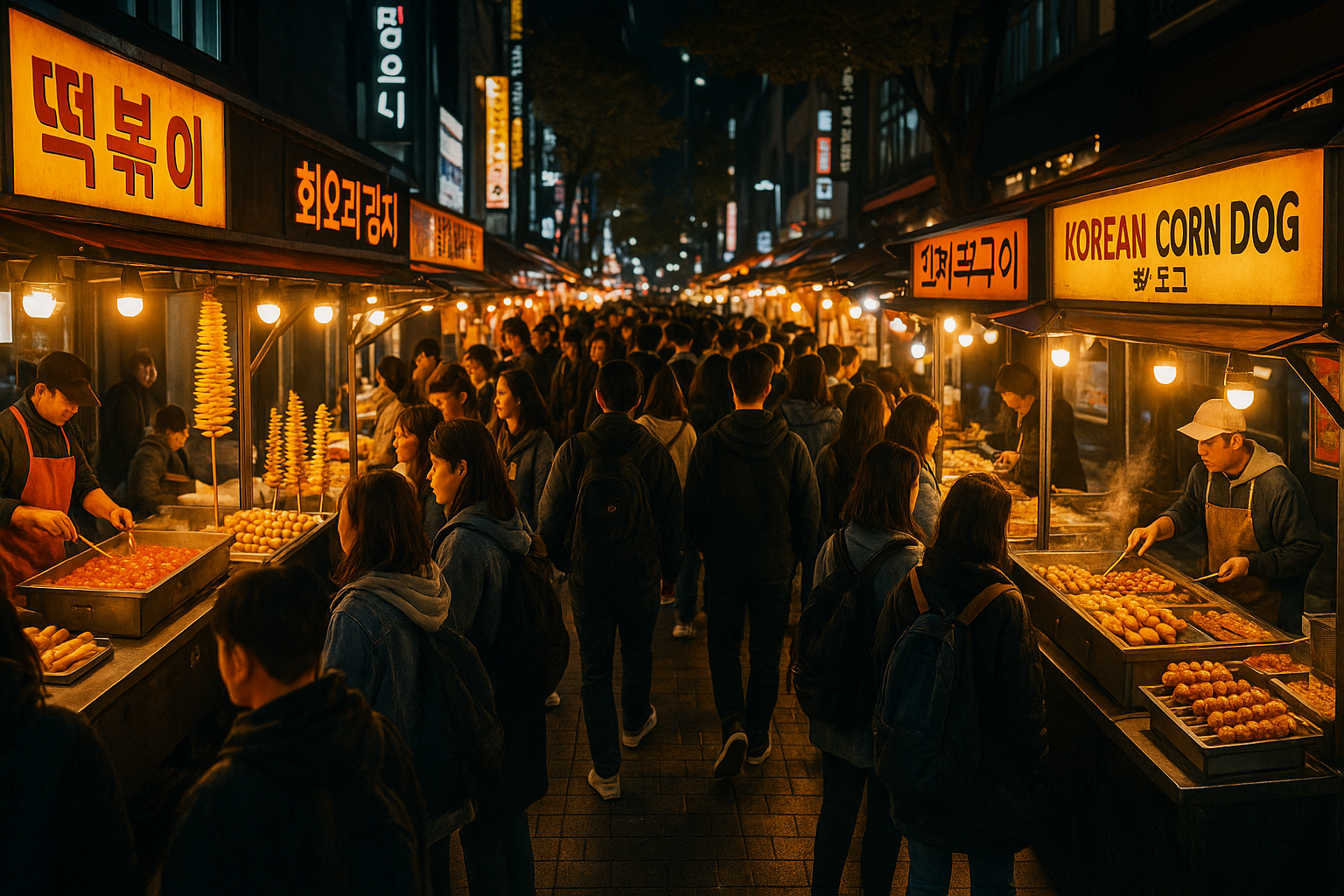
If there’s one place in Seoul that immediately earns its reputation, it’s the Myeongdong street food alley that transforms every evening into one long, glorious snack crawl. Hundreds of vendors pack a walkable strip off the main shopping boulevard, and prices are refreshingly honest — most snacks run ₩2,000–₩8,000 (roughly $1.50–$6 USD).
This guide gives you the exact stalls to prioritize, what to pay, how to get there, and how to avoid the single most common tourist mistake in the area.
Last updated: June 2026
—
Quick Answer: What You Need to Know Before You Go
🎟️ Book Your Myeongdong Street Food Experience
Skip the queues and language barriers. Compare verified tours, tickets, and rentals for Myeongdong Street Food on Klook — instant mobile vouchers, English support, free cancellation on most activities.
| Detail | Info |
|---|---|
| Best time to visit | 6 PM – 10 PM (stalls open from ~5 PM, peak buzz after dark) |
| Typical spend | ₩10,000–₩20,000 for a full snack crawl (~$7–$15 USD) |
| Nearest subway | Myeongdong Station, Line 4, Exit 8 (2-min walk) |
| Guided food tour | ~₩35,000–₩55,000 per person via Klook |
| How to book a tour | Browse & book Myeongdong Street Food Night Tour on Klook |
| Cash or card? | Most stalls are cash only — withdraw KRW at a nearby ATM first |
| Duration (self-guided) | 1–2 hours |
Want a guide who knows every vendor? Book on Klook →
—
Why Myeongdong Street Food Is Worth the Hype
Myeongdong sits in the heart of central Seoul, about 10 minutes south of City Hall and 5 minutes north of Namsan Mountain. It’s primarily known as a shopping district — K-beauty stores, fast fashion, global brands — but the real draw for food lovers is the dense pedestrian lane that runs parallel to the main street.
From around 5 PM onward, vendors wheel out their carts and the whole strip becomes an open-air food market. What makes street food in Seoul’s Myeongdong district different from other city food markets is density: you can genuinely eat your way through a dozen different snacks in one city block.
—
The Best Myeongdong Street Food: Stall-by-Stall Breakdown
1. Tteokbokki (떡볶이) — Spicy Rice Cakes
Price: ₩3,000–₩5,000 per portion
Tteokbokki is the undisputed king of Korean street food. Chewy cylindrical rice cakes are simmered in a gochujang (red pepper paste) broth until the sauce thickens to a glossy, spicy-sweet glaze. Some Myeongdong vendors add fish cake slices and a hard-boiled egg. Heat level is real — ask for “덜 맵게” (less spicy) if you’re sensitive.
Practical tip: Look for stalls with a big communal pot and a queue. Turnover means the sauce is freshly made, not sitting.
2. Korean Corn Dogs (핫도그)
Price: ₩3,000–₩5,000
These aren’t your state-fair corn dogs. Korean corn dogs have evolved into something spectacular — you’ll find versions coated in panko breadcrumbs, crushed ramen noodles, or potato cubes, then deep fried. Many vendors offer a half-cheese, half-sausage filling. You can add sugar and ketchup on top, which sounds wrong and tastes right.
Most popular vendor type: Look for shops with a glass case showing different skewer options and a chalkboard menu in Korean and English.
3. Tornado Potato (회오리 감자)
Price: ₩3,000–₩4,000
A single potato, spiralled around a skewer and deep fried to crispy perfection. You can top it with a choice of seasoning: cheese powder, hot pepper, or sour cream. It’s a full meal disguised as a snack. Great for eating while walking.
4. Hotteok (호떡) — Sweet Pancakes
Price: ₩2,000–₩2,500
Hotteok is a fluffy, pan-fried pancake filled with brown sugar, cinnamon, and crushed nuts. The filling caramelizes inside while the outside turns golden. Winter versions sometimes add green tea or red bean paste. This is the snack that earns the most “oh WOW” reactions from first-timers.
Warning: The filling stays extremely hot for several minutes after purchase. Bite carefully.
5. Gyeranppang (계란빵) — Egg Bread
Price: ₩2,000
A small, slightly sweet bread roll baked around a whole egg. Simple, warm, filling. Perfect as a palate cleanser between heavier snacks.
6. Odeng/Eomuk (어묵) — Fish Cake Skewers
Price: ₩1,000–₩2,000 per skewer
Flat fish cakes threaded onto metal skewers and simmered in a mild anchovy broth. The broth is served free in small cups alongside. This is one of the cheapest and most authentically Korean snacks in the whole strip — locals eat this as a quick after-work snack year-round.
7. Bindaetteok (빈대떡) — Mung Bean Pancakes
Price: ₩4,000–₩5,000
A savory, thick pancake made from ground mung beans, pan-fried until crispy on the outside and dense inside. Often includes kimchi or vegetables. Less photogenic than a tornado potato, far more satisfying.
8. Dalgona (달고나) — Honeycomb Candy
Price: ₩1,000–₩2,000
Yes, the Squid Game candy. Vendors press a small circle or star shape into a thin disc of caramelized sugar. The game: extract the shape without breaking it. Prize is usually just bragging rights, but it’s worth the ₩1,000 for the experience.
—
9. Dalkochi (닭꼬치) — Grilled Chicken Skewer
Price: ₩3,000–₩6,000
Dakkochi is a chicken skewer cooked over coals, glazed in either a soy-garlic sauce or a fiery gochujang marinade and charred at the edges. It is more substantial than most of the sweeter options on the strip, which makes it a good anchor in the middle of a snack crawl.
Practical tip: Look for stalls using actual charcoal rather than electric grills — the smoke is most of the flavor.
10. Grilled Lobster with Cheese — The Splurge Item
Price: around ₩15,000
A half-portion of grilled lobster torched with stretchy melted cheese, sold by a handful of vendors that are hard to miss thanks to their oversized decorative lobster displays. It is theater as much as food — worth ordering once, ideally split with someone.
11. Coin Bread (동전빵)
Price: ₩4,000 for a small bag
Small pancakes shaped like Korean coins, filled with a cheese blend that pulls when you tear one open. They come hot, they are tiny, and a bag disappears faster than you planned.
12. Tanghulu (탕후루) — Candied Fruit on a Stick
Price: ₩3,000–₩5,000
Sugar-crystallized fruit — strawberry, grape, mandarin — with a hard shell that cracks when you bite through. It is lighter than the fried options and works as a palate reset between heavier items.
Practical tip: Buy it early in the evening. On humid nights the sugar shell softens as the hours pass.
13. Twigim (튀김) — Korean Tempura
Price: ₩1,000–₩2,000 per piece
Individual deep-fried pieces of sweet potato, squid, shrimp, and vegetables, usually served with a spicy dipping sauce. This is the budget filler that keeps you going between the flashier purchases — grab three or four pieces straight from the fryer.
Myeongdong Street Food Map: How to Navigate the Alley
The main street food action is concentrated along Myeongdong 8-gil, the pedestrian lane that runs northeast from the main Myeongdong boulevard. The lane is roughly 400 meters long.
Navigation tips:
- Enter from Exit 8 of Myeongdong Station (Line 4). Walk straight up the main boulevard for about 200 meters, then turn right into the covered pedestrian lane.
- Do one full pass before buying anything. Prices and quality vary between stalls selling the same item. The stalls midway through the lane tend to have the freshest inventory because foot traffic is highest there.
- Grab a map of the broader area from the Seoul Tourism Office kiosk near Exit 8 — staff speak English.
—
Should You Take a Guided Street Food Tour in Myeongdong?
Self-guided works perfectly well if you’re comfortable navigating independently and don’t mind some trial and error. The stalls are clustered and easy to find.
A guided tour is worth it if:
- You want someone to explain the cultural backstory of each dish
- You’re visiting alone and want company for the experience
- You want to combine Myeongdong with other Seoul food neighborhoods in one night
The most-booked option is the Seoul Street Food & Neighbourhood Walk on Klook, which typically covers Myeongdong plus one or two additional areas (Insadong or Namdaemun). Groups are small (usually under 12 people), guides are English-speaking, and the tour cost often includes a few dishes.
Typical price: ₩35,000–₩55,000 per person | Duration: 2.5–3 hours | Booking: Online via Klook, confirm at least 24 hours in advance
—
Practical Tips: Avoid the #1 Tourist Mistake
The mistake: Arriving at lunch time (before 2 PM) expecting the full street food experience. The majority of Myeongdong street food vendors don’t set up until late afternoon, and the best atmosphere — all the lights, all the bustle, all the options — only exists after dark.
Go at 6:30 PM or later. Vendors are fully set up, lighting is atmospheric, and you’ll see the district at its best.
Other practical notes:
- Cash first. There’s a Woori Bank ATM inside the Myeongdong Station concourse and a KEB Hana Bank branch near Exit 5. Withdraw before you enter the food lane.
- Weather: In summer (June–August), the lane gets very hot and humid. Bring water. In winter (December–February), hotteok and odeng broth are comfort food at their finest.
- Dietary needs: Vegetarian and vegan options are limited but exist — hotteok, tornado potato, and dalgona are all vegetable-based. Fish cake and many broths contain seafood stock.
- Weekends vs. weekdays: Saturday evenings are the busiest. If you want slightly shorter queues, Tuesday–Thursday evenings are noticeably more relaxed.
—
Myeongdong vs. Other Seoul Street Food Districts
Myeongdong gets the most tourist attention, but it isn’t Seoul’s only street food hub. Here’s how it compares:
| District | Best for | Avg. price per snack | Crowd level |
|---|---|---|---|
| Myeongdong | Variety, accessibility, late-night | ₩2,000–₩8,000 | Very high |
| Gwangjang Market | Traditional Korean (bindaetteok, mayak gimbap) | ₩3,000–₩10,000 | High |
| Namdaemun Market | Budget, local atmosphere | ₩1,000–₩5,000 | Medium-high |
| Dongdaemun | Late-night after midnight | ₩2,000–₩7,000 | Medium |
If you’re curious how a traditional market hall compares, our Gwangjang Market food tour guide covers Seoul’s most famous market with visiting hours and subway directions.
For official tourism information about Myeongdong and Seoul’s food districts, Visit Seoul’s official Myeongdong page is worth bookmarking before your trip.
—
Myeongdong Street Food by Season
The lineup on the strip shifts with the weather. Winter (November–February) is when hotteok, gyeranppang, and odeng are at their best — hot, cheap, and exactly what cold hands want. Summer pushes the balance toward shaved ice, fresh-fruit tanghulu, and a louder evening atmosphere. Spring and autumn are the easy middle: full vendor lineup, no extreme conditions.
In winter, also watch for bungeoppang (붕어빵) — fish-shaped pastry filled with red bean paste, sold by solo vendors working small cast-iron molds. They are not guaranteed inside Myeongdong itself, but the surrounding streets usually have one or two.
FAQ: Myeongdong Street Food
What is the most popular street food in Myeongdong?
Tteokbokki (spicy rice cakes) and Korean corn dogs consistently have the longest queues. If you only eat two things, make it those.
How much does street food in Myeongdong cost?
Most individual snacks cost ₩2,000–₩5,000 (about $1.50–$4 USD). Budget ₩10,000–₩20,000 for a satisfying crawl through 4–6 different items.
What time do the Myeongdong street food stalls open?
Vendors typically start setting up from 4:30–5:00 PM. The full market is running by 6 PM and most stalls stay open until 10–11 PM, sometimes midnight on weekends.
Is Myeongdong street food cash only?
The majority of street stalls are cash only. A few larger permanent shops accept cards, but assume cash and withdraw KRW before you arrive.
How do I get to the Myeongdong street food area?
Take Seoul Metro Line 4 to Myeongdong Station, use Exit 8, and walk straight up the main boulevard for about 200 meters. The food alley branches off to your right.
Is Myeongdong street food good for vegetarians?
Options are limited but not zero. Hotteok (sweet pancake), tornado potato, and dalgona candy are vegetarian-friendly. Many broths and sauces contain fish products, so ask vendors when in doubt.
Is it safe to eat street food in Myeongdong?
Yes. Seoul has strong food safety standards, and Myeongdong’s high-traffic location means vendors maintain visible hygiene. Stick to stalls with good queues — consistent demand means consistent freshness.
—
Final Word
Myeongdong street food is genuinely one of the best cheap-eats experiences in Asia. You don’t need a guide, a reservation, or much of a budget — just show up after dark with some cash and a willingness to point at things that look good. If you want to maximize the experience without spending time figuring out which stalls are worth the queue, a guided evening tour through Klook takes care of that planning for you.
Either way, arrive hungry. You won’t leave disappointed.
Book a Myeongdong Food Tour on Klook →
Hungry for more? Our guide to the best Korean snacks and the complete Korean food overview map out everything else worth tasting.
Disclosure: SeoulScope is a participant in the Klook Affiliate Program. We may earn a small commission when you book through links in this post, at no extra cost to you. We only recommend experiences we believe will genuinely help your trip.
5 thoughts on “Myeongdong Street Food: The Complete First-Timer’s Guide (2026)”