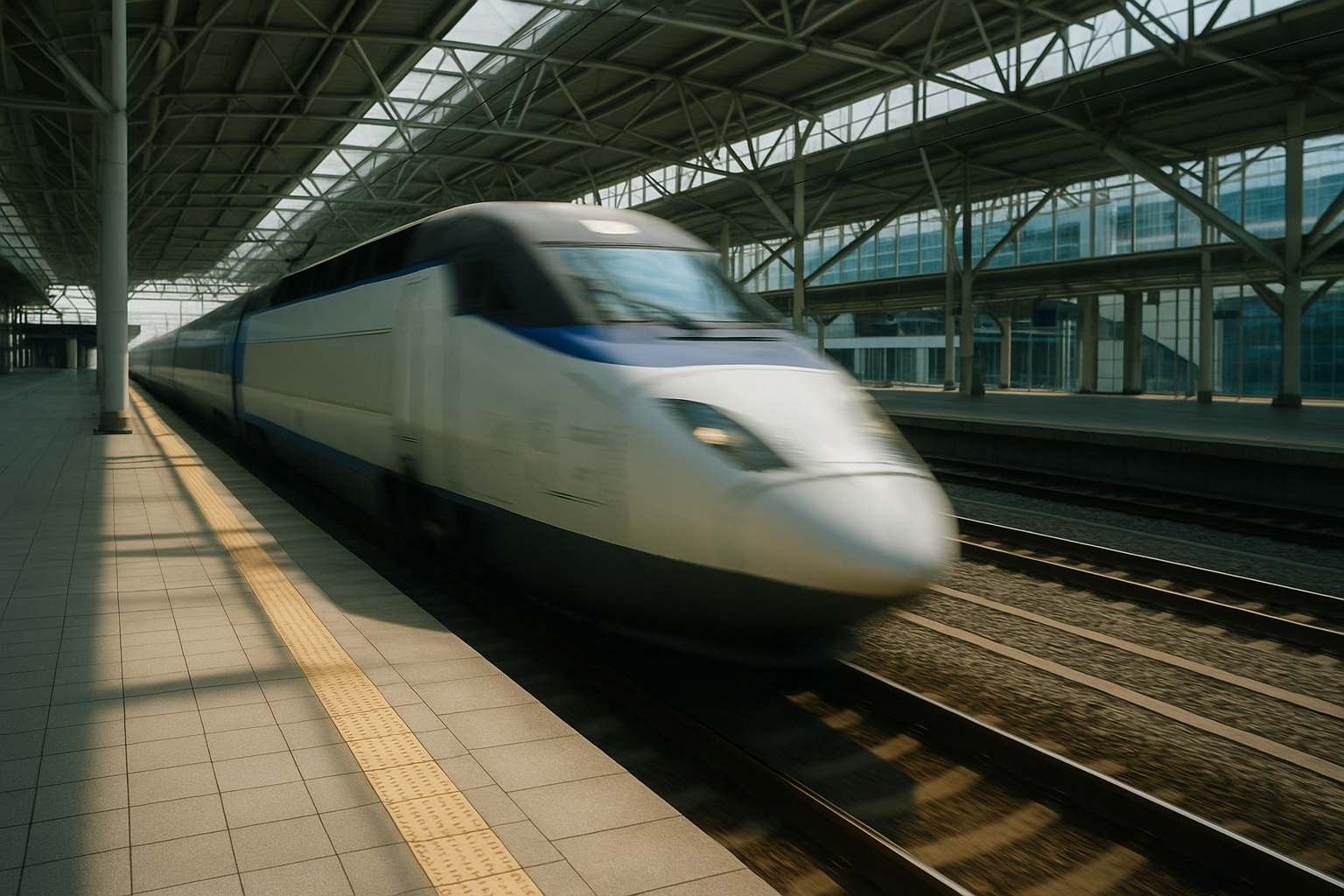
Planning a Seoul to Busan trip is the most common question travelers ask before leaving the capital — how to reach Korea’s second-largest city, home to Haeundae Beach, Gamcheon Culture Village, and some of the country’s best seafood. The good news: the Seoul to Busan journey is one of the most well-connected intercity routes in Asia, with bullet trains departing every 20–30 minutes and the whole trip taking as little as 2 hours and 10 minutes.
Last updated: June 2026. Fares and schedules verified against Korail and Klook listings.
This guide gives you concrete fares, departure stations, schedule windows, and a step-by-step booking process — no filler.
Making more than one intercity trip? Before you buy point-to-point tickets, our KORAIL Pass breakdown works out how many journeys it takes for a pass to come out ahead.
—
Quick Answer: Seoul to Busan at a Glance
How much does the Seoul to Busan train cost? The KTX ticket price is ₩59,800–₩78,700 one-way in standard class; the SRT costs ₩52,600–₩67,700 on the same route. The full fare comparison — including bus and driving costs — is in the table below.
🎟️ Book Your Seoul To Busan Experience
Skip the queues and language barriers. Compare verified tours, tickets, and rentals for Seoul To Busan on Klook — instant mobile vouchers, English support, free cancellation on most activities.
| Method | Duration | One-Way Fare (approx.) | Departs From | Arrives At |
|---|---|---|---|---|
| KTX (bullet train) | 2h 10min – 2h 40min | ₩59,800 – ₩78,700 | Seoul Station | Busan Station |
| SRT (bullet train) | 2h 10min – 2h 30min | ₩52,600 – ₩67,700 | Suseo Station (SRT) | Busan Station |
| Express Bus | 4h – 5h | ₩23,600 – ₩28,600 | Seoul Express Bus Terminal (강남) | Busan Central Bus Terminal |
| Drive (private car) | 4h – 5h (no traffic) | Fuel + tolls ≈ ₩55,000–₩80,000 | — | — |
> Bottom line: For most travelers, the KTX from Seoul Station is the best balance of speed, convenience, and availability. Book at least 3–5 days ahead for weekend travel.
Book your KTX Seoul–Busan ticket on Klook →
—
Best Ways to Get from Seoul to Busan (Compared)
There are four realistic ways to make the seoul to busan trip. Here’s when each one makes sense.
- KTX: Best for most travelers. English-friendly booking, frequent departures, arrives at central Busan Station (subway Line 1 access).
- SRT: Slightly cheaper than KTX, but you depart from Suseo Station in Gangnam — convenient if you’re staying in southern Seoul, inconvenient otherwise.
- Express Bus: Best for budget travelers who don’t mind 4–5 hours. No advance booking required; just show up.
- Driving: Only worth it if you have a Korean driver’s license or international permit, a rented car, and are traveling with 3+ people sharing costs.
—
Taking the Train from Seoul to Busan: KTX & SRT
KTX: Fastest & Most Popular
The KTX (Korea Train Express) is the go-to choice for the seoul to busan route. Trains run from approximately 05:15 to 22:30 from Seoul Station, with departures roughly every 20–30 minutes during peak hours.
Key facts:
- Station: Seoul Station (서울역) — accessible via subway Lines 1 and 4, and AREX airport rail
- Journey time: 2h 10min (nonstop) to 2h 40min (stops at Daejeon and/or Dongdaegu)
- Fare classes: Standard (일반실) vs. First Class (특실, ~40% more)
- Standard fare: ₩59,800 (economy, nonstop) — prices shown here are adult one-way as of June 2026
- Best seats: Window seats on the right side (seats A/B) southbound offer mountain scenery through the Gyeongbu corridor
Practical tip: KTX seats sell out fast on Friday evenings and Sunday afternoons. If you’re traveling on those days, book 5–7 days ahead. Trains labeled “KTX-산천” (KTX-Sancheon) are the newer fleet — slightly quieter.
Skip the ticket queue — grab your KTX pass on Klook →
SRT: Slightly Cheaper, Different Station
The SRT (Super Rapid Train) is operated by SR, not Korail, and costs about ₩7,000–₩11,000 less than KTX for the same journey time.
Key facts:
- Station: Suseo SRT Station (수서역) — subway Line 3 and Bundang Line
- Journey time: 2h 10min – 2h 30min
- Standard fare: ₩52,600 (nonstop)
- Book at: SRT website (Korean) or via Korail Pass at korail.com
When to choose SRT: If your hotel is in Gangnam, Bundang, or Jamsil, Suseo Station may actually be more convenient than Seoul Station. If you’re staying near Myeongdong, Hongdae, or Itaewon, stick with KTX from Seoul Station.
Which Seoul Station Do You Leave From?
This is the most common mistake first-timers make. KTX and SRT leave from different stations:
- KTX → Seoul Station (서울역, subway Lines 1 & 4)
- SRT → Suseo Station (수서역, subway Line 3 / Bundang Line)
They are not the same place and not interchangeable. Double-check your ticket before heading to the wrong station — they’re about 40 minutes apart by subway.
—
Bus from Seoul to Busan: Cheapest Option
Express Bus (고속버스)
For budget-conscious travelers, the express bus cuts the seoul to busan fare nearly in half.
Key facts:
- Terminal: Seoul Express Bus Terminal (서울고속버스터미널, 강남) — subway Lines 3, 7, 9
- Arrival: Busan Central Bus Terminal (부산종합터미널), then subway Line 1 to city center
- Duration: 4h – 5h (longer during holiday traffic — Chuseok and Lunar New Year can add 2+ hours)
- Fares: ₩23,600 (standard) / ₩28,600 (premium “우등”)
- Book at: kobus.co.kr (Korean) or buy at the terminal
Best for: Travelers on a tight budget or those who prefer a flexible, no-advance-booking option (buses depart frequently throughout the day).
Intercity / Nonstop Coaches
A few private coach operators run nonstop luxury buses between Seoul and Busan at fares between ₩30,000–₩40,000. These are often bookable at the terminal counter but rarely through English-language platforms.
—
Driving from Seoul to Busan
Toll Roads & Driving Time
The Gyeongbu Expressway (경부고속도로, Highway 1) is the main route connecting Seoul and Busan — about 325 km (202 miles) door to door.
- Drive time: 4–5 hours without traffic
- Tolls: Approximately ₩18,000–₩22,000 one way
- Fuel cost: Approximately ₩35,000–₩50,000 one way (mid-size car, regular petrol)
- Total estimated cost: ₩55,000–₩80,000 one way
When driving makes sense: Road trips with family or groups of 4+, or if you plan to stop at destinations along the route like Daejeon or Gyeongju.
Practical warning: Traffic on the Gyeongbu Expressway on Friday evenings can turn a 4-hour drive into 7+ hours. Real-time navigation apps like Naver Map or Kakao Map are essential.
—
Booking Your Seoul to Busan Train Ticket Step by Step
Option 1: Book Through Korail (Korail.com)
Note: The Korail website can be finicky with non-Korean cards. If payment fails, use Klook.
Option 2: Book on Klook (English, Card Payment)
Klook’s KTX listing works with all major international credit cards (Visa, Mastercard, Amex) and requires no Korean phone number.
Book your KTX Seoul–Busan ticket on Klook →
—
Practical Tips & Mistakes to Avoid
1. Don’t confuse Seoul Station with Suseo Station.
KTX = Seoul Station. SRT = Suseo. See above — this mistake causes more missed trains than anything else.
2. Arrive at the station 15 minutes early.
KTX doors close 1–2 minutes before departure. Unlike airports, there’s no long check-in, but you need time to find your platform (홈, hom).
3. Book weekend trains early.
Friday evening (16:00–20:00) and Sunday afternoon (14:00–19:00) trains sell out days in advance. Midweek trains are rarely full.
4. Standard class is perfectly comfortable.
First class (특실) offers slightly wider seats and more legroom, but for a 2h 10min journey, standard class is fine.
5. Busan Station is central; Busan Haeundae is not.
The KTX arrives at Busan Station (부산역), which is in the Jung-gu area near the port. Haeundae Beach is about 40 minutes east by subway (Line 2). Factor that into your plan.
For more on what to do once you arrive, read our guide to things to do in Busan for first-timers.
If you’re weighing this against other routes, see our roundup of best day trips from Seoul by train — Gyeongju and Jeonju are strong alternatives to a full Busan trip.
Already based in Seoul and planning your evenings before the trip south? Check out Han River night activities in Seoul for what to do the night before you depart.
—
Insider Tips from Riding This Line
Book well ahead for holiday travel. If you’re travelling Friday evening or Sunday afternoon around a public holiday — Chuseok, Seollal, or the long weekends in May and October — prime departures sell out fast. Book as early as your dates allow rather than assuming you can buy at the station on the day.
Check seat orientation when you book, don’t assume it. On standard KTX formations part of each carriage faces backward, and which half that is flips depending on whether you’re heading south or north. Newer KTX-Sancheon trains seat everyone facing the direction of travel. If you’re prone to motion sickness, pick your seat during booking instead of leaving it to the automatic assignment.
—
FAQ: Seoul to Busan
How far is Busan from Seoul?
Busan is approximately 325 km (202 miles) from Seoul by road. By KTX rail, the track distance is about 442 km but the train covers it in as little as 2 hours 10 minutes.
How long does the train to Busan from Seoul take?
The fastest KTX nonstop service takes 2 hours 10 minutes. Trains with stops at Daejeon and Dongdaegu take 2h 30min – 2h 40min. SRT nonstop is similar at around 2h 10min – 2h 15min.
What is the cheapest way to get from Seoul to Busan?
The express bus is the cheapest option at around ₩23,600 one way, departing from Seoul Express Bus Terminal in Gangnam. The trade-off is 4–5 hours of travel time.
Which station in Seoul do trains to Busan leave from?
KTX trains depart from Seoul Station (서울역). SRT trains depart from Suseo Station (수서역). These are different stations — confirm which service you’ve booked before heading out.
Can I buy KTX tickets without a Korean phone number?
Yes. Use Klook or the Korail English site at korail.com. Both accept international credit cards without requiring a Korean phone number.
Is the train to Busan scenic?
The first hour out of Seoul is mostly urban and industrial corridor. Scenery picks up through the Chungcheong and North Gyeongsang provinces — rolling hills, river valleys, and tunnels through mountain ridges. The journey is comfortable but not a primary reason to take the train; speed is.
How much does a KTX ticket from Seoul to Busan cost?
As of June 2026, standard class one-way fares run ₩59,800 – ₩78,700 depending on the departure time and train type. First class (특실) runs approximately ₩82,000 – ₩107,300.
—
All fares cited are adult one-way standard class as of June 2026 and subject to change. Book directly through Klook or Korail to confirm current pricing.
Disclosure: SeoulScope is a participant in the Klook Affiliate Program. We may earn a small commission when you book through links in this post, at no extra cost to you. We only recommend experiences we believe will genuinely help your trip.
6 thoughts on “Seoul to Busan: Fastest Train, Bus & Drive Options with Exact Fares (2026)”