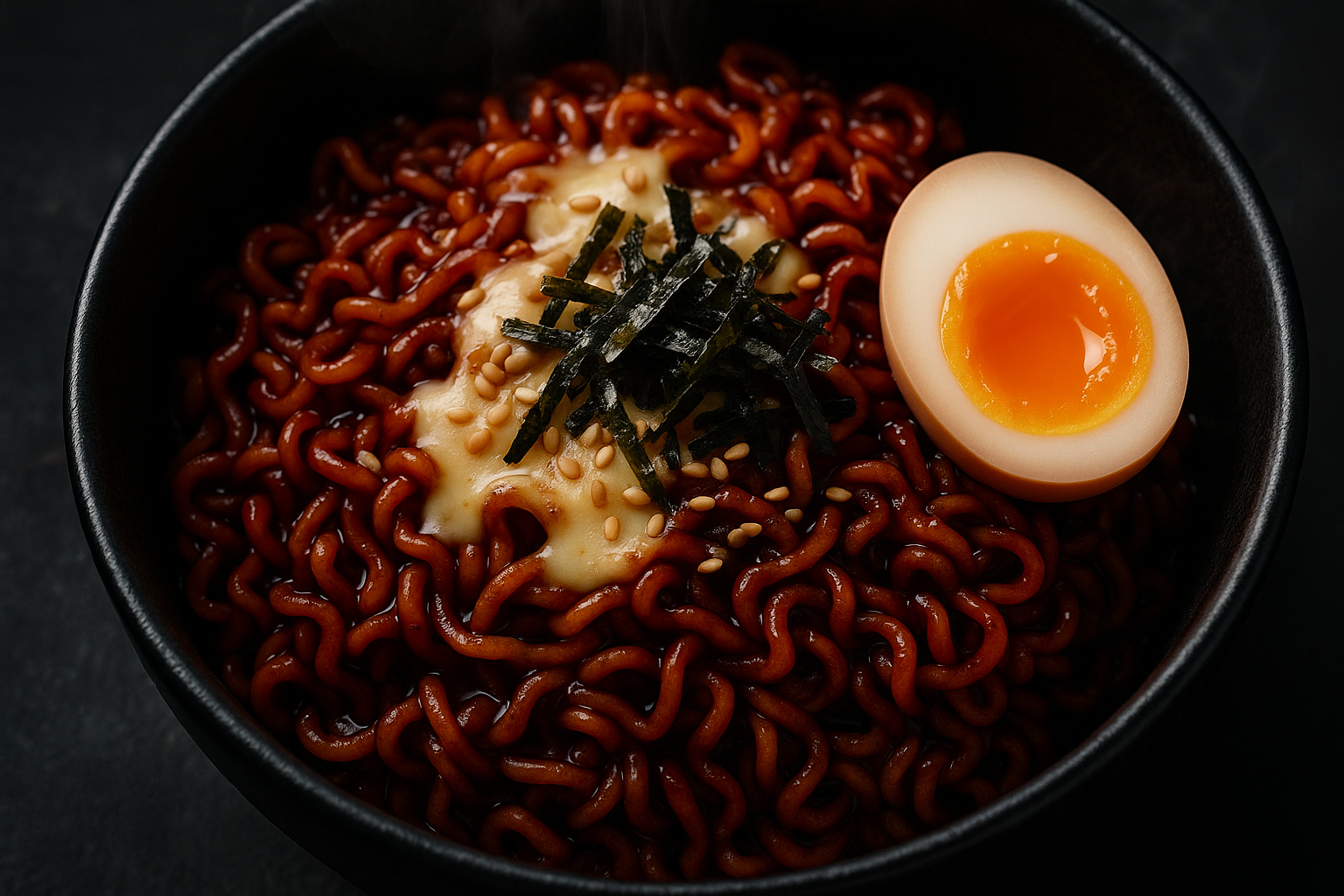
If you’ve seen someone on YouTube turn red, sweat, and gasp their way through a bowl of glossy dark-red Korean noodles, you’ve met buldak. Short for buldak-bokkeummyeon (불닭볶음면), this stir-fried “fire chicken” ramen from Samyang Foods became a global phenomenon on the back of the Fire Noodle Challenge, and it has since spun off into one of the biggest flavor lineups in instant-noodle history.
But the original is just the beginning. There are creamy ones, cheesy ones, soupy ones, and a nuclear tier that should come with a warning label — more than twenty variants have shipped worldwide. This guide explains what buldak actually is, how hot it really gets, and ranks the main flavors from mildest to most punishing, so you can find your level before you commit.
What is buldak?
Buldak is a stir-fried instant noodle made by Samyang Foods, first released in South Korea in April 2012. Unlike a brothy ramyeon, it’s a bokkeum (stir-fried) noodle: you boil the noodles, drain almost all the water, then coat them in a thick, intensely spicy-sweet sauce. The result is dry, chewy, glossy, and relentlessly hot — closer to a saucy pasta than to soup.
The name is a clue to the flavor. Buldak (불닭) means “fire chicken,” after the fiery grilled-and-braised buldak dish served at Korean chicken joints — so the sauce leans savory-sweet and chicken-forward under all that heat. Today the brand is exported to more than a hundred countries and is one of Korea’s best-known food products abroad, which is why you’ll spot the cartoon black chicken on shelves far from Seoul.
A short history of the fire noodle
Samyang launched the original buldak-bokkeummyeon in April 2012, reportedly inspired by the popularity of punishingly spicy dishes at Korean restaurants. For its first couple of years it was a modest domestic seller. Then, around 2014, the Fire Noodle Challenge took off: people filmed themselves eating a whole bowl in one sitting and dared their friends to do the same. The clips spread across YouTube and later TikTok, turning a single spicy noodle into a worldwide dare and a genuine internet subgenre.
Samyang leaned into the moment. Cheese and carbonara editions arrived to widen the audience beyond chili die-hards, while ever-hotter “nuclear” versions kept the thrill-seekers chasing the next level. That two-track strategy — milder spin-offs on one side, extreme editions on the other — is exactly why the lineup is now so large, and why there’s a buldak for almost every palate.
How spicy is buldak?
Spice here is measured in Scoville Heat Units (SHU), and the numbers are public. The original buldak sits at 4,404 SHU — hot, but more of a steady, building burn than an instant knockout. From there the line splits in two directions: creamy and saucy variants that pull the heat down, and “extra” versions that push it sharply up.
For reference: the 2x Spicy (often labeled Nuclear) roughly doubles the original to about 8,706 SHU, and the 3x Haek (“nuclear”) version tops the range near 13,200 SHU. At the other end, the mala variant actually comes in below the original. So “buldak” is not one heat level — it’s a whole spectrum, and picking the right flavor matters more than bracing yourself.
Every buldak flavor and fire level, ranked from mildest to hottest
Here are the main flavors you’ll find abroad, ordered by roughly how hot they run. Heat varies by batch and palate, but this is the reliable shape of the lineup.
How many buldak flavors are there? There is no single fixed number — Samyang rotates limited editions and Korea-only variants constantly. But nine make up the core lineup that ships internationally, and those are the nine below. Published Scoville figures only exist for the heat-tier variants; the flavored ones are positioned by taste rather than by a measured burn, so their fire level is a band, not a number.
| Flavor | Fire level | Scoville (SHU) | What it tastes like |
|---|---|---|---|
| Mala | Mild | ~2,700 | Numbing, tingly peppercorn over the chicken sauce |
| Carbonara | Mild | — | Creamy and cheesy; the chili drops to a warm hum |
| Cheese | Mild | — | Powdered cheese, rich and salty; rounds off the burn |
| Jjajang | Mild | — | Sweet-savory black bean with vegetable bits |
| Curry | Mild | — | Sweet, with dehydrated potato and carrot |
| Rosé | Mild–medium | — | Creamy, sweet, faintly smoky |
| Original (Hot Chicken) | Hot | 4,404 | The benchmark: dry, glossy, genuinely hot |
| 2x Spicy / Nuclear | Very hot | ~8,706 | Double the original; where casual eaters tap out |
| 3x Haek / Nuclear | Extreme | ~13,200 | A challenge rather than a meal |
The same nine in detail, mildest first:
- Mala (~2,700 SHU) — milder than the original, with the numbing, tingly mala peppercorn note layered over the chicken sauce. A surprisingly gentle entry point.
- Carbonara — the most beginner-friendly: a creamy, cheesy sauce that mutes the chili into a warm background hum. The usual gateway flavor, and the one most people recommend to first-timers.
- Cheese — powdered cheese rounds off the burn; spicier than carbonara but still approachable, with a rich, salty finish.
- Jjajang — a sweet-savory black-bean sauce (debuted 2018) with bits of vegetable; one of the mildest and least “fire” of the range.
- Curry — sweet and mild, with dehydrated potato and carrot that make it eat almost like a real curry rather than a chili bomb.
- Rosé (rosé buldak) — creamy, sweet, and a little smoky; sits in the mild-to-medium band and is one of the most popular newer flavors.
- Original (Hot Chicken / 4,404 SHU) — the benchmark, and the one every other flavor is measured against. Dry, glossy, and genuinely hot.
- 2x Spicy / Nuclear (~8,706 SHU) — double the original. This is where casual eaters tap out.
- 3x Haek / Nuclear (~13,200 SHU) — the hottest mainstream variant, and a real challenge rather than a meal. Approach with dairy nearby.
If you’re new to the whole Korean instant noodles world, start at carbonara or cheese and work up — there’s no prize for jumping straight to nuclear.
How to cook buldak the right way
The single biggest mistake is treating it like soup. The correct method for the bagged version:
For the cup and big-bowl versions, you fill to the line, wait, then drain through the lid before stirring in the sauce — same dry-noodle principle, no stove required. The cups are slightly milder and the portions smaller, which makes them a good way to test a flavor before buying a full multipack.
How to tame the heat (or push it further)
The buldak sauce is intense, but it’s easy to dial. To cool it down, melt a slice of cheese or a handful of mozzarella over the hot noodles, crack in a soft-boiled egg, or stir in a spoonful of mayonnaise or milk — fat is what tames capsaicin, and a glass of water won’t. Adding rice or pairing it with creamy convenience stores sides also stretches the heat across more food.
Want it hotter instead? Cooks add fresh chili, extra of the bottled buldak sauce, or turn it into rabokki by tossing the noodles with rice cakes — the same trick behind spicy tteokbokki. Either way, fat and starch are your two levers.
Buldak sauce: beyond the noodles
Samyang also bottles the buldak sauce on its own, and it has quietly become a pantry staple far beyond instant noodles. People brush it onto chicken wings and grilled meat, swirl it into fried rice and mayo, glaze tteokbokki and corn, and use it as a one-bottle shortcut to that signature sweet-hot, chicken-savory flavor. If you like the noodles but want the taste without the full ramen ritual, the bottle is the move — a little goes a long way, so start with less than you think.
Is buldak bad for you?
Like most instant noodles, buldak is an occasional treat rather than health food — it’s calorie-dense, high in sodium, and the sauce is rich. The intense capsaicin can also upset sensitive stomachs, which is part of why the nuclear tiers generate so many dramatic on-camera reactions. Eaten in moderation, and rounded out with some vegetables, egg, or cheese, it’s a perfectly reasonable indulgence — just don’t make the 3x version a daily habit, and keep the hottest editions away from kids.
Where to buy buldak
It’s never been easier to find outside Korea:
- Korean and Asian grocers — H Mart, Hannam Chain, and local Korean markets carry the widest flavor range, including multipacks and the bottled sauce.
- Online — Amazon, Weee!, and Korean-grocery delivery ship most flavors, and variety packs are the cheapest way to taste-test the lineup.
- Mainstream supermarkets — as Korean food has gone mainstream, many Western chains now stock at least the original and carbonara in the international aisle.
Buy a variety pack first: it’s the low-risk way to find your heat level before committing to a full box of nuclear.
Frequently asked questions
How spicy is the original buldak?
About 4,404 SHU — hot but manageable, with a building burn. The 2x version roughly doubles that, and the 3x Haek tops out near 13,200 SHU.
How many buldak flavors are there?
Nine make up the core international lineup — mala, carbonara, cheese, jjajang, curry, rosé, original, 2x spicy, and 3x haek. Samyang releases additional Korea-only and limited-edition variants on top of that, so the total at any given moment moves.
What is the fire level of each buldak flavor?
Only the heat-tier variants have published Scoville numbers: original 4,404 SHU, 2x spicy about 8,706 SHU, and 3x haek about 13,200 SHU. Mala measures lower than the original at roughly 2,700 SHU. The flavored variants — carbonara, cheese, jjajang, curry, rosé — sit in the mild band without a published figure.
Which buldak flavor is the mildest?
The carbonara and cheese variants are the gentlest, and mala actually measures below the original. Jjajang and curry are mild too.
Why is buldak so popular?
The Fire Noodle Challenge made it a viral hit around 2014, and Samyang kept the momentum going with a steady stream of new flavors. The mix of genuine heat, a sweet-savory sauce, and shareable internet drama keeps it spreading.
Is buldak vegetarian or halal?
Most flavors contain chicken or other animal-derived seasoning, so check the label. Samyang does make some halal-certified versions, but they vary by market.
How do I make buldak less spicy?
Add fat and dairy — cheese, egg, mayo, or milk — plus rice to stretch it. Avoid drinking water, which spreads the heat rather than cutting it.
What’s the difference between buldak and other Korean ramyeon?
Buldak is a stir-fried, sauce-coated dry noodle built around extreme heat, not a soup. For the wider world it comes from, see our guide to Korean food.
🛒 Buy Buldak Online
Can’t get to a Korean convenience store? Get Buldak shipped to your door on Amazon — compare top-rated imports, check real reviews, and stock up on the real thing without leaving home.
Disclosure: SeoulScope is a participant in the Klook and Agoda affiliate programs and the Amazon Associates Program. As an Amazon Associate we earn from qualifying purchases. We may earn a small commission when you book or buy through links in this post, at no extra cost to you. We only recommend experiences and products we believe will genuinely help your trip.
4 thoughts on “Buldak Flavors Ranked: Every Samyang Fire Noodle Explained”