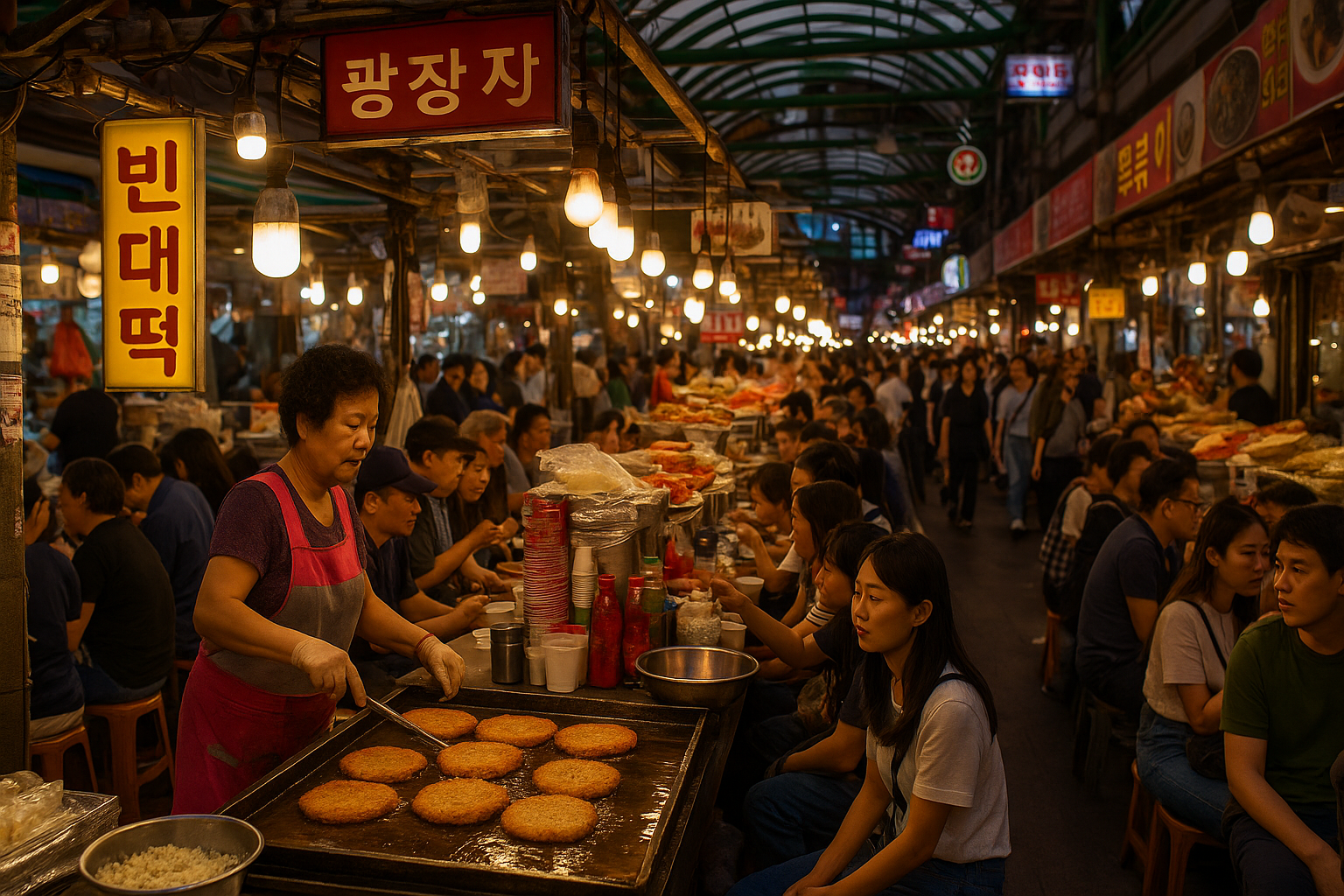
The smell of bindaetteok hits you before you find the right entrance. That sizzling mung bean pancake—crispy on the outside, dense with scallions and kimchi inside—is the scent that’s been pulling people into Gwangjang Market since 1905. Step inside and you’re in one of Asia’s greatest food halls: a long covered arcade of shoulder-to-shoulder stalls, grandmothers in aprons, and the kind of noise that tells you this place has never once needed a marketing budget.
This guide covers everything you need to eat, book, and plan for your Gwangjang Market food tour in 2026. If you’d rather go with a local guide who knows exactly which stalls are worth the wait, explore tours from $29 on Klook and you can have a full experience sorted in minutes.
—
Why Gwangjang Market Deserves a Half-Day of Your Seoul Trip
🎟️ Book Your Gwangjang Market Seoul Food Tour Experience
Skip the queues and language barriers. Compare verified tours, tickets, and rentals for Gwangjang Market Seoul Food Tour on Klook — instant mobile vouchers, English support, free cancellation on most activities.
Most visitors head to Myeongdong for street food. The ones who come back for a second trip make time for Gwangjang. It’s different in a way that matters: Gwangjang is a working market—not a tourist street. The vendors here are multi-generational. Some stalls have been run by the same family for over 40 years. When Netflix’s Street Food: Asia featured it, global interest surged, but the market itself didn’t change to accommodate that. It kept being exactly what it always was.
At 570 metres long and home to more than 200 food vendors, Gwangjang is also the oldest continuously operating market in South Korea. For travellers who want to eat the way locals eat—cheaply, communally, at a shared table with strangers—it’s the most authentic food experience Seoul offers.
—
12 Must-Try Dishes at Gwangjang Market (With Prices)
1. Bindaetteok (Mung Bean Pancake) — The Market’s Signature Dish
On weekends after noon, the centre of the food hall fills up faster than you’d expect—and it’s because everyone wants a seat near the bindaetteok stalls. These thick, golden pancakes are made from ground mung beans, packed with kimchi and pork, and pressed onto a flat griddle until they develop a crust that shatters at the fork. One pancake runs ₩3,000–4,000. Order two.
2. Mayak Gimbap — Tiny Rolls With a Loyal Following
Mayak means narcotic in Korean—and the name sticks because these thumb-sized rice rolls are genuinely hard to stop eating. Filled with carrot, spinach, and pickled radish, they come with a soy-mustard dipping sauce that elevates what sounds like a simple snack into something memorable. A portion of 15–20 pieces: ₩3,000.
3. Yukhoe (Beef Tartare) — For the Adventurous Eater
The best yukhoe in Seoul arrives in a stone bowl, topped with a raw egg yolk, sesame oil, and julienned pear for sweetness. It’s the kind of dish that requires trust in the vendor—and Gwangjang has vendors who have been serving it for decades. Price: ₩8,000–12,000.
4. Japchae — Glass Noodles Done Right
Japchae is everywhere in Seoul, but the market versions tend to be made to order, stir-fried with sesame oil, beef, and vegetables in a wok that’s been well-seasoned over years. You can eat it hot on a paper plate standing at the counter. ₩5,000–7,000.
5. Haemul Pajeon (Seafood Pancake) — Crispy Edges, Savory Centre
If bindaetteok is the market’s signature, haemul pajeon is the crowd pleaser. The batter is laced with green onions, squid, and shrimp, and pressed thin enough that the edges go almost lacey with crispiness. Best eaten immediately, with the soy dipping sauce on the side. ₩8,000–10,000.
6. Sundae (Korean Blood Sausage) — A Market Staple
This is not European blood sausage. Korean sundae is steamed, not fried, and the casing is packed with sweet potato starch noodles, pork, and barley. It comes sliced, on a plate, with a sprinkle of salt and a side of liver. Surprisingly mild, deeply satisfying. ₩5,000.
7. Twigim (Deep-Fried Snacks) — The Crowd-Pleaser
You can find twigim vendors at the edges of the market: battered sweet potato, squid, vegetables, and odeng (fish cake) fried to order. It’s the food you grab while standing, waiting for your table. ₩1,000–2,000 per piece.
8. Mandu (Dumplings) — Steamed, Fried, or Boiled
Gwangjang mandu are made by hand, visible from the counter, by vendors working fast. The pork and kimchi filling is where you start. The pan-fried version develops a crispy bottom that the steamed version doesn’t—order one of each and compare. ₩5,000 for 5 pieces.
9. Tteok (Rice Cakes) — Chewy and Satisfying
You can eat your way through a full snack meal at Gwangjang for under ₩15,000. Tteok—glutinous rice cake in a dozen shapes and flavours—is the snack that fills the gaps. Look for the vendors with the colourful trays near the textile section.
10. Makgeolli — The Market’s Drink of Choice
Makgeolli is unfiltered rice wine, slightly fizzy, slightly sweet, and served cold in a large bowl or ceramic kettle. It’s why the tables at the bindaetteok stalls are sized for groups. At around 6–7% alcohol and ₩4,000–5,000 a bowl, it’s the best reason to linger. Pairs with everything.
11. Sikhye — Sweet Rice Punch to Cleanse the Palate
If you’re not drinking alcohol, sikhye—a non-alcoholic fermented sweet rice drink, served cold—does the same job of resetting your palate. Look for the vendors near the market centre. ₩2,000 a cup.
12. Hotteok (Sweet Pancakes) — Save Room for the Exit Snack
Find the hotteok stall near the market’s Jongno-5 exit. These street pancakes are filled with brown sugar syrup, cinnamon, and crushed nuts, pressed flat on a griddle until the filling caramelises. One hotteok: ₩1,000. The right note to end on.
—
Best Gwangjang Market Food Tours to Book in 2026
Guided Food Tour vs. Self-Guided: Which Should You Choose?
If you have three hours and no particular plan, you can do Gwangjang on your own with this guide. But a local guide changes what’s possible: they know which stalls are multi-generational, which vendors speak a little English, and where the best versions of each dish are hiding on any given day. Tours also handle the ordering, which removes the friction of pointing and guessing quantities.
Klook Tours: Best Picks
Klook offers a well-reviewed Gwangjang Market food tour that covers 8–10 dishes with a local guide, runs about 2.5 hours, and includes entry to Insadong for the back half of the walk. It’s one of the most consistently booked Seoul food experiences on the platform.
Prefer an Evening Tour?
The evening version of the market food walk — which covers Gwangjang as it transitions from day vendors to nighttime regulars — is particularly popular in summer, since the food alley stays open until 11:00 PM.
—
How to Get to Gwangjang Market Seoul
The fastest route is Jongno 5-ga Station (Line 1), exits 7 or 8. The walk from exit 8 to the main food hall entrance is about two minutes. You’ll know you’re in the right place when the roof of the covered market appears and the smell of hot oil hits. Check the official Gwangjang Market page on Visit Seoul for the most current opening hours.
If you’re coming from the other side of the city, Naver Map directions work better than Google Maps for navigating Seoul’s subway transfers.
If you’re combining Gwangjang with a day trip outside Seoul, you can plan your train from Seoul and time your market visit for the morning before departure.
Gwangjang Market Opening Hours in 2026
Gwangjang Market opening hours in 2026: the food alley runs 9:00 AM–11:00 PM daily, including Sundays, while the general market is open 9:00 AM–6:00 PM Monday–Saturday and closed on Sundays.
Beyond that headline, hours vary by section, which catches out a lot of first-time visitors. Based on the official Visit Seoul listing:
| Section | Hours (2026) | Open days |
|---|---|---|
| Food alley | 9:00 AM–11:00 PM | Daily, incl. Sunday |
| General market | 9:00 AM–6:00 PM | Mon–Sat (closed Sun) |
| Textile & clothing (2nd floor) | 10:00 AM–7:00 PM | Mon–Sat (closed Sun) |
The short version: for food, any day works and evenings are fair game; for fabric, hanbok, or vintage clothing, come Monday–Saturday before 7 PM and skip Sunday. Individual stalls set their own hours within these windows, so a handful open later or close earlier.
—
When to Visit: Best Times and What to Avoid
The general market runs 9:00 AM to 6:00 PM Monday through Saturday, while the food alley keeps going until 11:00 PM every day, Sunday included. Weekday mornings are the least crowded window. The textile section (on the upper floors) is active during business hours; the food hall runs slightly later.
Peak hours to avoid if you hate crowds: Saturday 11 AM–2 PM. The food hall becomes difficult to move through, and seating at the bindaetteok stalls can involve a 15-minute wait.
Best time for solo travellers: Weekday, 9:30–11:00 AM. The vendors are set up, fresh batches of everything are ready, and you can actually hold a conversation with the person cooking your food.
Best time for the full evening experience: 4:30 PM onward, when the market transitions into a more relaxed, social atmosphere with more makgeolli flowing.
—
Gwangjang Market + Insadong: The Perfect Seoul Food Walk
If you only have one morning for Seoul’s food culture, this is the combination: start at Insadong for coffee and traditional rice cakes at one of the alley cafes, then walk 15 minutes southeast to Gwangjang for the main event. The two areas connect naturally along Insadong-gil, and the contrast between Insadong’s curated craft shops and Gwangjang’s working market makes the walk more interesting than either place alone.
For the best cafes near the Insadong end of this walk, the Seongsu-dong neighbourhood guide has the updated 2026 picks for where locals are actually drinking coffee right now. After Gwangjang, if you want to extend the day into the evening, our best cafes in Hongdae and Myeongdong street food guide cover both the daytime and night-time angles.
—
Practical Tips for First-Timers
- Bring cash. Most stalls accept card payment, but some smaller vendors prefer cash or bank transfer. ₩30,000 in cash is enough for a full market meal with drinks.
- Come hungry. A conservative estimate for a complete Gwangjang tasting (bindaetteok, mayak gimbap, mandu, makgeolli, hotteok): around ₩20,000–25,000 per person.
- Wear layers. The food hall gets warm from all the cooking, especially in summer. The textile floors above are air-conditioned and worth a quick look if you’re into fabric shopping.
- Don’t be afraid to point. Most vendors have photos or the actual food visible. Pointing and holding up fingers works fine for ordering.
- Book your food tour in advance for weekends. Weekend Gwangjang tours sell out by Thursday on Klook during peak season (May–October).
—
—
How to Order at Gwangjang Market on Your First Visit
Do one slow lap before committing to a seat. The first busy counter is not automatically the best fit for you, and each stall has its own rhythm: some vendors take the order before pointing you to a stool, while others expect you to sit first. Watch one transaction, check the displayed menu, and then make eye contact with the vendor. That thirty-second pause makes the market feel far less chaotic.
Step 1: Choose the stall, then the seat
Seats immediately in front of a stall normally belong to that business, so order there before settling in. If there is a visible queue, join it instead of taking an empty stool from the side. At a shared counter, show the vendor what you want and follow their gesture to the appropriate seat. This avoids the awkward situation of carrying food from one stall into another vendor’s small seating area.
Step 2: Order with the item and quantity first
You do not need a fluent Korean sentence. Point to the menu, a displayed dish, or a photo and give the quantity. Igeo hana juseyo means “one of this, please”; replace hana with dul for two. If a portion looks designed for sharing, ask before ordering several dishes at once. Solo visitors have a better meal when they start with one item, see the actual portion, and add the next dish afterward.
Step 3: Confirm payment before the food arrives
Payment methods vary by stall. Ask Kadeu dwaeyo? (“Does card work?”) before ordering, and carry some cash as a backup rather than assuming every counter handles payment the same way. Use the price shown on the current menu, not an old blog post or a screenshot, and confirm the total if the menu is unclear.
Step 4: Make language and dietary limits explicit
For a simple preference, a translation app plus the visible dish is usually more useful than a long explanation. For allergies or strict dietary restrictions, show the ingredient in Korean and ask before ordering; recipes, broths, oils, and garnishes can differ between vendors. If the answer is uncertain, choose another dish rather than treating a guessed translation as confirmation.
What to Eat at Gwangjang Market: Choose by Appetite, Texture, and Comfort
The useful question is not “What is famous?” but “What kind of meal do I want right now?” Build a short tasting around contrast instead of ordering every headline dish. One crisp or rich plate, one lighter bite, and one drink or sweet finish gives you more range without turning the visit into a checklist.
Choose bindaetteok when you want a filling, crisp centrepiece
Bindaetteok is the best starting point for someone arriving hungry and comfortable with a substantial fried dish. The contrast between the browned exterior and dense mung-bean interior is the reason to order it. Because it can dominate a solo meal, see the portion before adding another heavy pancake or fried snack.
Choose mayak gimbap when you want a lighter, shareable start
The small rolls are easier to divide across a group and make sense when you want to keep room for several flavours. They also suit a cautious first order: you can begin with a familiar rice-and-vegetable format, then decide whether to move toward richer dishes.
Choose yukhoe only if raw beef is part of the experience you want
Yukhoe is not a compulsory “market badge.” Choose it because you enjoy raw beef and want the cool, soft texture against sesame oil and pear—not because a list says you must. If anyone in your group is unsure about raw meat, spend that part of the budget on a cooked dish everyone can share.
Use the second dish to create contrast
After a rich pancake, move toward gimbap, rice cake, or a cold drink rather than ordering another plate with the same weight and texture. After a lighter first bite, add a cooked dumpling or pancake for warmth. This simple sequence makes a two- or three-dish visit feel intentional and helps a solo traveller stop before ordering more than one person can comfortably finish.
A Crowd Strategy That Does Not Depend on Repeating Opening Hours
Think in trade-offs, not a single “best time.” An earlier visit generally gives you more room to read menus and communicate, but not every stall will have reached its full service rhythm. The main meal periods offer the broadest sense of the market at full energy, but they also bring the most competition for stools and the least time for questions. Later visits can feel more relaxed at some counters, while the selection may narrow as individual vendors finish for the day.
If easy ordering matters most, arrive before the main meal rush
This is the better choice for a first-time solo visitor, a family that needs adjacent seats, or anyone who wants to ask about ingredients. The trade-off is atmosphere: you may see a quieter version of the market and should not assume every stall follows the same start-of-day schedule.
If maximum choice matters most, accept the busy middle of the day
Use this window when seeing the market at full pace is part of the appeal. Decide on a first dish before entering the densest aisle, keep your group together, and treat a wait for seating as part of the plan. The trade-off is that browsing slowly or holding a detailed conversation becomes harder.
If atmosphere matters most, stay flexible later in the day
A later food-focused visit can feel more social, but it is a poor choice if one exact stall or dish is non-negotiable. Individual vendors may close, pause, or run out independently of the market-wide schedule. Keep two backup dishes in mind and judge the live selection rather than forcing an itinerary built from an old recommendation.
One-Person Budget: Build a Range From the Menu in Front of You
There is no honest single price for “a Gwangjang meal.” The useful range depends on whether you want one signature plate, a multi-dish tasting, raw beef, alcohol, or a guided experience. Prices and portion sizes can change by vendor, so use the posted menu on the day as the source of truth and confirm before ordering.
Lower end of the range: choose one filling signature dish or one lighter snack set, then add a non-alcoholic drink only if you still want it. This is the sensible plan for a solo visitor who is also eating elsewhere in Seoul.
Middle of the range: combine two contrasting dishes and a drink. Share the larger plate when possible, then buy the smaller item individually. This gives one person a real tasting without paying for several overlapping portions.
Upper end of the range: add a premium ingredient dish, more plates, alcohol, or the service and context of a guided tour. At this point you are buying a longer experience, not simply more food. Compare what is included before treating a tour price and a self-guided food budget as equivalent.
A practical safeguard is to set a personal ceiling before entering, check the live menu, and order in rounds. The market rewards curiosity, but ordering one dish at a time is the easiest way to keep both spending and leftovers under control.
Is a Gwangjang Market Seoul Food Tour Worth It?
Yes, if your priority is a seated market meal built around classic Korean dishes and you are comfortable making choices in a crowded working environment. It is less compelling if you mainly want photogenic snacks while shopping, dislike shared counters, or need every dietary detail confirmed in advance. “Worth it” depends on the kind of friction you enjoy, not on the number of famous foods you can collect.
Choose Gwangjang over Myeongdong for a market meal
Gwangjang is the stronger choice when the food itself is the destination: you want to sit at a counter, watch dishes being assembled, and compare several traditional staples in one covered market. Myeongdong makes more sense when your route already centres on shopping and you want quick street snacks between stops. They solve different trip problems, so visiting both only makes sense if those two experiences both matter to you.
Choose self-guided when you enjoy browsing and can tolerate uncertainty
A self-guided visit gives you control over pace, appetite, and spending. It works best when you are willing to circle back, point at a menu, change your choice when a stall is busy, and leave without completing a fixed list.
Choose a guided food tour when interpretation is the product
A guide is valuable when you want someone else to handle ordering, explain what you are eating, and turn a confusing first lap into a coherent route. It is not automatically better food, and it is not necessary for a confident traveller. Pay for the reduced language friction and added context only if those benefits are important to your group.
The strongest first visit is usually the simplest: decide whether you want a market meal, a snack walk, or a guided story before you arrive. A Gwangjang Market Seoul food tour is worth booking when you want the guided story; otherwise, the decision framework above is enough to order confidently on your own. Once that choice is clear, Gwangjang becomes easier to order, budget, and enjoy.
FAQ: Gwangjang Market Seoul
What are Gwangjang Market opening hours in 2026?
The food alley is open daily 9:00 AM–11:00 PM including Sundays — evenings and weekends both work for eating. The general market runs 9:00 AM–6:00 PM Monday–Saturday (closed Sundays), and the textile and clothing floors run 10:00 AM–7:00 PM, also closed Sundays. These are the hours on the official Visit Seoul listing; individual stalls set their own hours within those windows.
How much does a Gwangjang Market food tour cost in Seoul in 2026?
Self-guided eating at Gwangjang Market costs ₩15,000–30,000 per person for a full tasting including drinks. Guided food tours through Klook range from $29–55 USD per person and include a local guide and 8–12 dishes.
What is the most popular food at Gwangjang Market?
Bindaetteok (mung bean pancake) is the most iconic dish — it’s the one featured in Netflix’s Street Food: Asia and the scent you smell before you see the stalls. Mayak gimbap (addictive mini rice rolls) runs a close second for volume of orders.
Is Gwangjang Market good for vegetarians?
There are vegetarian-friendly options — plain bindaetteok (without pork) can be requested at some stalls, and the japchae and tteok options are sometimes meat-free. However, the market’s strongest dishes all involve meat or seafood. Communicate clearly at each stall.
Is Gwangjang Market worth it in 2026?
Yes — and more so than in previous years. The post-Netflix surge has stabilised, vendor quality has remained consistent, and the market’s pricing hasn’t inflated to match tourist interest the way some other Seoul food destinations have. It remains one of Seoul’s best-value food experiences.
How long should I spend at Gwangjang Market?
A self-guided tasting takes 1.5–2 hours. A guided food tour runs 2.5–3 hours including the Insadong walk. Half a day gives you time to eat, explore the textile floors, and walk to Insadong for coffee.
Gwangjang’s dessert stalls are also ground zero for the yaketing frenzy around Korean traditional snacks like yakgwa. For the full picture of the cuisine, see our complete guide to Korean food.
Disclosure: SeoulScope is a participant in the Klook and Agoda affiliate programs. We may earn a small commission when you book through links in this post, at no extra cost to you. We only recommend experiences we believe will genuinely help your trip.
7 thoughts on “Gwangjang Market Seoul: 12 Must-Try Foods & Best 2026 Food Tours (Insider Guide)”