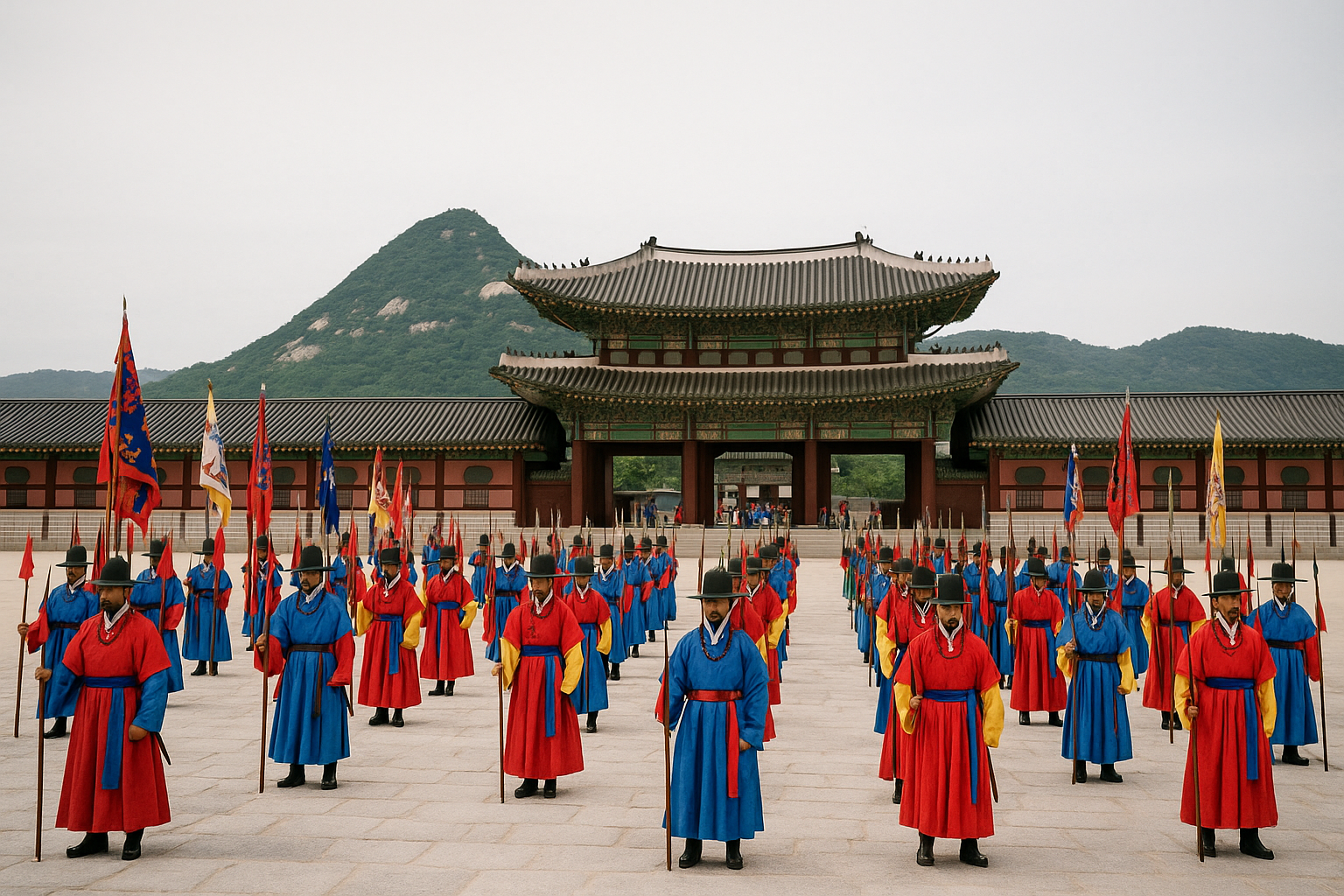
Gwanghwamun Square fills up twice a day, and almost nobody standing there knows the schedule. They saw a crowd, joined it, and hoped something would happen. You can do better than that — the gyeongbokgung guard changing ceremony runs on a fixed daily timetable, it costs nothing, and it sits inside a stretch of the day where three other free guard performances happen at Gyeongbokgung within a few hours of each other.
This guide gives you the exact times, tells you where to stand so the palace roofline is behind the guards instead of a wall of phones, and shows you how to stack the ceremony with the ticketed palace visits that are genuinely worth booking.
—
Quick Answer: Gyeongbokgung Guard Changing Ceremony Times
🎟️ Book Your Gyeongbokgung Guard Changing Ceremony Experience
Skip the queues and language barriers. Compare verified tours, tickets, and rentals for Gyeongbokgung Guard Changing Ceremony on Klook — instant mobile vouchers, English support, free cancellation on most activities.
| Performance | Times | Length | Where |
|---|---|---|---|
| Changing of the Royal Guard | 10:00 and 14:00 | about 20 minutes | Heungnyemun Gate courtyard |
| Gwanghwamun Gate Guard Duty | 11:00 and 13:00 | about 10 minutes | Gwanghwamun Gate |
| Guard Training Session | 09:35 and 13:35 | about 15 minutes | Heungnyemun Gate courtyard |
Three practical rules that decide whether your trip works:
- Closed Tuesdays. Gyeongbokgung closes on Tuesdays and every guard performance is suspended that day. This is the single most common wasted trip.
- Free to watch. The ceremony takes place in the outer courtyard, before the ticket gate. You do not need a palace ticket to stand and watch.
- Weather cancels it. Heavy rain and extreme heat both cancel performances, and the call is made on the day. Check before you leave your accommodation.
Schedules for all of these are published by the Korea Heritage Service, which runs the palace. The Korea Tourism Organization’s official Gyeongbokgung page on visitkorea.or.kr carries the same timetable in English along with any seasonal notices.
—
What You Are Actually Watching
The Joseon court kept a rotating guard on the palace gates, and shifts changed on a formal schedule with its own inspection, drum signals, and handover of the gate tallies. The modern performance reconstructs that handover: the outgoing guard unit is inspected, the tallies confirming authority over the gate are passed across, and the incoming unit takes position.
What makes it worth twenty minutes rather than a passing glance is the scale. You get several dozen performers in layered blue, red, and yellow court dress, a percussion line, ceremonial flags and weapons, and no barrier between you and them. It is one of the very few large-scale historical performances anywhere in Seoul that costs nothing to attend.
The Gwanghwamun Gate Guard Duty performance at 11:00 and 13:00 is the smaller sibling — a shorter sentry routine at the main gate itself. The 09:35 and 13:35 training session shows the guards drilling in formation before they perform. If you only have one slot, take a 10:00 or 14:00 changing ceremony; the other two are bonuses if you happen to be nearby.
—
Where to Stand
Most visitors arrive two minutes before the hour, find a wall of raised phones, and film the backs of heads. The fix is arriving fifteen to twenty minutes early and choosing a side rather than the centre.
The best general position is along the sides of the Heungnyemun courtyard rather than dead centre. The guards process through and turn, so a side angle gives you movement across the frame and puts the palace gate roofline in the background. Centre-front gives you a straight-on view that flattens into a line of people.
For photographs specifically, stand on the side the guards enter from. You get them walking toward you rather than away, and the light in the morning slot falls across the costumes instead of behind them.
If you are short or travelling with kids, the elevated ground near the courtyard edges beats the front row. The front row is a wall of shoulders within five minutes of the start.
Arrive earlier in autumn. September through November is the heaviest visitor season at Seoul’s palaces, and both hanbok rental and the courtyard fill noticeably faster than in the summer heat.
—
Getting There
Gyeongbokgung sits at the top of Gwanghwamun Square in central Seoul, and two subway lines put you within a short walk:
- Line 3, Gyeongbokgung Station — exits open directly onto the palace’s grounds, the shortest approach.
- Line 5, Gwanghwamun Station — puts you at the bottom of the square, a walk of roughly ten minutes north with the palace ahead of you the whole way.
The Line 5 approach is slower but better on a first visit. You walk the full length of the square with Gwanghwamun Gate and Bugaksan mountain framed behind it, which is the view the palace was sited for.
—
Should You Buy a Palace Ticket Too?
The ceremony is free, but you are already at the gate of one of the four main Joseon palaces, and admission to Gyeongbokgung is 3,000 won for adults — among the cheapest major attractions in Seoul.
There is also the hanbok rule: visitors wearing hanbok enter the palace free. Rental shops cluster in the streets around the palace and in nearby Bukchon, and a two-hour rental typically costs more than the ticket you save — so treat free entry as a bonus rather than the reason to rent. We break down where to rent and what the sizing and return process actually looks like in our hanbok rental guide for Gyeongbokgung.
A sensible half-day: watch the 10:00 ceremony, go through the ticket gate and spend ninety minutes in the palace grounds, then walk up into Bukchon Hanok Village, which starts about ten minutes uphill from the palace’s east side.
—
The Ticketed Experiences Worth Planning Around
Here is the thing the free ceremony does not tell you: the genuinely memorable palace experiences in Seoul are the night programmes, and those sell out. If you are going to be near Gyeongbokgung anyway, it is worth knowing what needs booking weeks in advance versus what you can walk up to.
Gyeongbokgung Starlight Tour is the evening programme at this palace — a guided night route through the grounds with a court meal, released in limited seasonal rounds. Tickets go in a scheduled online release and are gone quickly. Our Gyeongbokgung night tour guide covers the release mechanics and what actually happens on the tour.
Changdeokgung Moonlight Tour is the other headline night programme, at the palace one stop east. It is the harder ticket of the two and the one most people mean when they say they want to see a palace at night. See our Changdeokgung Moonlight Tour ticket guide for the booking windows.
Changdeokgung Secret Garden (Huwon) is the daytime one people miss. The rear garden is only accessible on a timed guided tour with a separate, capped ticket, and it is the most restricted part of any Seoul palace. Details on how the timed slots and the separate reservation work are in our Huwon booking guide.
The pattern across all three: the free thing you can walk up to, and the good thing you cannot. Watch the guard ceremony on the day, but book the night tours before you fly.
—
Common Mistakes
Turning up on a Tuesday. Gyeongbokgung’s closing day takes the ceremony with it. Changdeokgung and Deoksugung close on Mondays instead, so a Tuesday in central Seoul is better spent at Changdeokgung.
Arriving at 09:58. Fifteen minutes early is the difference between a clear view and a phone-screen mosaic.
Assuming rain means it is on anyway. Cancellations for heavy rain and extreme heat are real and same-day. If the forecast is bad, have a second plan before you set out.
Watching the 14:00 and then trying to do the whole palace. Gyeongbokgung’s grounds are large and last admission is well before closing. The morning ceremony leaves you a full afternoon; the 14:00 one does not.
Booking a night tour on the same day you plan the ceremony. They are the same palace and the same feet. Split them.
—
Gyeongbokgung Guard Changing Ceremony: A Practical Plan
If you want a single itinerary that uses the timetable properly:
That sequence gets you three separate performances, the palace interior, and a neighbourhood, on one ticket costing less than a coffee.
—
FAQ
Is the gyeongbokgung guard changing ceremony free?
Yes. It takes place in the outer courtyard before the ticket gate, so you can watch without buying palace admission. Entering the palace grounds afterwards costs 3,000 won for adults.
What time is the ceremony?
10:00 and 14:00, running about twenty minutes each. The separate Gwanghwamun gate duty performance is at 11:00 and 13:00, and the guard training session at 09:35 and 13:35.
Which day is it cancelled?
Every Tuesday, when Gyeongbokgung is closed. It is also cancelled on the day for heavy rain or extreme heat.
How early should I arrive?
Fifteen to twenty minutes for a clear view, and more in autumn peak season.
Is there a similar ceremony at other palaces?
Deoksugung runs its own royal guard changing ceremony on a separate schedule. If you want the palace experience rather than the ceremony specifically, the night programmes at Gyeongbokgung and Changdeokgung are the ones worth planning around.
Can I take photos?
Yes, throughout, and the performers are used to it. There is no barrier, so the constraint is other visitors rather than any rule.
—
The Short Version
The gyeongbokgung guard changing ceremony is the highest-value free thing in central Seoul: 10:00 and 14:00, about twenty minutes, no ticket needed, closed Tuesdays. Arrive fifteen minutes early, stand to the side rather than the centre, and build the rest of the day around it — the 3,000 won palace ticket, Bukchon uphill to the east, and a night tour booked well in advance if you want the version of these palaces that most visitors never see.
Schedules follow the Korea Heritage Service timetable for Gyeongbokgung. Performances are subject to same-day cancellation for weather and to seasonal changes — confirm on the day before travelling across the city for a specific slot.
Disclosure: SeoulScope is a participant in the Klook and Agoda affiliate programs and the Amazon Associates Program. As an Amazon Associate we earn from qualifying purchases. We may earn a small commission when you book or buy through links in this post, at no extra cost to you. We only recommend experiences and products we believe will genuinely help your trip.
3 thoughts on “Gyeongbokgung Guard Changing Ceremony 2026: Times, Best Spot, and What Else to See”