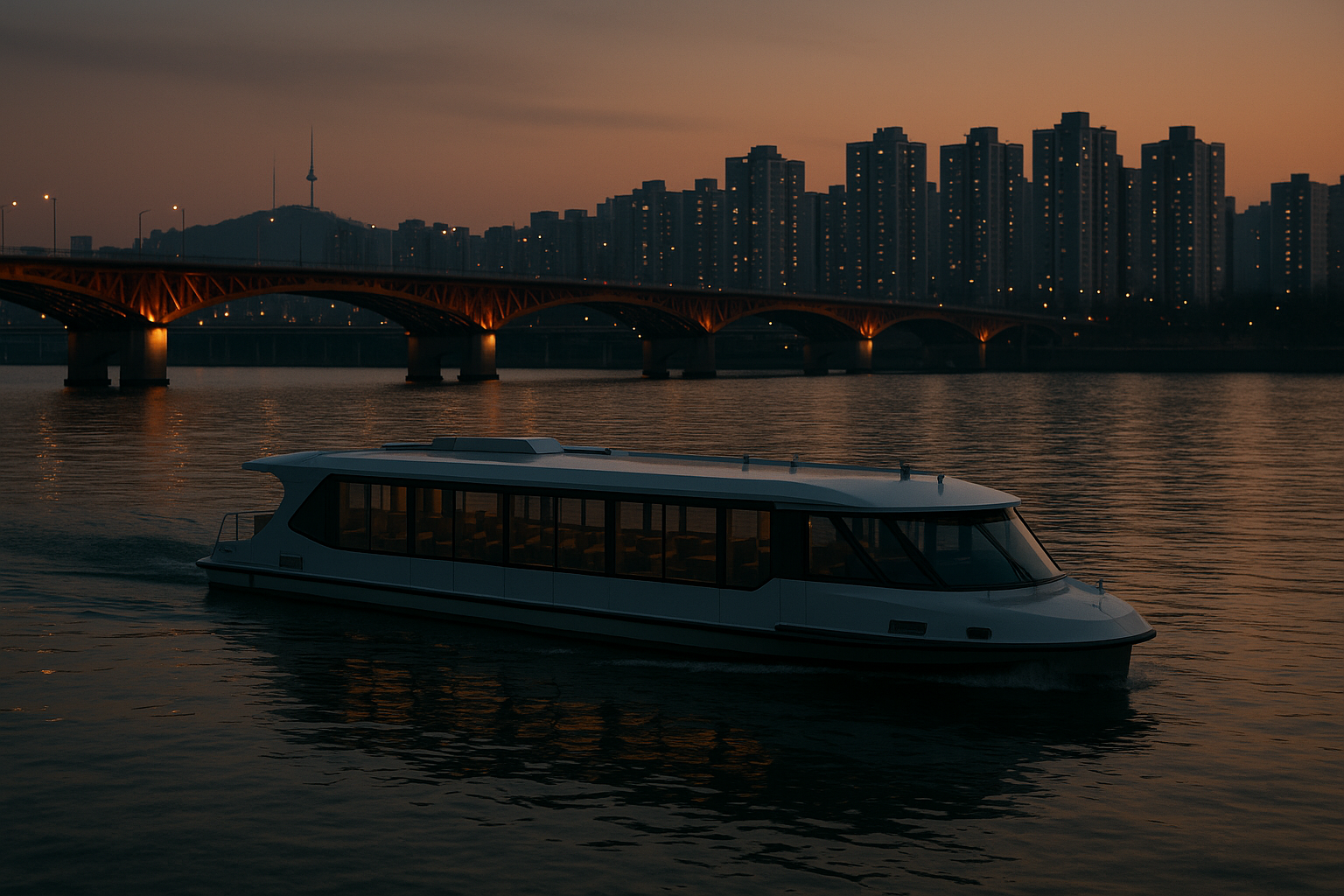
If you search for the Hangang Bus — Seoul’s river ferry service — you will find the fare quoted as 2,500 won and as 3,000 won, the number of piers given as seven and as eight, and the operating window given as 09:00 to 21:37 in one place and 11:00 to 21:28 in another. None of these sources is lying. They were written on different dates about a service that has changed four times since it opened.
This guide does something most Hangang Bus pages do not: it dates every number. Where sources disagree, the disagreement is shown rather than smoothed over, because the resolution is usually “one of them is simply older,” and knowing which one is older is the whole skill of using this service without being surprised at the pier.
The short version
🎟️ Book Your Hangang Bus Experience
Skip the queues and language barriers. Compare verified tours, tickets, and rentals for Hangang Bus on Klook — instant mobile vouchers, English support, free cancellation on most activities.
The Hangang Bus is a scheduled public ferry on the Han River, operated as part of Seoul’s public transport system rather than as a tourist cruise. It launched in full service on 18 September 2025. As of this writing it runs between eight piers, the standard adult fare charged by the operator is 2,500 won, and — this is the part that catches people out — you cannot reserve a seat in advance. There is no booking app. You tap a transit card or buy a single ticket from a machine at the pier on the day of travel.
It is a commuter boat with a very good view, not a cruise with a departure you hold a ticket for. Treating it as the former will save you a wasted trip.
Why published numbers contradict each other
Almost every disagreement you will find online resolves into a date. Here is the timeline that produces them:
| Date | What changed |
|---|---|
| 18 September 2025 | Full service begins with seven piers: Magok, Mangwon, Yeouido, Apgujeong, Oksu, Ttukseom, Jamsil |
| 1 November 2025 | Seoul’s policy page describes service as roughly 09:00–21:37, departures about every 90 minutes, 16 sailings a day |
| 8 June 2026 | Seoulsup (Seoul Forest) pier added as an eighth stop, tied to the garden expo, with 16 daily calls |
| 15 August 2026 | Evening sailings added — extra departures on the Jamsil→Yeouido and Yeouido→Magok legs, plus two added afternoon runs |
| 10 August 2026 | The free shuttle buses that connected some piers to the nearest subway stations were discontinued |
So: a page that says seven piers was written before June 2026. A page that says the last boat is at 20:32 is quoting the Seoulsup-era western-line schedule, not the current evening-extended one. A page that says 3,000 won is quoting a figure that appeared in early coverage and in some city communications; the operator’s own fare page, checked directly, says 2,500 won for a standard adult.
When the operator and a secondary source disagree about money, use the operator. When two sources disagree about a schedule, use the more recent one — and then check the day you travel, because this service has a habit of changing.
Hangang Bus fares, as charged by the operator
From the operator’s fare page (hgbus.co.kr), the single-ride fares are:
- Adult: 2,500 won
- Youth: 1,800 won
- Child: 1,100 won
That is per boarding, the same structure as a bus or subway ride. It is not a cruise ticket and there is no hop-on-hop-off day pass built into the fare.
A useful comparison: a standard Seoul subway ride starts around 1,400 won, and a commercial Han River sightseeing cruise runs many times the Hangang Bus fare. The river ferry sits between them — priced like transport, experienced like sightseeing. Whether that is good value depends entirely on whether the route happens to go where you were going anyway.
How to pay for the Hangang Bus — and why you cannot book
Accepted payment:
- Transit cards (T-money and the usual compatible cards), tapped as you board
- Credit and debit cards
- Single-ride tickets bought from a ticket machine at the pier
The single-ride ticket is valid for that day only. You cannot buy one in advance for a later date.
And the point that trips up most visitors: the operator states plainly that there is no mobile app for reservations, and advance booking is not possible, because the Hangang Bus is classified as public transport. There is no seat to hold. You arrive, you tap, you board if there is room.
The practical consequence is that a Hangang Bus trip is not something to build a tight itinerary around. If your plan is “the 19:20 boat, then dinner at 20:00,” you are exposed to a boat that is full, delayed, or cancelled for weather with no fallback. Build it in as a pleasant option on a loose afternoon instead.
Hangang Bus piers: all eight of them
Eight, as of the 8 June 2026 addition:
- Magok — western end, near the Gimpo-side edge of the city
- Mangwon — next to Mangwon Hangang Park and the Mangwon Market area
- Yeouido — the central interchange; most useful pier for a visitor
- Apgujeong — Gangnam side, north of the Apgujeong shopping district
- Oksu — north bank, close to the Oksu subway area
- Ttukseom — Ttukseom Hangang Park, a major riverside park
- Seoul Forest (Seoulsup) — added June 2026
- Jamsil — eastern end, near the Jamsil complex and Lotte World Tower
One thing to plan for: as of 10 August 2026 the free shuttle buses linking piers to nearby subway stations were discontinued. Several piers are a genuine walk from the nearest station — riverside parks are on the far side of embankments and expressways. Check the walking route before you commit, particularly in summer heat or after dark. If the walk looks unpleasant, our list of indoor alternatives is the better plan for that afternoon.
Hangang Bus timetable, with the dates attached
There is no single timetable that has been true for the whole life of the service, which is exactly why quoting one without a date is misleading. What is documented:
- From November 2025 (Seoul city policy page): service roughly 09:00–21:37, departures about every 90 minutes, 16 sailings a day.
- From the Seoulsup addition (June 2026): eastbound line 11:00–21:28, westbound line 11:20–20:32.
- From 15 August 2026: evening service extended. Added departures Jamsil→Yeouido at 18:50 and 19:20, and Yeouido→Magok at 20:25 and 20:55. Two afternoon runs were also added, Magok→Yeouido at 15:00 and 15:30, and Yeouido→Jamsil at 16:00 and 16:30.
The direction of travel matters more than the clock here. This is a linear river route with two directional lines, and the last useful boat in your direction may be well before the last boat of the day in the other. Check the leg you actually need.
The service also runs special schedules around major riverside events — for the fireworks festival in early September 2026, the operator posted temporary sailings for 3–5 September. Those notices go up on the operator’s site and nowhere else reliably.
The Climate Card trap you need to know about in October 2026
This is the most consequential thing in this guide, and it is wrong on a great many pages.
The Hangang Bus was included in the 30-day Climate Card as a paid add-on tier — 67,000 won for transit plus the river bus, 70,000 won with Ttareungi bikes added, with reduced rates for youth and for multi-child and low-income households. Add-on charging opened on 14 September 2025 and use began with the ferry’s launch on 18 September.
But the short-term 1-to-7-day Climate Cards that tourists actually buy have never included the Hangang Bus, and never included Ttareungi either. Seoul states this explicitly. If you bought a 3-day Climate Card expecting to ride the river bus on it, you will be refused.
And the 30-day product that did include it is being retired. Prepaid top-ups closed on 31 July 2026; post-paid cards run until 30 September 2026. From 1 October 2026 there is no Climate Card product that covers the Hangang Bus at all. Pay with an ordinary transit card or a payment card instead. Our Seoul Climate Card guide covers what the short-term passes do and do not cover.
What is still unstated
In the interest of not inventing what I could not confirm from an official source:
- Journey times between specific pairs of piers are not published as a simple table by the operator.
- Precise weather-cancellation thresholds — the service is suspended in bad conditions, but the trigger is not published as a number.
- Luggage and bicycle policy in detail.
If you need certainty on any of those for a specific date, the pier staff and the operator’s notice board are the only reliable answer. I would rather leave a gap here than fill it with a number that reads confidently and is wrong.
Is the Hangang Bus worth it?
By September 2026 the service had carried roughly 600,000 passengers since launch, which for a year-old river route is real usage rather than a novelty spike. But the honest answer for a visitor is conditional.
Worth it if: you were going to be at one end of the river anyway, you have a loose afternoon, the weather is good, and the view of the bridges is the point. The stretch through central Seoul at dusk is genuinely one of the better cheap views in the city — see our guide to the Han River at night for what else is near the piers after dark.
Not worth it if: you are trying to get somewhere on a schedule. Ninety-minute headways, no reservations, pier-to-station walks with the shuttle buses gone, and weather cancellations make this a slower and less certain option than the subway for essentially every journey it covers. It is a view with a timetable, not a shortcut.
FAQ
Can I book Hangang Bus tickets in advance?
No. The operator states there is no reservation app and advance booking is not possible because it operates as public transport. Single-ride tickets from pier machines are valid that day only.
How much is the Hangang Bus?
2,500 won for an adult, 1,800 for youth, 1,100 for a child, per boarding, according to the operator’s own fare page. Sources quoting 3,000 won are quoting a different or older figure — use the operator’s.
Does the Climate Card cover it?
Only the 30-day pass with the river-bus add-on tier did, and that product is being retired — prepaid top-ups closed 31 July 2026 and post-paid use ends 30 September 2026. The short-term 1–7 day tourist passes have never covered it.
How many piers are there?
Eight since 8 June 2026, when Seoul Forest was added to the original seven.
Is there a boat from the airport?
No. The Hangang Bus does not serve Incheon Airport; the western terminus is Magok. See getting in from Incheon Airport for the options that actually exist.
Sources and how to re-check
Every figure above came from one of two places: the operator’s site at hgbus.co.kr for fares, payment rules and service notices, and Seoul city channels at seoul.go.kr for launch dates, pier additions and schedule expansions. Both publish notices when something changes, and both have changed something roughly every two months since launch.
If you are reading this well after September 2026, treat the schedule section as the part most likely to have moved, and the payment rules as the part most likely to have stayed put.
Disclosure: SeoulScope is a participant in the Klook and Agoda affiliate programs and the Amazon Associates Program. As an Amazon Associate we earn from qualifying purchases. We may earn a small commission when you book or buy through links in this post, at no extra cost to you. We only recommend experiences and products we believe will genuinely help your trip.
1 thought on “Hangang Bus Seoul 2026: Fare, Piers, and Why Sources Disagree”