Last updated: August 2026 — prices, coverage and the 30-day-pass shutdown timeline checked against the Seoul Metropolitan Government’s official Climate Card notices (intro, how to use, closure FAQ).
If you’ve been Googling transit passes for your Korea trip, you’ve landed in the right place. This Seoul Climate Card tourist guide 2026 covers what the card is, exactly how much it costs, where to buy it, which transport it really covers — and the airport mistake that catches out almost every first-timer, because the card does not work the way most travel blogs claim.
—
Quick Answer: Is the Seoul Climate Card Worth It in 2026?
🎟️ Book Your Seoul Climate Card Tourist Guide 2026 Experience
Skip the queues and language barriers. Compare verified tours, tickets, and rentals for Seoul Climate Card Tourist Guide 2026 on Klook — instant mobile vouchers, English support, free cancellation on most activities.
Yes — if you’ll take more than four or five rides a day inside Seoul. No, if you’re mostly staying in one neighbourhood or planning day trips out of the city.
The Climate Card (기후동행카드) is an unlimited-ride pass for Seoul’s subway network and Seoul-licensed city and village buses. Short-term passes come in 1, 2, 3, 5 and 7-day tiers. Ttareungi public bikes and the Hangang River bus are not included in the short-term passes — Seoul sold those as add-on options on the 30-day pass only, and that pass is being retired.
A single Seoul subway ride starts around ₩1,400, so a 1-day card at ₩5,000 breaks even at roughly four rides.
Two things to know before you read further, because they change the maths:
Buy the Seoul Climate Card on Klook →
—
What Exactly Is the Seoul Climate Card?
The Seoul Climate Card (기후동행카드, Gihu-donghaeng Card) was introduced by the Seoul Metropolitan Government in January 2024 as a climate initiative: make unlimited transit cheap enough that people leave the car at home. For visitors it doubles as a simple all-in-one city pass.
Unlike Japan’s IC cards (Suica, ICOCA), which are prepaid pay-per-ride wallets, the Climate Card is a flat-rate unlimited-ride pass for a set number of days. You load it once, then tap freely inside the coverage area.
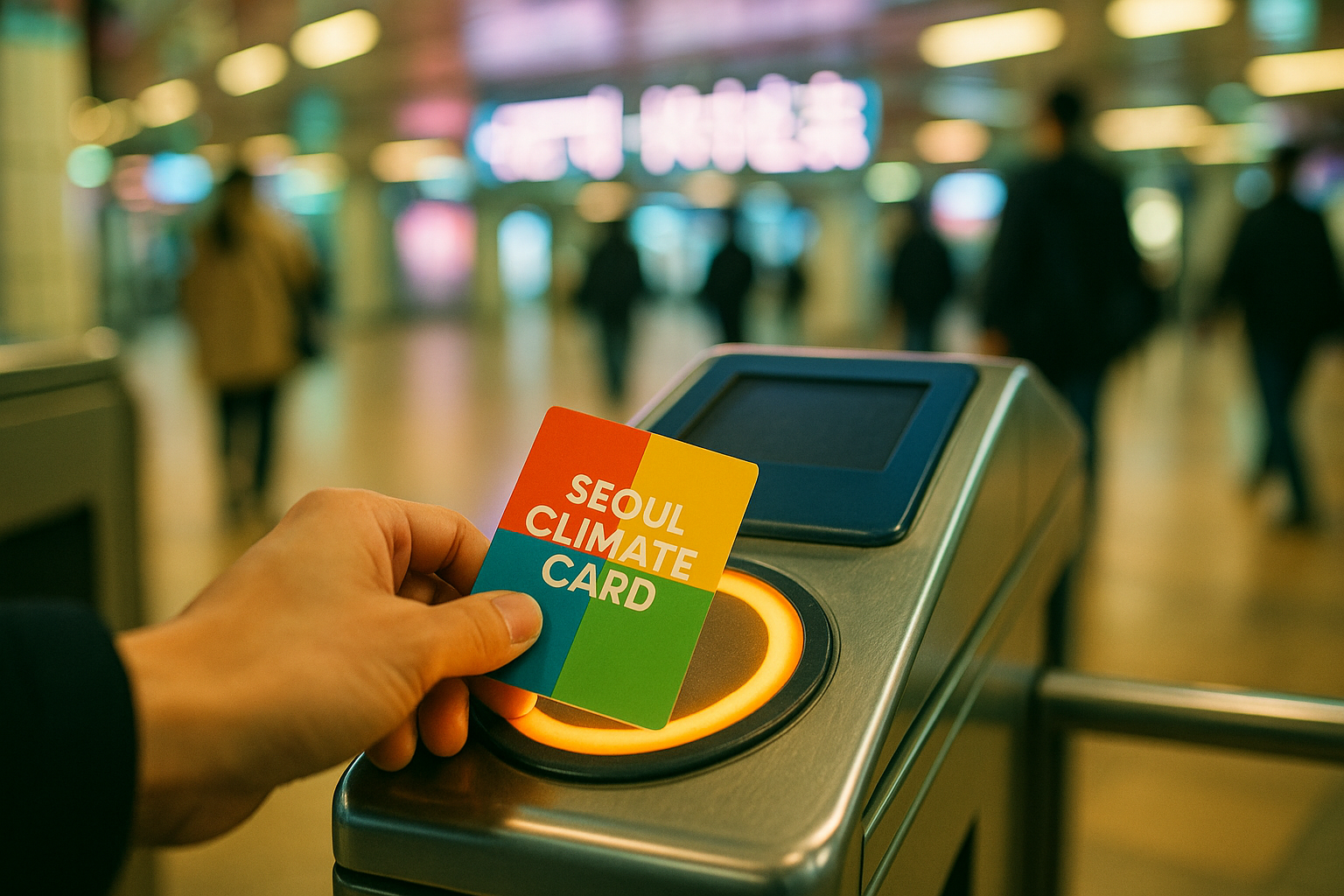
Physically it’s a plastic transit card with an embedded chip, the same form factor as T-money. You tap it on the card reader at subway turnstiles and on the panel beside the bus driver.
—
Seoul Climate Card Tourist Guide 2026: Prices, Zones & What’s Covered
The short-term pass prices
| Pass | Price | Best for |
|---|---|---|
| 1-day | ₩5,000 | One packed sightseeing day — Gyeongbokgung → Insadong → Hongdae |
| 2-day | ₩8,000 | A weekend city break |
| 3-day | ₩10,000 | The standard 3-night Seoul itinerary |
| 5-day | ₩15,000 | Extended Seoul stays |
| 7-day | ₩20,000 | A full week using transit as your default |
The card itself costs extra — and there is no deposit
The physical card is a separate ₩3,000 purchase, paid once. That ₩3,000 is not a refundable deposit: you buy the blank card, then load a pass onto it. Keep it and you can reload it on a future trip.
There is no card-return kiosk to reclaim money from, and once a pass has expired it cannot be refunded. Budget the ₩3,000 as a sunk cost on top of the pass price — a 3-day card is really ₩13,000 the first time you buy one.
The clock starts on the day you load it, not on your first tap
This is the single most expensive misunderstanding about the card. The validity period runs from the day you charge the pass, not from your first tap. A 1-day pass loaded on a Wednesday is dead after Wednesday’s last train, even if you never tapped it.
You also cannot pre-load a pass for a future date. Buy it on the morning you intend to start using it, not the night you land at 11pm.
What’s covered
- Subway: Seoul-area subway lines, plus some Gyeonggi Province sections — check any route you’re unsure about in Naver Map, which shows line-by-line coverage
- Buses: Seoul-licensed city buses and village (maeul) buses
- AREX: the Gimpo Airport–Seoul Station section only
What’s NOT covered
- Ttareungi public bikes — an add-on that existed only on the 30-day pass, never on the short-term tiers
- The Hangang River bus — same: a 30-day add-on tier, not part of any 1–7 day pass. See our Hangang Bus guide for how to pay for it instead
- The Sinbundang Line and GTX — both explicitly excluded
- Boarding the airport train at Incheon Airport (see below)
- Subway outside the Seoul area
- Gwangyeok (metropolitan express) buses and airport buses
- Buses licensed to other regions — i.e. a bus registered in Gyeonggi, even if you catch it in Seoul
- KTX and other Korail intercity trains
- Taxis
The Incheon Airport rule, precisely
Most English-language guides get this wrong, so here it is exactly as Seoul states it:
- Boarding at Incheon Airport T1 or T2 is not possible with the Climate Card. Arriving from abroad, you pay separately — a single AREX fare on T-money, or an AREX Express ticket.
- Alighting at Incheon Airport T1/T2 is allowed if you boarded at a station inside the coverage area. So the card can carry you to the airport on your departure day, just not from it on arrival.
Practically: plan and budget your airport-to-city transfer as a separate expense, and start the Climate Card once you’re in the city. Our guide to getting from Incheon Airport into Seoul walks through the options and what each one costs.
—
Where to Buy the Seoul Climate Card
Subway stations (the official route)
Seoul Metro sells them from the new-model transit card machines inside Line 1–8 stations, and at convenience stores near those stations. Both cash and credit/debit cards are accepted at the machines. This is the method Seoul itself documents, and it’s the one to default to.
Tourist information centres
Foreign visitors can also buy physical cards at the Seoul Tourism Plaza tourist information centre and the Myeongdong tourist information centre — useful if you’d rather ask a human in English than work a machine.
Pre-purchase online
If you’d rather have it sorted before you fly, the pass can be pre-booked online and redeemed on arrival. Follow the redemption instructions on your specific voucher — pickup points vary by seller, so don’t assume an airport counter without checking.
Book the Seoul Climate Card on Klook →
—
How to Use the Seoul Climate Card Step-by-Step
—
Seoul Climate Card vs. T-Money: Which One Should You Get?
| Climate Card | T-Money | |
|---|---|---|
| Type | Unlimited rides, fixed days | Pay-per-ride, top-up |
| Card cost | ₩3,000, non-refundable | Card fee, non-refundable |
| Best for | Active sightseers, 2+ days inside Seoul | Light users, day-trippers, airport arrivals |
| Bus coverage | Unlimited, Seoul-licensed buses only | Any bus, pay per ride |
| Boarding AREX at Incheon | ❌ Not possible | ✅ Yes |
| Sinbundang Line / GTX | ❌ Excluded | ✅ Yes |
| Trips outside Seoul | ❌ Not covered | ✅ Yes |
| Unused value refund | ❌ None after expiry | ✅ Balance refundable |
Bottom line: the Climate Card wins when your days are dense and Seoul-shaped. T-money wins on flexibility — and it’s the card you actually want in your hand when you land at Incheon. Plenty of visitors carry both: T-money for the airport run and anything outside the city, Climate Card for the sightseeing days in between.
Heading out of the city at some point? Our Seoul to Busan guide covers the KTX route, which no transit pass covers.
—
Common Mistakes to Avoid
Mistake #1: Expecting to tap out of Incheon Airport on arrival
The most common and most disruptive one. You land, you have a Climate Card, and the gate refuses you. Boarding at Incheon Airport simply isn’t in the card’s coverage. Pay for that first ride separately and start the pass in the city.
Mistake #2: Loading the pass the night you arrive
The validity runs from the charge date. Load a 1-day pass at 11pm and you’ve bought yourself an hour. Load passes in the morning, on the day you’ll use them.
Mistake #3: Treating the ₩3,000 as a deposit
It isn’t refundable, and there’s no return kiosk. If you’re in Seoul for two days and will take six rides total, the card fee may tip the maths towards T-money. Do the sum before you buy.
Mistake #4: Assuming any bus in Seoul counts
Coverage is by licence, not by where the bus happens to be. A Gyeonggi-licensed bus, a metropolitan express bus or an airport bus will charge you even if you board it in central Seoul. Village and city buses with a Seoul licence are fine — which is nearly everything you’ll use inside the city.
Mistake #5: Riding the Sinbundang Line by accident
It’s excluded, and it’s easy to end up on it heading south towards Gangnam and beyond. Check your route in a transit app before you tap.
—
Planning Your Seoul Days Around the Card
Here’s what a dense transit day actually looks like:
Morning: Line 3 from Gyeongbokgung Station, transfer at Chungmuro to Line 4, out at Myeongdong. Walk Namsangol Hanok Village, eat your way through the market stalls — our Myeongdong street food guide maps the ones worth queueing for.
Afternoon: Bus across to Itaewon for lunch, then Line 6 and Line 2 towards Hongdae for the street culture.
Evening: Line 2 down to Gangnam for dinner, and a Ttareungi bike along the river if the weather’s behaving — that’s included too. More riverside ideas in our guide to Han River night activities.
That’s six to eight rides. Pay-as-you-go, you’re looking at roughly ₩8,000–₩10,000. On a ₩5,000 1-day card you’re ahead, and you stopped thinking about your wallet at turnstiles.
Still deciding on a base? Our guide to where to stay in Seoul breaks down which neighbourhoods put you closest to the lines you’ll actually use.
Grab your Seoul Climate Card on Klook before you fly →
—
Frequently Asked Questions
Can tourists buy the Seoul Climate Card?
Yes. There are no residency or ID requirements. Buy the physical card for ₩3,000 at a Line 1–8 station machine, a convenience store near a station, or the Seoul Tourism Plaza and Myeongdong tourist information centres.
Does the Seoul Climate Card work on the airport train?
Only on the Gimpo Airport–Seoul Station section. You cannot board at Incheon Airport. You may alight at Incheon T1/T2 if you boarded inside the coverage area.
How many days does the Seoul Climate Card come in?
1-day (₩5,000), 2-day (₩8,000), 3-day (₩10,000), 5-day (₩15,000) and 7-day (₩20,000), plus the one-off ₩3,000 card fee.
When does the Climate Card start counting down?
From the day you charge the pass — not your first tap. Passes cannot be loaded in advance for a later date.
Is the Seoul Climate Card being discontinued?
The 30-day monthly pass is. Seoul closed prepaid top-ups on 31 July 2026 and post-paid cards run until 30 September 2026, as benefits move to the national K-Pass scheme. The short-term 1–7 day passes continue to operate. One practical consequence: the Ttareungi and Hangang River bus add-ons existed only on the 30-day pass, so they disappear with it. Coverage rules are reviewed periodically, so check Seoul’s official notice before you travel.
Can I get a refund on unused days?
No. Once a pass has expired there’s no refund, and the ₩3,000 card fee is not refundable either.
Can I use the Seoul Climate Card on night buses?
Yes — Seoul’s owl buses (marked N plus a number) are Seoul-licensed city buses and are covered.
Does it cover Ttareungi bike rental?
Not on a short-term pass. Ttareungi and the Hangang River bus were add-on tiers sold on the 30-day pass only, and that pass is being retired — so from October 2026 there is no Climate Card product that covers either. Pay for the river bus with a regular transit card instead.
—
Coverage rules and prices here reflect Seoul Metropolitan Government notices as of August 2026. Seoul updates these pages periodically — check the official Climate Card notice before you buy if you’re travelling later in the year.
Disclosure: SeoulScope is a participant in the Klook and Agoda affiliate programs and the Amazon Associates Program. As an Amazon Associate we earn from qualifying purchases. We may earn a small commission when you book or buy through links in this post, at no extra cost to you. We only recommend experiences and products we believe will genuinely help your trip.
3 thoughts on “Seoul Climate Card Tourist Guide 2026: Everything You Need to Know Before You Tap”