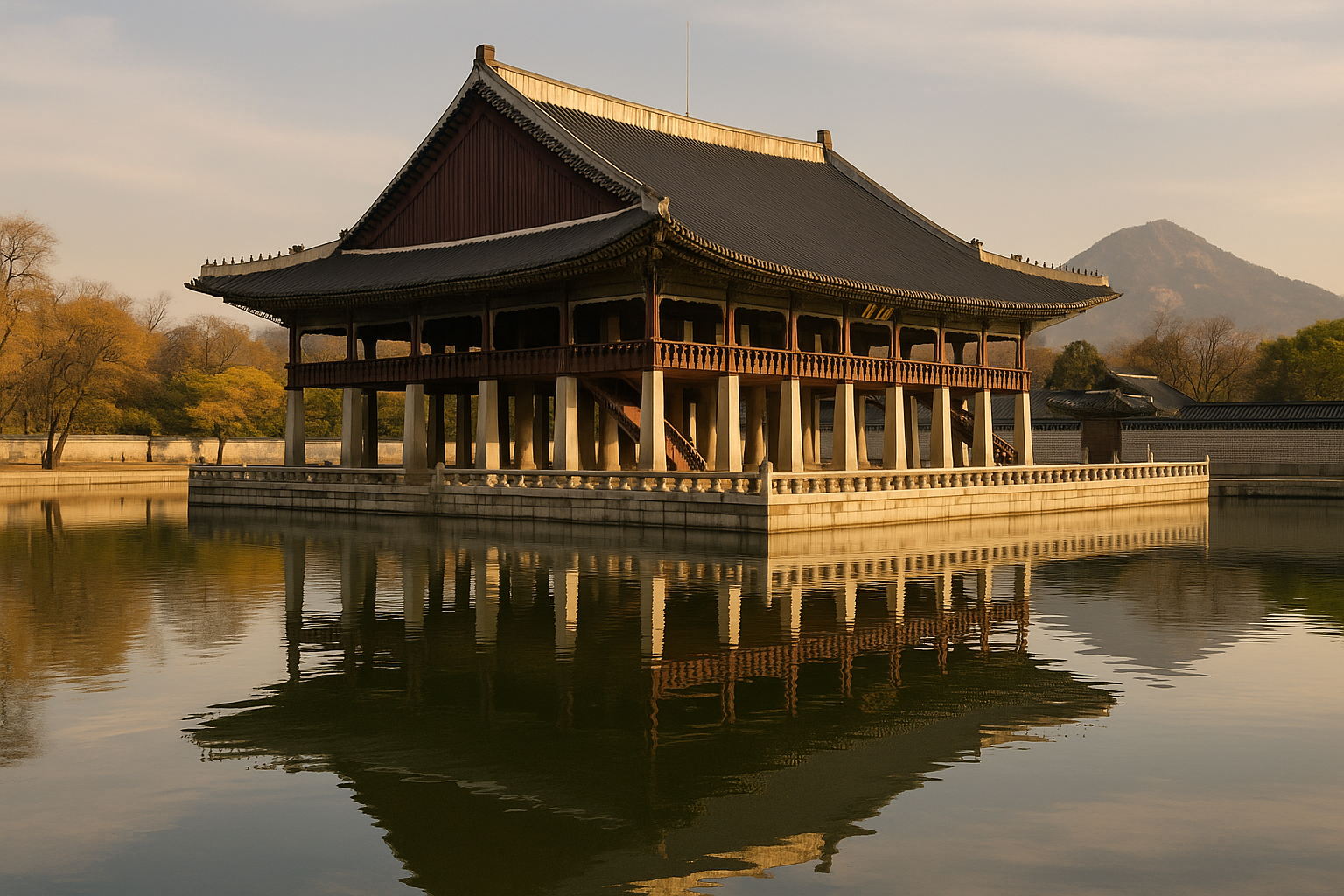
Everyone who visits Gyeongbokgung photographs the same building from the same spot: Gyeonghoeru Pavilion, a vast two-storey banquet hall on stone pillars, standing in a rectangular pond, shot across the water from the fence on the eastern side.
Almost nobody goes inside it. Not because it is closed, and not because it is expensive — it costs nothing. They miss it because the booking rule is close to invisible if you are reading in English, and because the reservation window has a shape that no other attraction in Seoul uses.
You cannot book it this week for this week. You also cannot book it a month out. The window opens nine days before your chosen date and slams shut three days before, and if you are outside that six-day slot, there is no way in at all.
This guide covers how the gyeonghoeru pavilion interior tour actually works in 2026, the exact dates left in this year’s autumn season, when each one opens for booking, and the two things about it that most English-language write-ups get wrong.
Gyeonghoeru Pavilion Special Viewing at a Glance
🎟️ Book Your Seoul Experience
Skip the queues and language barriers. Compare verified tours, tickets, and rentals for Seoul on Klook — instant mobile vouchers, English support, free cancellation on most activities.
| Tour cost | Free |
| Palace admission | ₩3,000 adult — paid separately, not included |
| 2026 autumn season | 2 September – 30 October |
| Days | Wednesdays and Fridays only |
| Times | 10:00 and 14:00 |
| Length | About 70 minutes |
| Capacity | 25 people per session |
| Booking window | Opens 9 days before, 10:00 · closes 3 days before, 23:59 |
| Seats per person | 2 |
| Minimum age | 7 |
| Commentary language | Korean only |
| Where to book | Korea Heritage Service integrated reservation site |
| Group bookings | Not accepted |
Four rows in that table decide everything. The tour is free but the palace ticket is not. It runs two days a week, not seven. There are fifty seats a day in total. And the booking window is a moving six-day slot that you have to catch.
The Booking Window Is the Whole Problem
This is the rule that costs people the visit, so start here.
Reservations open at 10:00, nine days before the date you want, and close at 23:59, three days before it. Both ends matter, and they fail in opposite directions:
- Turn up spontaneously and you are too late. There is no on-the-day sign-up, no standby line, no ticket window for this. If you decide on Monday that you want to go on Wednesday, the answer is no.
- Plan too far ahead and you are too early. Trying to lock this in when you book your flights does not work either. The system will not take a reservation ten days out.
So the practical instruction is unusually specific: count back nine days from the date you want, and set an alarm for 10:00 Korea time on that day. Every gyeonghoeru pavilion session is twenty-five seats, first come first served, released all at once. Autumn Wednesdays and Fridays in Seoul are the peak of the peak, and these are the sessions that go fastest.
One more clause worth knowing before you book: no-shows are penalised. The operator states that failing to turn up without cancelling counts against you for future events on the same reservation system. If your plans change, cancel.
Every Date Left in the 2026 Season
Here is the autumn season in full, with the day each session opens for booking. The season runs 2 September to 30 October 2026, Wednesdays and Fridays, and there is no winter season — it stops on 30 October and does not return until spring.
| Viewing date | Day | Booking opens | Booking closes |
|---|---|---|---|
| 9 September | Wed | 31 August | 6 September |
| 11 September | Fri | 2 September | 8 September |
| 16 September | Wed | 7 September | 13 September |
| 18 September | Fri | 9 September | 15 September |
| 23 September | Wed | 14 September | 20 September |
| ~~25 September~~ | Fri | Closed — Chuseok holiday | |
| 30 September | Wed | 21 September | 27 September |
| 2 October | Fri | 23 September | 29 September |
| 7 October | Wed | 28 September | 4 October |
| ~~9 October~~ | Fri | Closed — Hangeul Day | |
| 14 October | Wed | 5 October | 11 October |
| 16 October | Fri | 7 October | 13 October |
| 21 October | Wed | 12 October | 18 October |
| 23 October | Fri | 14 October | 20 October |
| 28 October | Wed | 19 October | 25 October |
| 30 October | Fri | 21 October | 27 October |
Two dates in the season are cancelled outright: the Chuseok holiday period takes out 25 September, and 9 October is Hangeul Day. Neither is obvious from the outside, and both fall on a Friday, which is the day most people would pick.
Count the surviving sessions and there are fourteen, times two sessions a day, times twenty-five seats. That is the entire remaining supply for 2026.
Dates and operating rules are set by the operator and do change, so confirm on the Korea Heritage Service event listing in the week you plan to book rather than trusting any table you read anywhere, including this one.
“Free” Means the Tour, Not the Palace
The word free is doing two different jobs in most write-ups, and separating them saves confusion at the gate.
The special viewing itself costs nothing. There is no tour fee, no booking fee, no deposit.
Gyeongbokgung admission is separate and still payable: ₩3,000 for an adult, the same price for Korean and foreign visitors, or ₩2,400 a head for groups. You buy that at the palace ticket office as normal and then walk to the meeting point.
A large share of visitors do not pay even that. Admission is free for foreign nationals aged 18 and under and 65 and over, and free for anyone wearing hanbok — which is the usual reason people rent it, and the hanbok rental guide covers the shops in the palace quarter. If you already hold the ₩6,000 Integrated Palace Ticket, that covers your Gyeongbokgung entry too; the special viewing sits on top of it either way, at no extra cost.
So the true price of this experience for most adults is ₩3,000, and for a lot of people it is zero.
The Honest Warning: There Is No English Commentary
This is the part that gets left out, and leaving it out is how people end up disappointed.
The tour is guided, and the guiding is in Korean. The operator’s own notice states plainly that foreign-language commentary is not provided. Seventy minutes is a long time to follow a heritage talk in a language you do not speak.
That does not make it a bad use of a morning — but it changes what you are buying. Be clear with yourself about which of these you are:
- You understand Korean, or you are with someone who does. Book it. The commentary is the point, and the interior detail is not self-explanatory.
- You do not, and you are there for the building and the view. Still worth it, but go in treating it as seventy minutes of supervised access to a space that is otherwise fenced off — not as a lesson. Read up beforehand and the silence is fine.
- You want an English-guided palace experience. This is not it. Gyeongbokgung runs regular free English-language guided tours of the main grounds, which are a completely different and much easier thing to join, and the night palace tour is the other after-hours option at the same site.
I would rather tell you this before you spend a 10:00 alarm on it than after.
What You Actually Get Inside
The gyeonghoeru pavilion course is a walk your ordinary ticket does not buy: past the fence, across to the island, into the ground level of the hall, and then up onto the second floor.
That upper floor is the entire reason to do this. Gyeonghoeru was where the Joseon court held state banquets — for national celebrations and for visiting envoys — and the room was designed around a view that is now almost impossible to see: the pond in the foreground, the palace roofs behind it, and Inwangsan rising over the western wall. From the ground you are looking at the building. From the second storey you are looking at what the building was aimed at.
The hall is designated a National Treasure, and it survived where most of Gyeongbokgung did not.
One practical note that catches people out: slippers are provided and must be worn to go up to the second floor. Plan your footwear accordingly — this is a shoes-off building.
The same programme also covers Hyangwonjeong, the small hexagonal pavilion on its own island at the northern end of the grounds, which is designated a Treasure and is a quieter, more intimate counterpart to the banquet hall. You reach it over Chwihyanggyo bridge, and the bridge has a story of its own: the original was lost during the Korean War, a stone replacement was built on the south side in 1953, and it was only after excavation confirmed the true position on the north side that the wooden bridge was rebuilt in its original form and location in 2021 — 32 metres long, 165 centimetres wide. Timber analysis during that project dated Gyeonghoeru Pavilion’s construction to around 1885.
Fitting It Into the Day
The session times shape the day more than the palace does.
The 10:00 version. Be at the ticket office by about 09:20, buy admission, and use the forty minutes before your slot on Geunjeongjeon and the main courtyard while the palace is still quiet. Tour from 10:00 to roughly 11:10, then continue through the rest of the grounds and out the north gate toward Bukchon Hanok Village for the afternoon.
The 14:00 version. This is the better one in October. Come at midday, do the grounds first, take the 14:00 session, and you finish around 15:10 with the low autumn light on the pond — which is when the gyeonghoeru pavilion photographs best anyway. In September and October the palace runs 09:00–18:00 with last entry at 17:00, so there is no rush afterwards.
The transit note. If you are moving between palaces and neighbourhoods all day, the Climate Card usually pays for itself on this kind of itinerary.
One scheduling detail works in your favour. Gyeongbokgung closes on Tuesdays — and this programme runs Wednesdays and Fridays, so the two never collide. You do not have to hold both rules in your head at once. If a Tuesday is the day you have free, that is the day for an indoor and rainy-day plan instead.
Getting There and Booking
Gyeongbokgung is at 161 Sajik-ro, Jongno-gu, Seoul, per the palace’s Visit Korea listing. Gyeongbokgung Station on Line 3, Exit 5, puts you at the palace wall.
Book through the Korea Heritage Service’s integrated reservation system, reachable from royal.khs.go.kr, where the special viewing is listed among Gyeongbokgung’s reservable programmes. The site offers English, Chinese and Japanese versions, though the reservation flow itself is easiest in Korean. Current admission prices are published on the official fee schedule and opening hours on the official hours page. Enquiries go to the Gyeongbokgung office on +82-2-3700-3900.
Quick Answers
How much does the gyeonghoeru pavilion tour cost? The tour is free. Gyeongbokgung admission of ₩3,000 is separate, and free for foreign visitors 18 and under or 65 and over, and for anyone in hanbok.
When exactly can I book? From 10:00 nine days before your date until 23:59 three days before it. Not earlier, not later.
Can I just turn up? No. There is no same-day entry to the Gyeonghoeru Pavilion interior, and no standby line.
What days does it run? Wednesdays and Fridays only, at 10:00 and 14:00, from 2 September to 30 October 2026.
How many people get in? Twenty-five per session, so fifty a day.
Is there an English guide? No. Commentary is in Korean only.
Can children go? Age 7 and over. Under-7s cannot enter, including as accompanied children.
How many seats can I book? Two per person. Group reservations are not accepted.
What should I wear? Something you can take your shoes off in — slippers are compulsory on the second floor.
The whole thing reduces to a single instruction. Pick the Wednesday or Friday you want, count back nine days, and be at the reservation site at 10:00 that morning. Do that and you spend seventy minutes standing on the upper floor of the gyeonghoeru pavilion looking west at Inwangsan over the water, for free. Miss the window and the best room in Gyeongbokgung stays a photograph you take from behind a fence.
Disclosure: SeoulScope is a participant in the Klook and Agoda affiliate programs and the Amazon Associates Program. As an Amazon Associate we earn from qualifying purchases. We may earn a small commission when you book or buy through links in this post, at no extra cost to you. We only recommend experiences and products we believe will genuinely help your trip.
2 thoughts on “Gyeonghoeru Pavilion Tour 2026: Free, but You Have to Book 9 Days Out”