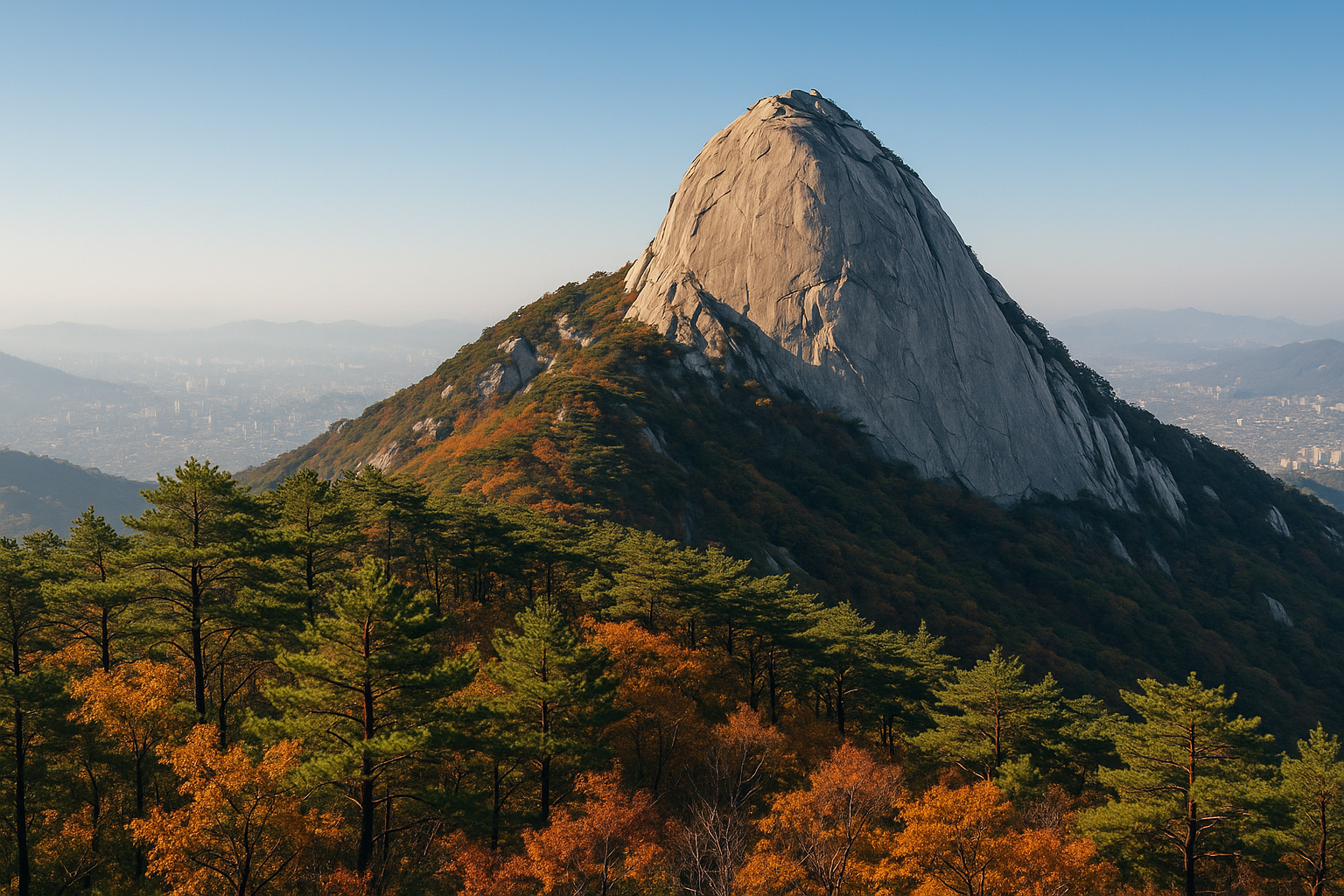
Bukhansan National Park sits at the northern edge of Seoul, close enough that you can be standing at a trailhead less than an hour after leaving your hotel. That accessibility is exactly why it catches visitors out. Most people treat Bukhansan hiking as a city park with a hill in it, and instead find a 76.922 km² national park with graded trails, a daily entry cutoff, and — on one specific route — a reservation system that turns walk-up hikers away at the gate.
This guide covers what the Korea National Park Service actually publishes about Bukhansan hiking: course distances and official walking times, the park’s operating hours, its difficulty grading, and the reservation rules on Uiryeong-gil, the one trail where showing up unprepared costs you the day. Where the official pages contradict each other — and they currently do — this guide says so rather than picking the version that reads better.
Quick Answer: What Bukhansan Hiking Requires
🎟️ Book Your Bukhansan Hiking Experience
Skip the queues and language barriers. Compare verified tours, tickets, and rentals for Bukhansan Hiking on Klook — instant mobile vouchers, English support, free cancellation on most activities.
For most trails in the park, nothing. You walk to a trailhead and start. The two things that catch people out are:
Everything else on this page is detail on those two points plus the course facts you need to pick a route that fits your day.
The One Bukhansan Trail You Have to Reserve: Uiryeong-gil
Uiryeong-gil is the low pass connecting Ui-dong in Seoul’s Gangbuk-gu with Gyohyeon-ri in Yangju, Gyeonggi-do. It was closed to the public for decades and reopened under a controlled-access scheme, which is why it behaves differently from every other trail in the park.
What the reservation rule says
The Korea National Park Service reservation service publishes these terms for the Uiryeong-gil trail:
- Reservation required on weekends and public holidays. Weekday entry is walk-up, under the rules applying from April 2026.
- Daily quota: 1,190 people.
- Access hours: 09:00–16:00.
- Entry cutoff: 16:00 from March through November, 15:00 from December through February. Arrive after the cutoff and you are not admitted, even though the trail is technically still open.
- Two trailheads, and you can start from either: Uiryeong Trail Information Center (우이령탐방지원센터) on the Seoul side in Gangbuk-gu, and Gyohyeon Trail Information Center (교현탐방지원센터) on the Gyeonggi side in Yangju.
- Booking channels: the national park reservation website, or the automated phone line at 1670-9202.
- Weather closures. The trail closes under severe weather advisories, and that decision is made on the day.
Book through the official reservation service at res.knps.or.kr. There is no third-party booking channel for this trail, and no reason to pay anyone for access to it.
The contradiction in the official pages — read this before you go
The park’s Dulle-gil information page for Uiryeong-gil still carries a blanket instruction that advance reservation is required, phrased without any weekday exception, and adds that ID must be carried. The reservation service’s own terms describe the weekend-and-holiday rule with weekday walk-up entry from April 2026.
These two official pages disagree. The reservation service is the system that actually admits or refuses you, so its terms are the operative ones — but the safe play is to book regardless of which day you are going. A reservation on a weekday costs you nothing if it turns out you did not need it, and carrying photo ID is trivial insurance against a checkpoint applying the stricter reading.
If you want to confirm on the day, the trail office numbers published for Uiryeong-gil are 031-855-6559 and 02-998-8365. The park’s main office line is 02-909-0497.
Course facts
The Uiryeong-gil route runs 6.8 km between Ui-dong and Gyohyeon-ri, with an official walking time of about 3 hours 30 minutes and a difficulty grade of moderate. That is a point-to-point route, not a loop, so plan how you are getting back from whichever end you finish at — the two trailheads are in different administrative regions and are not a short hop apart.
No-show penalties are real
Reserved slots on this trail are enforced. A no-show draws a one-month restriction on making further reservations; a second no-show draws three months. The record clears after one year without another no-show. If your plans change, cancel — it takes a minute and it frees a slot on a capped trail.
Baegundae: The Classic Bukhansan Hiking Route
If you want the summit rather than the pass, the standard approach is from Bukhansanseong Trail Information Center, running through Daeseomun and Borisa to Baegundae, the park’s high point.
Published course facts: 3.4 km, about 2 hours 40 minutes, difficulty grade moderate.
Note what that ratio tells you. Uiryeong-gil covers 6.8 km in 3.5 hours; Baegundae covers half that distance in 2 hours 40 minutes. The Baegundae route is short and steep, with hand-cable sections near the top. “Moderate” in the park’s grading is not a promise of an easy walk — it is a relative grade inside a system that runs all the way to “very difficult.”
Neither of these routes needs a reservation in the way Uiryeong-gil does, but both sit inside the park’s entry-time control, and that is the next thing to understand.
Park Hours and the Entry Cutoff
Korea’s national parks operate a designated-entry-time system (입산시간지정제) that sets the latest hour you may start a given trail, separately from when the trail closes. The point is to prevent people summiting late and descending in the dark.
For Uiryeong-gil specifically, access runs 09:00–16:00, with entry stopping at 16:00 in March–November and 15:00 in December–February. Other trailheads publish their own cutoffs, which vary by route and season, so check the specific trail rather than assuming a single park-wide time.
Practical consequence: Bukhansan is a morning activity. A 09:00 start gives you the full window on any route in the park. A 14:00 start gives you a good chance of being turned around at a checkpoint.
How Hard Is It? Reading the Park’s Difficulty Grades
The Korea National Park Service grades trails across five levels, from very easy to very difficult. Both routes described above sit in the middle grade. Two things follow from that:
- The grade is relative to national park trails, not to city walking. A moderate-grade Korean mountain trail typically means sustained stone-step climbing.
- Distance is a poor proxy for effort here. Use the published walking time instead. When the park says 2 hours 40 minutes for 3.4 km, it is telling you about gradient.
If you are building a first Korean mountain day and want something gentler in feel, a coastal or lowland trail network is a different proposition entirely — our Jeju Olle Trail hiking guide covers a route system designed around walking rather than climbing.
What This Means for Planning Your Day
A realistic Bukhansan hiking day from central Seoul looks like this:
- Leave early. You want to be at the trailhead near opening, not near the cutoff.
- Pick one route, not two. The park is large and the trailheads are genuinely far apart — Bukhansanseong and Uiryeong are not interchangeable starting points.
- Check the weather advisory before you commit, especially for Uiryeong-gil, which closes under severe weather warnings.
- Bring water and food up with you. Plan on carrying what you need rather than counting on finding it on the trail.
- Reserve if there is any chance you need to, given the conflicting guidance described above.
Where Bukhansan Fits in a Seoul Trip
Bukhansan hiking is the one activity where Seoul stops being a city without you having to leave it. That makes it a natural half-day anchor rather than a full expedition.
If mountains are the point of your trip rather than a side quest, Seoraksan as a day trip from Seoul is the bigger commitment and the bigger payoff, particularly in autumn. For a slower version of the same instinct — mountains, quiet, early mornings — a temple stay puts you inside the same landscape with a reservation system that is far more forgiving than a capped trail.
And if you want the contrast rather than the escape, Bukchon Hanok Village sits between the palaces and the northern hills, which is about as close as central Seoul gets to the mountain edge.
FAQ
Do I need a reservation for Bukhansan hiking?
Not for the park generally. Uiryeong-gil is the exception: reservations apply on weekends and holidays under the rules from April 2026, with a daily cap of 1,190 people. Other trails are walk-up, subject to entry-time limits.
How long does Uiryeong-gil take?
The park publishes 6.8 km and about 3 hours 30 minutes, graded moderate, between Ui-dong and Gyohyeon-ri.
Can I still start a hike in the afternoon?
Depends on the trail and season. For Uiryeong-gil, entry stops at 16:00 from March to November and 15:00 from December to February. Other trailheads set their own cutoffs — check the specific route before you travel out.
What happens if I book and do not show up?
A no-show restricts you from making reservations for one month; a second no-show extends that to three months. The record clears after one year without a further no-show.
Is Baegundae harder than Uiryeong-gil?
Both carry the same moderate grade, but Baegundae’s published time of 2 hours 40 minutes for 3.4 km implies significantly steeper ground than Uiryeong-gil’s 6.8 km in 3 hours 30 minutes.
Where do I confirm the current rules?
The Korea National Park Service is the only primary source worth trusting on hours, quotas, and closures — its reservation service at res.knps.or.kr and the park portal at knps.or.kr. Rules on this trail have changed before and can change again.
Disclosure: SeoulScope is a participant in the Klook and Agoda affiliate programs and the Amazon Associates Program. As an Amazon Associate we earn from qualifying purchases. We may earn a small commission when you book or buy through links in this post, at no extra cost to you. We only recommend experiences and products we believe will genuinely help your trip.
1 thought on “Bukhansan Hiking from Seoul: Trail Times, Park Hours, and the One Course You Have to Reserve”