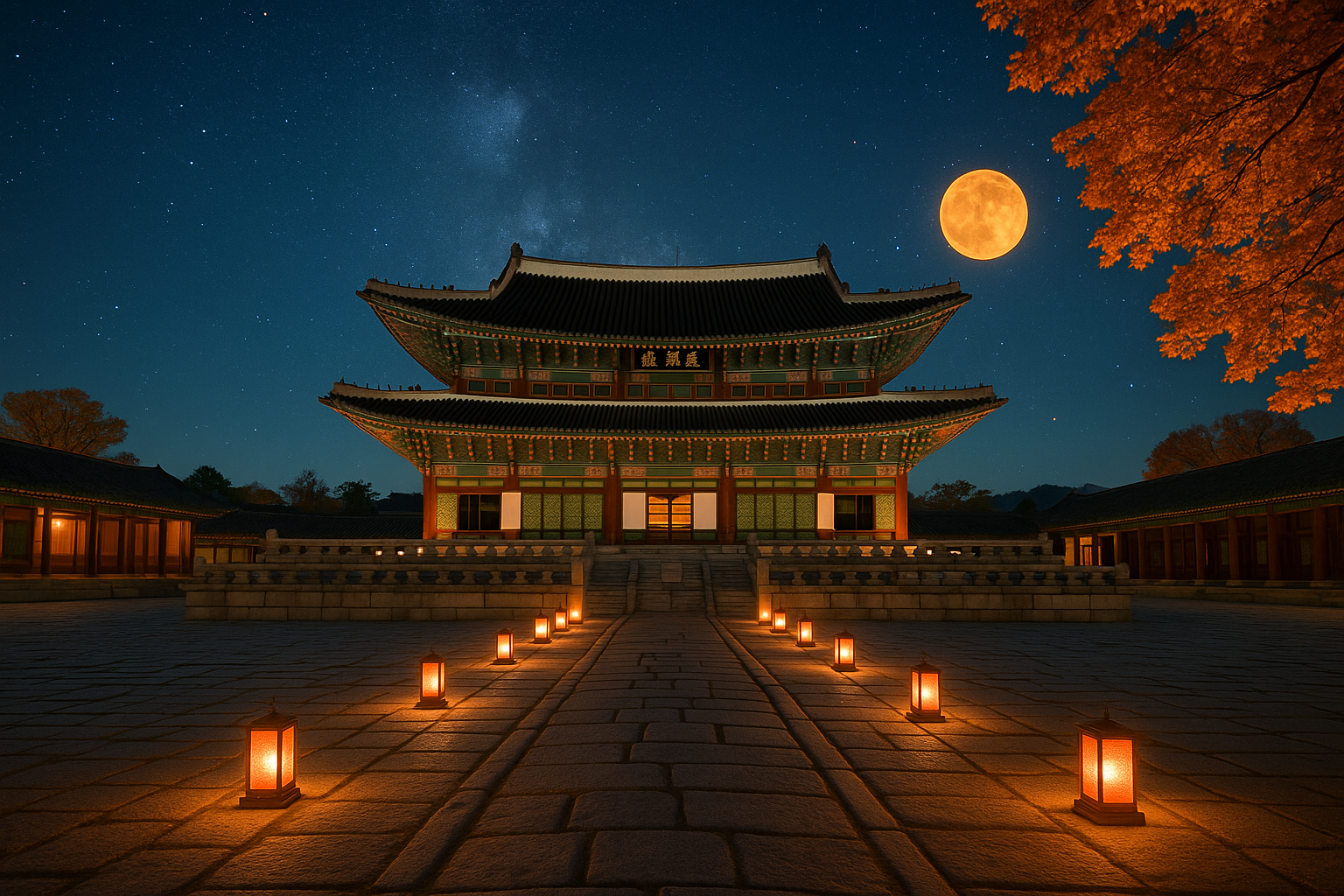
Most Gyeongbokgung programs work the way visitors expect. You show up, you pay at the gate or you buy online, you walk in. The Gyeongbokgung Starlight Tour — Byeolbit Yahaeng (별빛야행) — does not work that way, and that single difference is why travellers keep arriving in Seoul with it on their list and no ticket in hand.
This guide separates what the official sources publish from what they do not. The Korea Tourism Organization’s festival listing and the Korea Heritage Service’s own notice board confirm a specific set of facts: the season dates, the price, the organizers, and the fact that tickets are allocated by lottery rather than sold on demand. A great deal of what circulates elsewhere — session times, group sizes, what exactly is served — is not stated on those official pages. Where that is the case, this guide says so instead of filling the gap with a confident-sounding number.
Quick Answer: Can You Book the Gyeongbokgung Starlight Tour Right Now?
🎟️ Book Your Gyeongbokgung Starlight Tour Experience
Skip the queues and language barriers. Compare verified tours, tickets, and rentals for Gyeongbokgung Starlight Tour on Klook — instant mobile vouchers, English support, free cancellation on most activities.
Not in the ordinary sense. Three things are worth knowing before you plan around it.
That third point is the one that catches people. By the time most visitors research the Gyeongbokgung Starlight Tour, the priority allocation round for the season has already been drawn.
Who Actually Runs It
The program is organized by the Royal Palaces and Tombs Center of the Korea Heritage Service together with the Korea Heritage Service Promotion Institute. This matters for a practical reason: it tells you which website is authoritative when sources disagree.
For anything involving ticketing rules, season dates, or programming at Gyeongbokgung, Changdeokgung, Changgyeonggung, Deoksugung, or Jongmyo, the operating body is the same national heritage authority — not the city, not a tour operator, and not the aggregator sites that rank well for these searches. The official heritage portal is at khs.go.kr, and the tourism listing used for the confirmed facts above is the Korea Tourism Organization festival page.
Why a Lottery Instead of a Ticket Counter
Gyeongbokgung is large, but this program does not use the whole palace and does not run at scale. It is a guided evening walk through a subset of the grounds after normal closing, with staff in traditional dress receiving participants past the main entrance. A format like that has a hard ceiling on numbers in a way that a daytime admission ticket does not.
When demand exceeds that ceiling by a wide margin, selling tickets first-come produces a queue that collapses the instant booking opens. A lottery spreads the allocation and removes the advantage of simply being awake at the right minute. It is the same reasoning behind the reservation systems on other capacity-limited Korean heritage experiences, and it produces the same traveller-facing problem: you cannot convert a decision into a ticket on the day you make the decision.
Confirmed Schedule, Capacity, and What Is Still Unstated
The Korea Heritage Agency publishes the operating detail on its own event page, and it is more specific than most secondary write-ups suggest. The autumn 2026 season runs Wednesday through Sunday with two departures a night, at 18:20 and 19:30, each running roughly 110 minutes. Capacity is the reason the lottery exists: 38 places per session, 76 per night. The program pauses entirely from 30 September to 4 October, and the final block of dates, 21 to 24 October, is reserved for foreign visitors.
Two things genuinely are not published, and it is worth being precise about which:
- The maximum number of tickets one winning applicant may buy. Secondary sources circulate a figure. The official event page does not carry it.
- An itemized description of what the 60,000 KRW covers. The program is described as a guided night route with a court-dining component, but the fee is not broken down into parts.
Note what the 21–24 October block does and does not mean. It is a set of dates allocated to foreign visitors, which is not the same as a guarantee of English-language guiding on every other date. If language access is the deciding factor for you, confirm it through the booking channel rather than inferring it from the foreign-visitor dates.
The ticketing product page itself is rendered dynamically and does not expose any of this to a plain page fetch, which is why the numbers tend to propagate through blog posts rather than from the source — and why they drift. Times quoted ten minutes off the official ones are common. Our Seoul palace night programs guide sets this program beside the other two Gyeongbokgung night options; this page stays with the heritage agency’s own published detail.
The practical consequence: check a session time against the heritage agency’s event page rather than a travel blog before you build an evening around it. With 38 places and a fixed start, arriving at the wrong hour for this program is not recoverable.
How It Differs From Gyeongbokgung at Night Generally
Three separate things at Gyeongbokgung get collapsed into “the palace at night,” and they are priced and booked completely differently.
Night opening (야간개장) is the ordinary evening admission season. It is inexpensive, it is not a guided program, and you move through the grounds on your own. If what you want is the palace lit after dark with no lottery involved, this is the one you actually want — the details are in our Gyeongbokgung night tour guide.
Special-access viewings open a structure that is normally closed or fenced. The pavilion on the water at Gyeongbokgung is the clearest example: it requires its own separate reservation and has nothing to do with the Starlight Tour. See our Gyeonghoeru Pavilion tour and tickets guide.
The Starlight Tour is the premium seasonal program described here — lottery-allocated, 60,000 KRW, and limited to a defined autumn window.
Confusing the first with the third is the single most common planning error. They are not tiers of the same ticket.
If You Do Not Get a Ticket
The realistic case for most visitors reading this mid-season is that they will not get in this year. That is worth planning for rather than treating as a failure.
The equivalent program at Changdeokgung. Changdeokgung runs its own capacity-limited evening program with the same booking character — limited numbers, advance reservation, and a season rather than year-round operation. Our Changdeokgung Moonlight Tour guide covers how that one allocates places.
The ceremonial programming that costs nothing. The guard changing ceremony at Gyeongbokgung’s main gate runs on a published daily schedule and requires no ticket at all. For a first-time visitor it delivers more visible pageantry per minute than almost anything else at the palace, and our guard changing ceremony guide has the timing and the viewing positions.
The hanbok route. Wearing hanbok changes the economics of palace visiting in Korea in a way most visitors do not expect, and the rental shops cluster immediately around Gyeongbokgung. Our hanbok rental guide for Gyeongbokgung covers how the rental process works near the palace. Whether any hanbok-related benefit applies to a paid special program like the Starlight Tour is not something the official listing addresses — do not assume it carries over from general admission.
Planning Around the Season Window
A 2 September to 24 October window has a specific implication for anyone building an itinerary: the program does not exist for most of the year. If your trip falls in November, or in June, the Gyeongbokgung Starlight Tour is simply not an option regardless of budget or persistence, and the evening palace experience you are picturing has to come from the night opening season or from Changdeokgung’s program instead.
For travellers who can choose their dates, the late-September and October window has a second advantage that has nothing to do with this program: it is when the palace grounds and the surrounding area are at their most photogenic, and when evening temperatures are comfortable enough that a long outdoor walk after dark is pleasant rather than endured.
Frequently Asked Questions
Is the Gyeongbokgung Starlight Tour worth 60,000 KRW?
That depends entirely on what you are comparing it to. Against general palace night admission at 3,000 KRW it is expensive by a wide multiple. Against a 110-minute guided evening inside a major heritage site after closing hours, with 38 people rather than a crowd, it is priced in line with comparable experiences. What the official page does not give you is an itemized breakdown, so judge it as a whole experience rather than by summing parts.
Can I buy a leftover ticket at the gate?
The program is allocated in advance through a lottery-based booking product. Walk-up purchase is not how the system is designed to work, and a capacity-limited evening program is precisely the case where a gate purchase should not be assumed.
Are there English-language sessions?
There is a foreign-visitor block: 21 to 24 October 2026, the last four dates of the season. What the official page does not spell out is the language handling on the rest of the calendar, so if you need English guiding on a specific earlier date, verify it through the booking channel rather than assuming it.
What is the difference between this and the palace night opening?
Night opening is ordinary self-guided evening admission at a low price. The Starlight Tour is a separate premium guided program with lottery allocation. They share a palace and a time of day and nothing else.
When does the next season open?
The heritage authority runs this program seasonally rather than continuously. Watch the organizer’s notice board for the following season’s lottery announcement; the 2026 priority lottery result was posted on 24 August 2026, which gives a rough sense of how far ahead the allocation cycle runs relative to a September start.
The Honest Summary
The Gyeongbokgung Starlight Tour is a genuinely limited thing, and the limits are the story. Confirmed on official channels: a 2 September to 24 October 2026 season running Wednesday to Sunday, departures at 18:20 and 19:30, about 110 minutes, 38 places per session and 76 a night, 60,000 KRW per person, no operation from 30 September to 4 October, foreign-visitor dates on 21–24 October, run by the national heritage authority and allocated by lottery with the priority round drawn in August. Still unstated: the per-winner ticket limit and an itemized breakdown of the fee.
If you are in Seoul during the window and you have a ticket, you have something most visitors will not get. If you do not, the palace at night is still available to you at a fraction of the price through the night opening season, and the guard changing ceremony costs nothing at all.
Disclosure: SeoulScope is a participant in the Klook and Agoda affiliate programs and the Amazon Associates Program. As an Amazon Associate we earn from qualifying purchases. We may earn a small commission when you book or buy through links in this post, at no extra cost to you. We only recommend experiences and products we believe will genuinely help your trip.
1 thought on “Gyeongbokgung Starlight Tour 2026: Dates, Price, and the Lottery Rule”