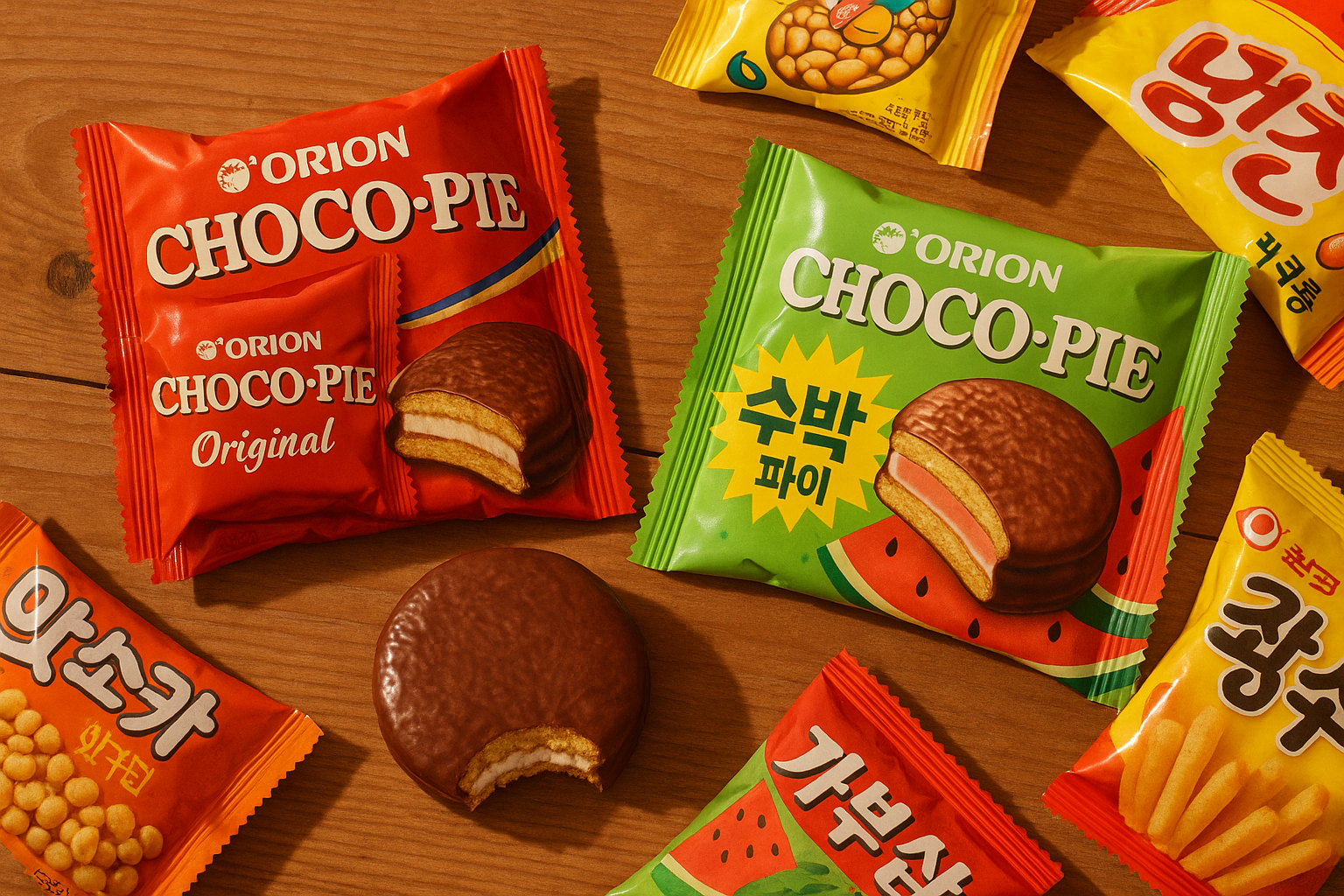
Two soft cocoa cake discs, a marshmallow layer between them, a thin chocolate shell around the whole thing, wrapped one to a package. That is the choco pie — a snack that is technically a supermarket cake and culturally something closer to a national institution in South Korea.
This guide covers what is actually inside it, how Orion and Lotte differ, which flavors are worth buying, how it compares to a Moon Pie, and what to check before you order a box online.
—
Quick Answer: What Is a Choco Pie?
It is a round, individually wrapped snack cake: two layers of soft chocolate-flavored sponge sandwiching marshmallow cream, enrobed in a thin chocolate coating. Each one is roughly the size of a coaster and eaten in three or four bites.
Orion launched the Korean version in 1974, and Lotte has sold a competing version for decades since. Both are stocked in essentially every convenience store and supermarket in the country, and both export widely — which is why the red and blue boxes turn up in Asian grocery aisles worldwide.
The short version: Korea’s marshmallow sandwich cake, softer and less sugary than its American cousins, sold by two rival brands and loaded with nostalgic weight for anyone who grew up there.
—
What Does a Choco Pie Taste Like?
Softer than you expect, and less sweet than the description suggests.
- Cake, not biscuit. The outer layers are sponge — pillowy and slightly dry on their own, which is what the marshmallow is there to fix.
- Mild chocolate. The shell is thin and more cocoa-flavored than rich. Nobody buys this for the chocolate.
- The marshmallow does the work. It is light and stretchy rather than dense and sticky. Warm it slightly and it turns molten.
- Overall: gentle. It is a snack you can eat two of without feeling punished, which is the entire commercial logic of the product.
—
Orion vs. Lotte Choco Pie: Which Is the Original?
Orion is the original. Orion launched the choco pie in Korea in 1974, and Lotte introduced its own version under the same name in 1978. Both still sit on the same shelf today, usually side by side — and the difference you will actually taste is sweetness, not age.
| Orion | Lotte | |
|---|---|---|
| Introduced | 1974 | 1978 |
| Box color | Blue | Red |
| Marshmallow | Slightly denser | Slightly softer, sweeter |
| Flavor lineup | Broader, frequent limited editions | Narrower, steadier |
| Signature name | Jeong (情, “affection”) branding | Standard brand naming |
Orion is the market leader and the version most people mean by default. Lotte’s runs a touch sweeter. The gap is small enough that preference usually comes down to whichever one you ate first — buy one of each and settle it yourself.
Orion’s Jeong branding is worth knowing about, because it explains the tone of the advertising: the character 情 means affection or attachment, and the campaigns lean on the snack as something you hand to someone rather than something you buy for yourself.
—
Why It Matters Culturally
Two threads explain the outsized place this snack holds.
The first is the workplace. Through the 1980s and 1990s it was a standard small reward — handed out on factory floors, in barracks, at schools. For a generation of Koreans it is shorthand for a minor kindness, which is exactly the association the Jeong campaigns were built on.
The second is the inter-Korean story, which is widely reported: South Korean managers at the Kaesong Industrial Complex gave the pies to North Korean workers, the snacks became prized enough to circulate as informal currency, and they were reportedly restricted afterward. It is a real footnote in how a supermarket cake ended up in foreign-policy coverage.
If you are visiting and want to see how food-related seasonal events line up, Seoul’s official tourism site is the reliable source for what is running while you are in the city.
—
Choco Pie vs. Moon Pie vs. Wagon Wheel
The format is not Korean in origin — the American Moon Pie predates it by decades, and the concept was adapted rather than invented.
What changed in the adaptation: the Korean version is smaller, the sponge is softer and more cake-like than the graham-cracker layers of a Moon Pie, the chocolate shell is thinner, and the whole thing is noticeably less sweet. The British Wagon Wheel is closer in size but usually carries a jam layer the Korean one does not.
If you find American marshmallow cakes too sweet or too dense, this is the version that fixes both complaints.
—
Flavors Worth Buying
Original is the baseline and the right first purchase. Beyond it, the lineup rotates constantly, especially from Orion.
- Original — cocoa sponge, plain marshmallow. The benchmark; buy this before anything else.
- Banana — banana-flavored marshmallow. The most established non-original flavor and the one most likely to be stocked outside Korea.
- Strawberry — lighter and tarter, aimed at a younger shelf.
- Green tea — matcha in the sponge and coating. Less sweet, and the pick for anyone who finds the original too gentle.
- Dark — a more intense cocoa shell over the same construction.
- Seasonal and collaboration editions — sweet potato, tiramisu, and similar appear and vanish on a months-long cycle.
The limited editions are genuinely fun in Korea and genuinely hard to source abroad. Do not build a shopping plan around a specific one.
—
How to Buy Choco Pie
In Korea
Every convenience store carries the original in singles and small packs; large marts carry full boxes, gift sets, and whatever seasonal flavor is current. Buy singles at a convenience store to taste, then buy boxes at a mart — the per-unit gap is significant. For how the convenience-store snack shelf is organized more broadly, see our Korean convenience store food guide.
Around Chuseok and Seollal, both brands sell holiday gift sets in tins and decorated boxes. Those are the best souvenir version of this snack by a wide margin, and they exist only seasonally.
Outside Korea
Korean and pan-Asian grocers stock the original almost universally, with banana as the usual second option. Online listings carry more variety but require reading carefully:
—
How Koreans Actually Eat It
- Warm it. Ten seconds in a microwave turns the marshmallow molten and the shell glossy. This is the single upgrade worth knowing.
- Freeze it. The opposite approach, common in summer: the marshmallow goes chewy and firm, closer to an ice-cream sandwich.
- With coffee or barley tea. The sponge is dry by design and wants something to drink alongside it.
- As a small gift. A box handed to a colleague or a host family reads exactly the way the Jeong branding intends — casual, warm, no ceremony.
If you are assembling a broader haul, our best Korean snacks roundup covers what else deserves suitcase space, pepero covers the other icon of the same aisle, and the Korean traditional snacks guide covers the older confectionery tradition running alongside all of it.
—
Is It Worth Buying Outside Korea?
Yes, with one caveat: what you get abroad is the original, and occasionally banana. The rotating flavors that make the aisle interesting in Seoul almost never cross over, so an imported box is the baseline product rather than the full experience.
That baseline is still worth having. A choco pie keeps well in a desk drawer, needs no refrigeration, survives being handed to a child, and costs little per piece when bought by the case. As a household default snack it is hard to beat.
Where it disappoints is as a gift outside Korea, where it lands as a generic import rather than the loaded, sentimental object it is at home. If gifting is the point, wait for a holiday tin — those are the version that carries the meaning.
—
FAQ
Who makes it?
Orion introduced the Korean version in 1974 and remains the market leader; Lotte has sold a competing version since the late 1970s. Several other Asian manufacturers make similar products.
Is it the same as a Moon Pie?
Same idea, different execution. The American original is larger, denser, sweeter, and built on graham-cracker layers. The Korean one uses soft sponge and a thinner chocolate shell.
What does Jeong mean on the box?
情 — affection, attachment, the bond built by shared time. Orion adopted it as the product’s branding, which is why the packaging and advertising lean sentimental.
Which flavor should I start with?
Original. Banana second, since it is the one most likely to be available wherever you shop.
Is it vegetarian, vegan, or gluten-free?
The sponge is wheat-based, so it is not gluten-free. Marshmallow typically uses gelatin and the recipe usually includes dairy, so standard versions are neither vegan nor reliably vegetarian. Formulations differ by market — read the label on the box in your hand.
Does it travel well?
Reasonably. The sponge is resilient and the wrapper is sealed, but heat softens the coating and long storage dries the cake. Eat within a few weeks of buying.
How should I store it?
Sealed, at room temperature, away from heat. The fridge extends life but firms the marshmallow; the freezer is a legitimate way to eat it, not a way to store it.
—
Building a Korean snack shelf? Start with this and pepero, then work outward through the Korean food guide.
🛒 Buy Choco Pie Online
Can’t get to a Korean convenience store? Get Choco Pie shipped to your door on Amazon — compare top-rated imports, check real reviews, and stock up on the real thing without leaving home.
Disclosure: SeoulScope is a participant in the Klook and Agoda affiliate programs and the Amazon Associates Program. As an Amazon Associate we earn from qualifying purchases. We may earn a small commission when you book or buy through links in this post, at no extra cost to you. We only recommend experiences and products we believe will genuinely help your trip.
1 thought on “Choco Pie: Korea’s Marshmallow Snack Cake, Explained”