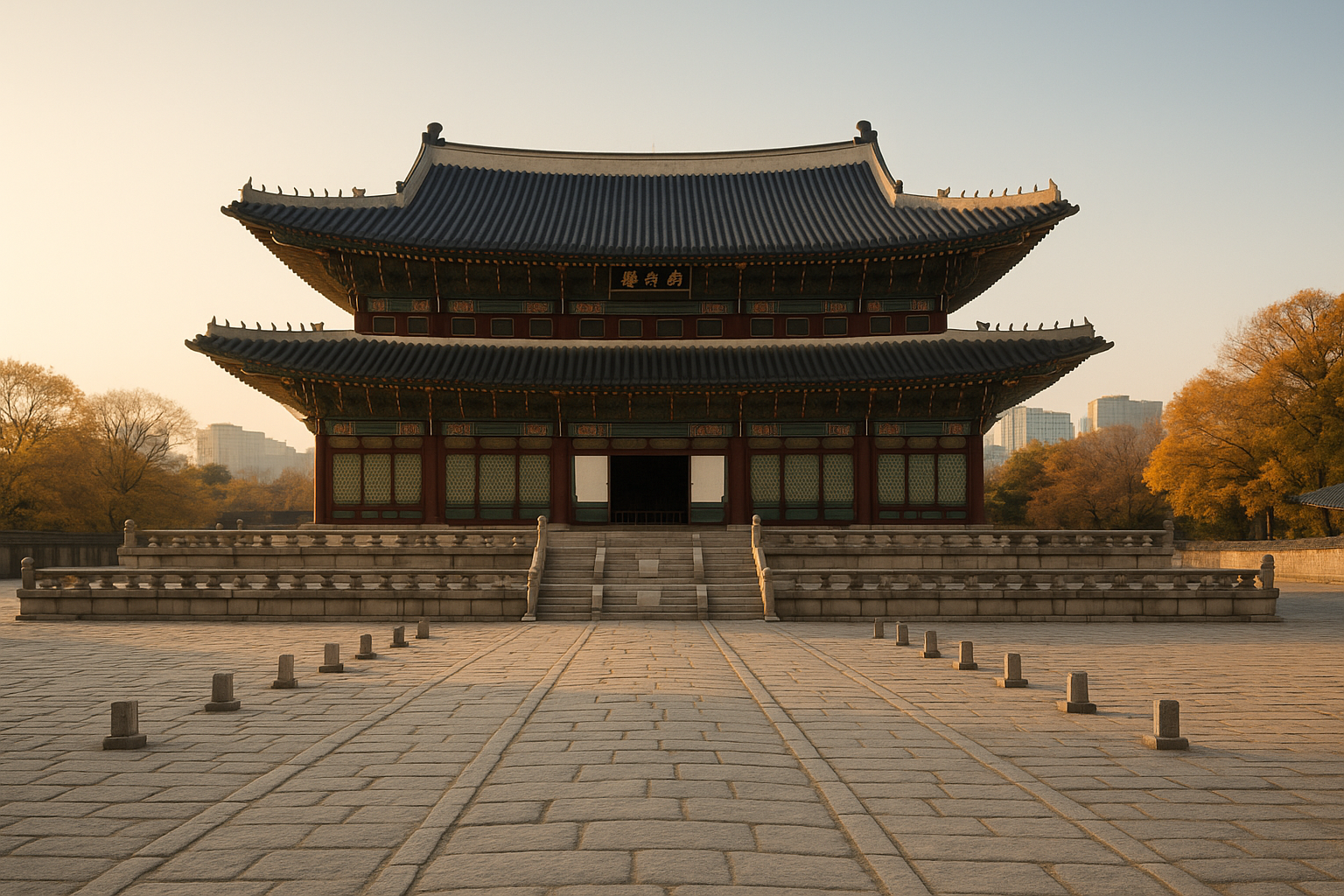
Gyeonghuigung is the one Seoul palace you can walk into for free, any day but Monday. The catch is the schedule: the free guided tours that make the site legible run on only three days of the week — Friday, Saturday and Sunday — and there are none from Monday through Thursday. Turn up midweek and you get a gate, a bridge, a main hall, and a great deal of open ground with nothing to explain it.
Buy the ₩6,000 Integrated Palace Ticket in Seoul and you will assume, reasonably, that it covers the palaces. It does not cover all of them. There is a fifth one, fifteen minutes’ walk from Gyeongbokgung, that the pass has never included and never will.
That is not a gap in the pass. It is a clue about what the place actually is.
Gyeonghuigung Palace costs nothing to enter. There is no ticket to buy, no booking window that opens at 10:00 a week out, no lottery, no session capacity. It is run by the Seoul Metropolitan Government rather than the national heritage authority that operates the other four palaces, which is exactly why it sits outside their ticketing system — and why the ₩6,000 pass, correctly, does not mention it.
The catch is a different one, and almost nobody writing about this palace in English mentions it: the free guided tours run on fixed weekend and Friday afternoon slots only, from two separate volunteer organisations, and if you turn up on a Tuesday you get a beautiful, empty, entirely unexplained set of buildings.
This guide covers the gyeonghuigung palace tour schedule that decides whether your visit is twenty minutes or two hours, plus the hours and closures and why the palace is not on the integrated ticket.
Gyeonghuigung Palace at a Glance
🎟️ Book Your Seoul Experience
Skip the queues and language barriers. Compare verified tours, tickets, and rentals for Seoul on Klook — instant mobile vouchers, English support, free cancellation on most activities.
| Admission | Free |
| Hours | 09:00–18:00 daily |
| Closed | Mondays, and January 1 |
| Integrated Palace Ticket | Does not apply — the ₩6,000 pass covers the four palaces and Jongmyo |
| Guided tours (Fri) | 14:00, 15:00 |
| Guided tours (Sat) | 13:00, 14:00, 15:00 |
| Guided tours (Sun) | 13:00, 13:30, 14:00, 14:30, 15:00 |
| Address | 45 Saemunan-ro, Jongno-gu, Seoul (03177) |
| Nearest station | Seodaemun Station, Line 5, Exit 4 — about 639 m |
| Also close | Gwanghwamun Station, Line 5, Exit 1 — about 875 m |
| Parking | Available, including accessible parking |
| Phone | +82-2-724-0274 |
| Advance booking | Not required |
Two rows are doing the work here. Admission is free, so there is nothing to plan around on the ticketing side at all. And the guided tours run on five specific days-and-times a week, which is the only genuine scheduling constraint the site has.
The Guided Tours Are the Real Booking Rule
Here is the constraint that actually shapes a visit, and the reason a Wednesday trip and a Sunday trip are different experiences.
Free guided tours run at Gyeonghuigung on a fixed weekly schedule, delivered by two separate volunteer heritage organisations:
- Friday: 14:00 and 15:00
- Saturday: 13:00, 14:00 and 15:00 — run by The Rediscovery of Korea (Woorigunggwol Guardians)
- Sunday: 13:00, 13:30, 14:00, 14:30 and 15:00 — run by Our Cultural Breath (Palace Guides)
Five slots on Sunday, three on Saturday, two on Friday, and nothing Monday through Thursday. That is the whole scheduling problem at this site.
It matters because Gyeonghuigung is the one Seoul palace where the buildings do not explain themselves. Gyeongbokgung has scale, Changdeokgung has its garden, Deoksugung has the collision of Korean and Western architecture in one courtyard. Gyeonghuigung has a gate, a bridge, a main hall, and a great deal of open ground where roughly a hundred buildings used to be. Without someone telling you what is missing, the site reads as small. With a guide, it reads as the record of a demolition.
Tour languages, operators and times are the sort of detail that shifts season to season, and these are volunteer-run programmes, so confirm the current schedule on the official listing in the week before you go rather than trusting any number you read anywhere, including here. But plan the visit around a Friday, Saturday or Sunday afternoon if you have the choice.
Free Admission Is the Whole Point
Start with what makes this palace different from every other royal site in the city.
Standard admission at Gyeongbokgung, Changdeokgung, Changgyeonggung and Deoksugung ranges from ₩1,000 to ₩3,000, with the Changdeokgung Secret Garden charging separately on top and running its own limited-slot booking. Every one of those sites has a ticket window, an opening-hours-versus-last-entry distinction, and a queue at some point in the day.
Gyeonghuigung Palace has none of that. Entry is free, listed as “Free admission” by the city’s own tourism authority, and there is no reservation system for general access. You walk in.
That single fact reshapes what the place is good for. Because there is no sunk cost, there is no pressure to extract two hours of value from it. Gyeonghuigung is the palace you can give twenty-five minutes to on the way somewhere else, and it is the only one where that is a sensible way to spend your time rather than a waste of a ticket.
Closed Mondays. This matters more than it looks, because Changdeokgung, Changgyeonggung and Deoksugung also close on Mondays. A Monday in the royal quarter removes almost everything at once, and the free option does not rescue you — Gyeonghuigung is shut too. If your itinerary has a Monday in it, sequence around that before anything else; an indoor and rainy-day plan is the standard substitute and holds up well.
The other closure is January 1, which catches New Year visitors who assume a free site has nothing to close for.
Why Gyeonghuigung Palace Isn’t on the ₩6,000 Integrated Ticket
This is the part that confuses people standing at a ticket window, and the answer is administrative rather than mysterious.
The Integrated Palace Ticket costs ₩6,000, stays valid for six months from purchase, and its stated scope is the four palaces plus Jongmyo — with Changdeokgung’s Huwon, the Secret Garden, explicitly excluded. That is the national heritage authority’s product, sold at the ticket offices of those five sites, and its official fee schedule lists exactly which places it covers.
Gyeonghuigung appears nowhere on that schedule. Not in the paid rows, and not in the free-entry rows either, where sites like Sajikdan, Chilgung and Sungnyemun are listed. The reason is that the palace grounds are managed by the Seoul Metropolitan Government — the Seoul Museum of History sits on the site and lists the palace among its branches — rather than by the national body that runs the other four.
So the practical rule is simple, and it works in your favour:
- The ₩6,000 pass is worth buying if you will see three or more of the four palaces plus Jongmyo.
- Whether you buy it or not makes no difference at all to Gyeonghuigung.
- Adding this palace to a day costs you nothing, so it is never the marginal decision.
If you want the full palace count in Seoul, you do it for the price of four tickets, not five.
What Is Actually Standing
Set expectations honestly before you go: this is a partial reconstruction, not a surviving complex, and the difference is the interesting part.
At its height the palace held around 100 buildings and served as a secondary residence for some ten Joseon kings. It was called Seogwol, the “palace of the west,” because it stood west of Gyeongbokgung. Construction was ordered by King Gwanghae and completed in 1623; it was originally named Gyeongdeokgung and renamed Gyeonghuigung in 1760.
Then it was dismantled, in stages, over a century and a half:
- Most of the halls burned in a fire in 1829.
- After the Japanese occupation began, the remaining buildings were torn down, and the palace grounds were converted into Gyeongseong Middle School — later Seoul High School.
- The school occupied the site until it moved to Gangnam in 1987.
- Restoration of Heunghwamun Gate and Sungjeongjeon Hall was completed in November 1994, and the site reopened to the public in 2002.
So what you walk through today is a main gate, a stone bridge over the old moat, a restored throne hall, and a lot of deliberate emptiness. The Seoul Museum of History stands on the same grounds, and the city’s tourism listings note a Seoul Museum of Art annex building on the site as well.
That emptiness is the exhibit. Every other palace in Seoul shows you what a Joseon court looked like. This one shows you what happened to one.
Building a Day Around It
Three shapes work, and none of them treat this as a headline stop.
The Friday or weekend version. Arrive by 12:40, walk the grounds cold for twenty minutes so you have your own impression first, then take the 13:00 or 14:00 guided tour. Follow it with the Seoul Museum of History next door, which is on the same grounds and covers the city’s transformation from the Joseon capital to the present. Half a day, no tickets, no bookings.
The palace-hop insert. Gyeonghuigung sits about 875 m from Gwanghwamun Station and is an easy walk from the Gyeongbokgung area, which makes it the cheapest possible addition to a palace day. Do the paid palace in the morning on your integrated ticket, come here in the afternoon for free, and finish the count. If you are moving around the city on transit all day, the Climate Card usually pays for itself on this kind of itinerary.
The hanbok day. Renting hanbok gets you free entry at the ticketed palaces, which is the usual reason people do it. Here the hanbok buys you nothing on admission — it is already free — but the restored Sungjeongjeon courtyard is markedly less crowded than Gyeongbokgung’s, which is worth more than the discount if photographs are the point. The hanbok rental guide covers the shops in the palace quarter, and Bukchon Hanok Village is the usual second half of that day.
For an evening extension, note that this palace closes at 18:00 with no late opening — if you want a palace after dark, that is a night palace tour at a different site entirely.
Getting There
The palace is at 45 Saemunan-ro, Jongno-gu, Seoul (03177).
- Subway: Seodaemun Station, Line 5, Exit 4 — about 639 m. This is the closest approach.
- Also walkable: Gwanghwamun Station, Line 5, Exit 1 — about 875 m, which is the one to use if you are coming from the Gyeongbokgung side.
- Parking: available on site, including accessible parking.
- Phone: +82-2-724-0274.
The site’s own listing sits on Visit Seoul and on Visit Korea, and the integrated ticket’s scope is published by the Korea Heritage Service. Hours and tour schedules are the things most likely to change, so check before you build an afternoon around a specific slot.
Quick Answers
How much are gyeonghuigung palace tickets? There are none. Admission is free, with no reservation system for general entry.
Is it covered by the ₩6,000 integrated palace ticket? No, and it does not need to be. The pass covers the four palaces plus Jongmyo; this site is managed separately by the city and is free regardless.
What day is it closed? Mondays, and January 1. Changdeokgung, Changgyeonggung and Deoksugung also close on Mondays.
What are the opening hours? 09:00–18:00 daily.
Can I get a guided tour? Yes, free: Friday at 14:00 and 15:00, Saturday at 13:00, 14:00 and 15:00, and Sunday at 13:00, 13:30, 14:00, 14:30 and 15:00. Nothing Monday to Thursday.
How long does a visit take? Twenty to thirty minutes on your own; roughly an hour on a guided tour; half a day if you add the Seoul Museum of History on the same grounds.
Is it worth going if the other palaces are more impressive? As a standalone destination, it is the smallest of the five and it would be dishonest to say otherwise. As a free forty-minute stop between two paid sites, it is the best value in the royal quarter.
What is the nearest subway station? Seodaemun Station on Line 5, Exit 4, about 639 m away.
The visit comes down to one question you answer before leaving your accommodation: is it Friday, Saturday or Sunday? If it is, come at half past twelve and take the tour, and the empty ground in the middle of gyeonghuigung palace turns into the most interesting thing you see that day. If it is not, come anyway — it costs nothing, it takes twenty minutes, and it is the only palace in Seoul where turning up with no plan carries no penalty at all.
Disclosure: SeoulScope is a participant in the Klook and Agoda affiliate programs and the Amazon Associates Program. As an Amazon Associate we earn from qualifying purchases. We may earn a small commission when you book or buy through links in this post, at no extra cost to you. We only recommend experiences and products we believe will genuinely help your trip.
1 thought on “Gyeonghuigung Palace 2026: Free Guided Tours, Fri–Sun Only”