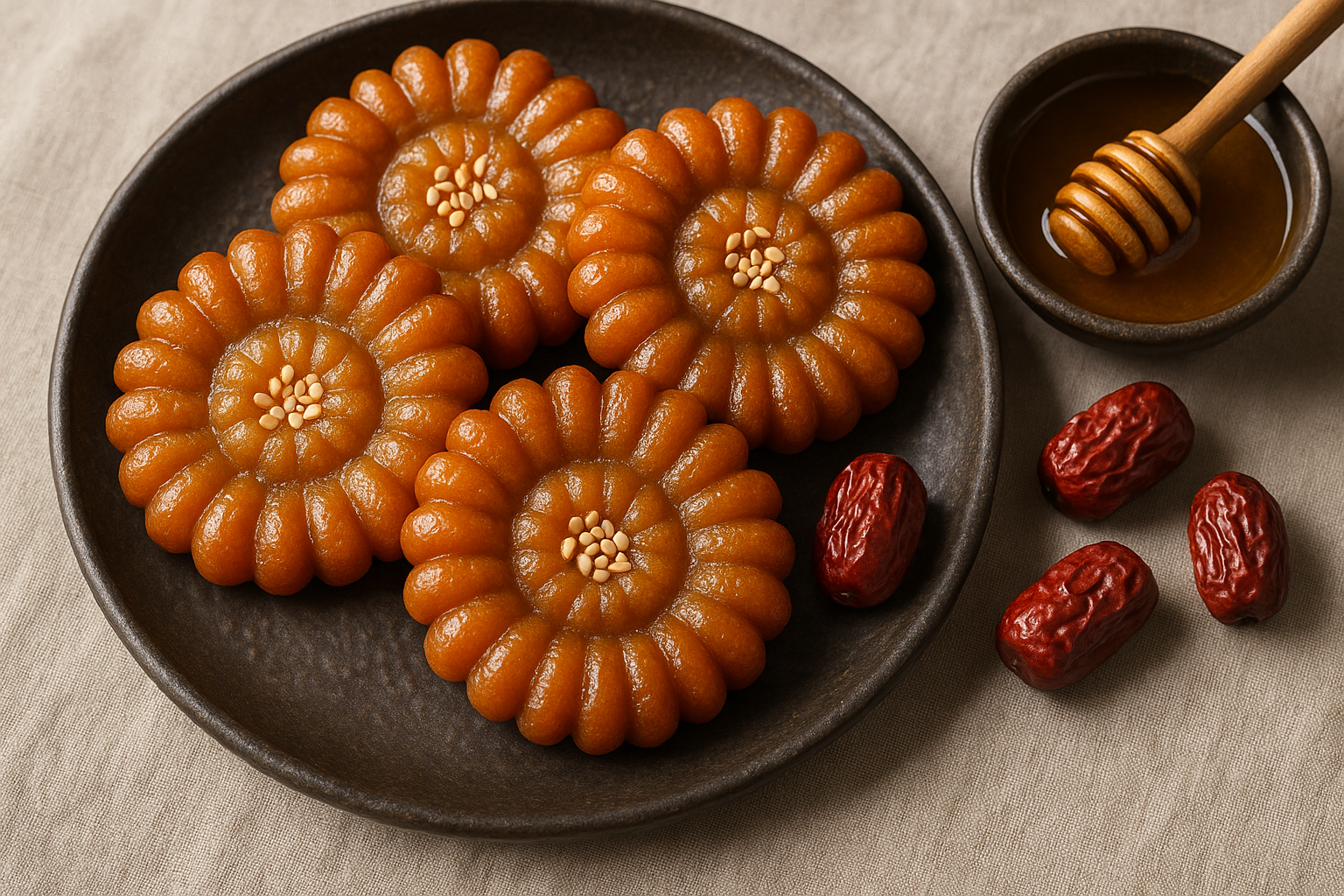
If you have seen a small, golden, flower-stamped cookie in a Korean gift box or a market stall and wondered what it was, you were almost certainly looking at yakgwa (약과). It is one of Korea’s oldest sweets, and after decades as a holiday-table item it has become something young Koreans queue for again.
This guide covers what yakgwa actually is, what it tastes like, the varieties you will run into, and how to buy it — in Korea or from abroad.
Quick answer: what is yakgwa?
Yakgwa is a deep-fried Korean confection made from a wheat-flour dough enriched with sesame oil, honey, rice wine, and ginger. The dough is pressed into a decorative mold, fried, and then steeped in syrup, which is where its dense, chewy, saturated texture comes from.
The name is literal: 약 (yak) means medicine and 과 (gwa) means confection — a nod to the honey, sesame oil, and ginger that were once considered restorative ingredients.
| Korean | 약과 |
| Family | Yumilgwa — the oil-and-honey branch of hangwa, Korean traditional confectionery |
| Core ingredients | Wheat flour, sesame oil, honey, rice wine, ginger |
| Texture | Chewy and dense, syrup-soaked rather than crisp |
| Flavor | Honey-forward, gently spiced, with a nutty sesame undertone |
| Shape | Flower or chrysanthemum, pressed from a mold |
| Best for | Tea pairing, gift boxes, souvenirs that survive a flight |
What it tastes like
The closest Western reference point is a very dense honey cake crossed with shortbread — but wetter than either. It is not a snapping, crumbly cookie; the syrup soak leaves it pliant and a little sticky at the edges.
The sweetness is deep rather than sharp, and the sesame oil pulls it back from being cloying with a nutty, almost savory undertone. Ginger sits underneath everything as a warm spice note. People expecting a dry biscuit are usually surprised by how moist it is.
It is traditionally served with tea, and the pairing is not decorative — a tart or earthy tea genuinely balances the syrup. Omija (five-flavor berry) tea, roasted barley tea, and Korean green tea all work for the same reason matcha works with Japanese wagashi.
The types of yakgwa you will see
Classic molded yakgwa
The recognizable form: pressed in a wooden or metal mold so the surface carries a raised floral or grid pattern, fried, then soaked. These are what appear in tiered ritual arrangements and in traditional gift boxes, and they are the largest of the common sizes.
Mini yakgwa
Bite-sized versions, often sold loose by weight or packed in small boxes. Because there is more surface area relative to volume, they take on more syrup — expect them to read as sweeter and stickier than the full-size ones. They are the easiest format for snacking and the most common in modern cafes.
Flavored and modern yakgwa
The current revival brought variations that would not have appeared on a ritual table: matcha and black-sesame glazes, citrus honey, nut toppings, and filled versions. Specialty bakeries in Seoul’s younger neighborhoods have driven most of this. If you want the traditional flavor, look for plain molded yakgwa rather than the glazed ones.
Jujube and ginger yakgwa
Some makers lean harder into the spice or fold in daechu (jujube), giving a result closer to a gingersnap in aroma while keeping the chewy yakgwa body. These turn up more often in specialty hangwa shops than in supermarkets.
Why it came back
For most of the last century, yakgwa was ceremonial food — something on the table at jesa (ancestral rites), weddings, Chuseok, and Lunar New Year, and rarely bought for its own sake. Its history goes back much further than that: yakgwa and its honeyed relatives were court and temple food under the Goryeo dynasty (918–1392), and the Joseon dynasty (1392–1897) refined hangwa into an aristocratic craft.
The recent turn is generational. Korean traditional sweets became fashionable among younger consumers, specialty makers started selling yakgwa as an everyday cafe item rather than a holiday obligation, and the format proved well suited to gifting and to social media. The result is a sweet that reads as both heritage and novelty at the same time.
How it compares to other hangwa
Yakgwa is one branch of a wider family, and the names get mixed up constantly:
- Yakgwa — fried wheat dough, syrup-soaked, chewy and dense.
- Maejakgwa — same yumilgwa family, but twisted into ribbons and much crisper.
- Gangjeong — puffed grain or nuts bound with syrup; crunchy, light, closer to a rice-crispy bar.
- Dasik — pressed, unbaked tea cookies made from grain or nut powder; dry and powdery, not fried.
If you want the whole picture, our guide to Korean traditional snacks walks through each category, and the wider best Korean snacks roundup covers the modern supermarket side.
How to eat and store it
- It is sticky. A small wooden pick or the paper sleeve it comes in keeps it manageable.
- Serve it with tea rather than alone — the syrup is a lot on its own.
- Keep packs sealed at room temperature and check the printed date on the package; commercially sealed yakgwa is made to travel, freshly made market yakgwa is not.
- If it has firmed up, a few seconds of gentle warming softens it again.
How to pick a good one
Quality varies more than the uniform look suggests, and there are a few things worth checking before you commit to a box.
Look at the syrup, not the shape. A well-made piece is saturated all the way through, not glazed on the outside with a dry core. If the packaging is transparent, a slightly translucent, deepened color near the edges is a good sign; a uniformly pale, matte surface usually means a thin soak.
Check the oil. Sesame oil in the dough is what separates a traditional recipe from a cheap one, and cheaper mass-market versions substitute neutral oil and add sesame only as a topping. The ingredient list tells you quickly which one you have.
Smaller is sweeter. Bite-sized pieces carry more syrup per gram. If you find the traditional version too sweet, the full-size molded ones are the milder choice, not the other way around.
Fresh beats packaged, but only if you eat it soon. Market pieces made that week have a softer, cleaner honey flavor. Vacuum-sealed export packs trade some of that for months of shelf life. Pick according to whether it is going in your mouth this week or in a suitcase.
Buying it as a gift
This is one of the few Korean sweets that genuinely works as a souvenir, and the reason is structural rather than sentimental: it is dense, it is sealed, it does not melt, and it does not crumble the way a rice cake or a fresh pastry would. A box survives a checked bag without special handling.
Gift-grade boxes come in tiered or grid arrangements, often mixed with dasik and gangjeong so the recipient gets a cross-section of hangwa rather than a dozen identical pieces. Department store food halls carry the most presentable versions; traditional markets carry the better-tasting ones at a lower price with plainer packaging. If the box is going to someone who will open it in front of other people, that trade-off matters; if it is going to someone who will eat it standing over the kitchen counter, it does not.
One thing to confirm before buying for travel: some countries restrict honey products at the border. The confection itself is a baked-and-fried wheat item rather than raw honey, but customs rules vary, and a sealed commercial package with a printed ingredient list is far easier to declare than an unlabeled market bag.
Where to buy yakgwa
In Korea
Traditional markets are the best value and the freshest product — the city’s official Visit Seoul tourism site is the reference point for market locations and current opening information, which changes often enough that it is worth checking rather than trusting a blog post. Gwangjang Market in Jongno has a traditional-food section alongside its better-known street food stalls. Insadong is the other obvious stop, with a concentration of traditional confectionery and tea shops, and department store food halls carry gift-boxed sets with proper packaging if you are buying to bring home.
One practical note: souvenir shops directly outside the major palaces stock long-shelf-life packaged versions aimed at tourists. Walking a few minutes into a market or a hangwa specialist gets you a noticeably better product.
Outside Korea
Yakgwa is shelf-stable and vacuum-packed for export, which makes it one of the easier Korean traditional sweets to get abroad — Korean grocers stock it, and it is available on Amazon if you do not have one nearby. Look for plain molded yakgwa if you want the traditional profile, and check the date on the listing rather than assuming, since syrup-soaked sweets are best well within their window.
Frequently asked questions
What is it made of?
Wheat flour, sesame oil, honey, rice wine, and ginger. The dough is molded, deep-fried, and then soaked in syrup.
Is it vegan?
No. Traditional yakgwa is made with honey. It contains no eggs or dairy, so it suits most vegetarians, but the honey rules it out for strict vegans.
Is it gluten-free?
No — it is a wheat-flour confection and is not suitable for anyone avoiding gluten.
Is yakgwa the same as a Korean honey cookie?
“Korean honey cookie” is the usual English translation. Some people call it a honey cake instead, because the texture is denser and moister than a Western cookie.
What does it taste like?
Sweet and honey-forward, with warm ginger spice and a nutty sesame background. The texture is chewy and syrup-soaked, not crisp.
Does it travel well?
Commercially sealed yakgwa does, which is why it is a standard gift item. Freshly made market yakgwa is better eaten soon after buying.
What is the difference between yakgwa and maejakgwa?
Both are fried honey pastries from the same yumilgwa family. Yakgwa is molded, thick, and chewy; maejakgwa is twisted thin and stays crisp.
🛒 Buy Yakgwa Online
Can’t get to a Korean convenience store? Get Yakgwa shipped to your door on Amazon — compare top-rated imports, check real reviews, and stock up on the real thing without leaving home.
Disclosure: SeoulScope is a participant in the Klook and Agoda affiliate programs and the Amazon Associates Program. As an Amazon Associate we earn from qualifying purchases. We may earn a small commission when you book or buy through links in this post, at no extra cost to you. We only recommend experiences and products we believe will genuinely help your trip.
1 thought on “Yakgwa: Korea’s Honey Cookie, Explained (Types, Taste & Where to Buy)”