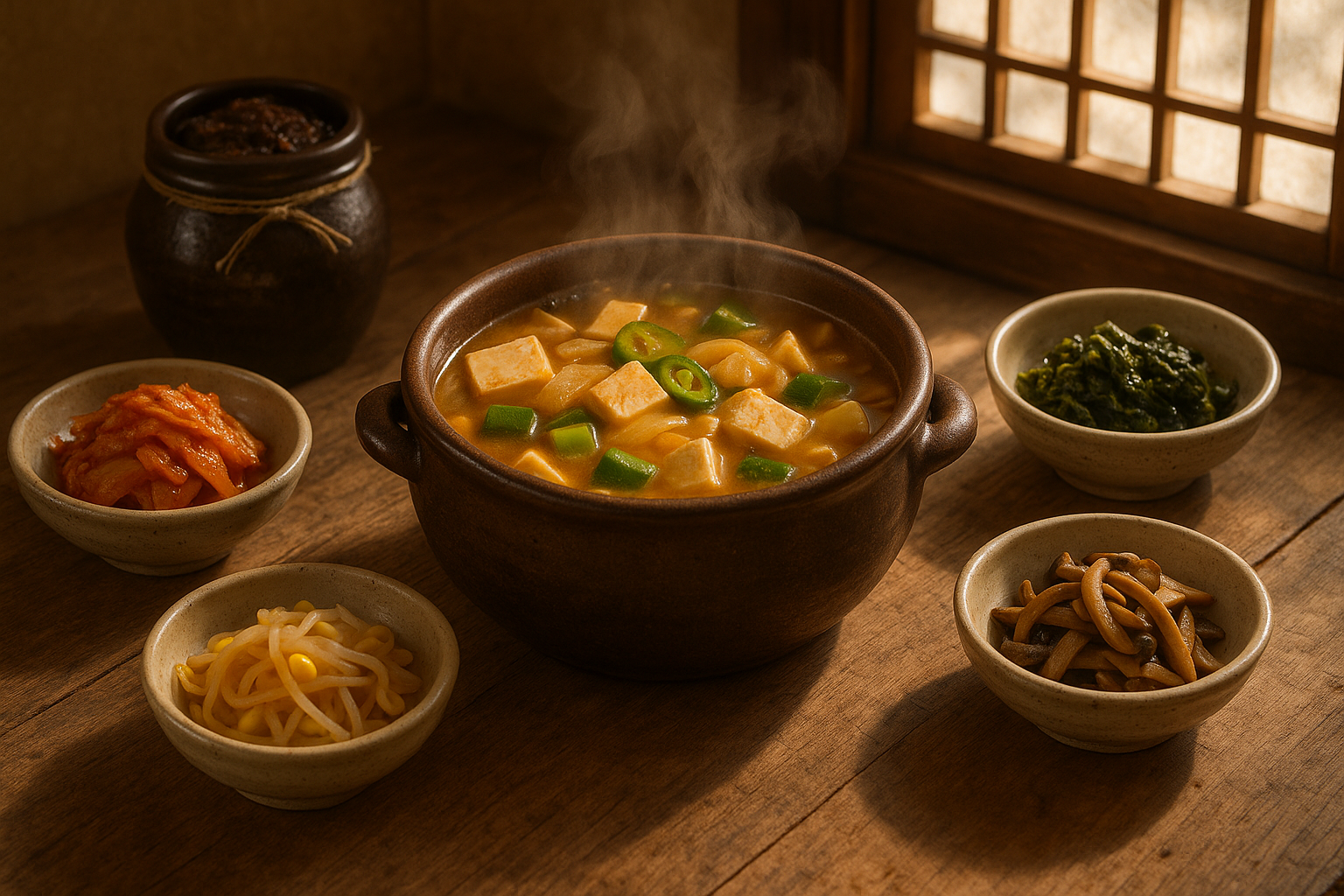
If you have eaten a bubbling Korean stew in an earthenware pot and wondered what gave it that deep, savory, slightly funky backbone, the answer was doenjang. It is one of the oldest and most fundamental ingredients in Korean cooking — and the one most likely to sit unopened in a Western pantry because nobody explained what to do with it.
This guide covers what doenjang is, how it differs from Japanese miso, what to make with it, which tub to buy, and how to keep it once it is open.
—
Quick Answer: What Is Doenjang?
Doenjang (된장, roughly dwen-jang) is a Korean fermented soybean paste made from soybeans, salt, and water — and, in the traditional method, nothing else. The beans are cooked, formed into blocks, colonized by wild molds, brined, and then aged, often for many months.
The result is thick, brown, chunky, and intensely savory. It is the base of Korea’s everyday stew, the backbone of the BBQ dipping sauce, and a marinade in its own right.
The one-line version: doenjang is Korea’s soybean paste — earthier, saltier, and funkier than Japanese miso, and made without rice.
—
What Does Doenjang Taste Like?
Bold, and honestly polarizing on the first spoonful.
- Umami-forward — deeply savory, almost meaty.
- Earthy and funky — the aroma is closer to aged cheese than to anything in a Western spice rack.
- Salty — salt is the preservative, so it is seasoning as much as flavor.
- Complex — long-aged versions pick up nutty and faintly bitter notes.
Do not judge it by the smell of the open tub. Cooked into a stew, the sharp edge mellows and what is left is the savory depth that makes Korean home cooking taste like Korean home cooking.
—
How Doenjang Is Made
Traditional production is a two-product process, which is the part most people find surprising.
So a single fermentation traditionally yields both the soy sauce and the paste. Most supermarket doenjang today is made on a faster industrial schedule; traditionally aged versions are still sold as a premium product and taste distinctly stronger.
—
Doenjang vs. Miso: What Is the Difference?
This is the question almost everyone arrives with, so here it is directly.
| Doenjang | Japanese miso | |
|---|---|---|
| Base | Soybeans and salt | Soybeans plus rice or barley koji |
| Fermentation | Typically longer | Often shorter |
| Texture | Chunky, coarse | Smooth |
| Flavor | Earthy, pungent, salt-forward | Milder, often faintly sweet |
| By-product | Yields ganjang (soy sauce) | No |
Can you substitute one for the other? In a pinch, yes — but expect a different dish. Miso in the stew makes a softer, sweeter stew that tastes Japanese rather than Korean. Going the other way, using it in miso soup will overpower it; start with about half the amount and taste up. Red miso (aka) is closer than white.
—
What to Cook With Doenjang
Doenjang jjigae — the everyday stew
The dish most Koreans grow up on: doenjang dissolved into stock with tofu, zucchini, mushrooms, potato, and often anchovy or clam. It is served bubbling, with rice and side dishes. It is also one of the most forgiving recipes in the cuisine — if the stew tastes flat, it usually needs more paste, not more salt.
Ssamjang — the BBQ wrap sauce
The small dish of sauce at every Korean BBQ table is ssamjang: doenjang blended with gochujang, sesame oil, garlic, and scallion. You spread it on a lettuce leaf, add grilled meat and rice, and wrap. If you are building toward a home BBQ night, our Korean BBQ guide covers how the table is actually assembled.
Marinades and grilled vegetables
Thinned with a little oil, it, garlic, and sugar makes a marinade that caramelizes well on heat — good on eggplant, mushrooms, or oily fish like mackerel. Because the paste is already salty, skip added salt until you taste. Bottled Korean BBQ sauces take the opposite approach — pre-mixed marinades sold ready to pour.
As a seasoning, not a condiment
Unlike gochujang, doenjang is rarely eaten straight. Think of it the way you would use anchovy paste or fish sauce: a spoonful that disappears into the dish and makes everything behind it taste deeper. For where it sits among the other staples, see our overview of Korean food.
—
Buying Doenjang: What to Look For
Four things decide whether you get a tub you will actually finish.
Korean grocery chains and the international aisle of larger supermarkets carry it, and the major Korean brands ship internationally. If you are shopping in Seoul instead, traditional markets sell small-batch versions from regional producers; our Gwangjang Market guide covers how those market stalls work, and Seoul’s official tourism site lists the city’s traditional markets.
—
How to Store Doenjang
- Refrigerate after opening. It is a live fermented product; the fridge slows the fermentation and keeps the flavor where you bought it.
- Press it flat and keep the surface clean. Smoothing the top and wiping the rim reduces the exposed surface. Some cooks lay plastic wrap directly on the paste.
- Darkening is normal. The paste continues to age and deepens in color over time. That is not spoilage.
- It lasts a long time. The salt content is high enough that a refrigerated tub stays usable far longer than most condiments. Trust smell and appearance over the printed date, and discard anything with fuzzy, colored mold rather than scraping it.
—
Doenjang Substitutes
If you cannot get it, in rough order of closeness:
For a Korean stew you actually want to repeat, the real paste is worth ordering. It keeps for a long time, so a single tub goes a long way.
—
FAQ
What is doenjang in English?
“Korean fermented soybean paste.” There is no established English word, so recipes use the Korean term.
Is doenjang the same as miso?
No. Both are fermented soybean pastes, but doenjang is traditionally made from soybeans and salt alone, is usually aged longer, and is chunkier, saltier, and more pungent. Miso commonly includes rice or barley koji and is milder.
Is doenjang the same as gochujang?
No. Gochujang is a sweet-spicy red chili paste made with gochugaru and glutinous rice. Doenjang is brown, salty, and not spicy at all. They are frequently used together — ssamjang is essentially a blend of the two.
Can I eat doenjang raw?
Generally it is cooked or blended into a sauce rather than eaten straight — on its own it is very salty and very strong. Ssamjang is the seasoned, dip-ready form.
Is doenjang gluten-free?
Traditionally made, it is soybeans, salt, and water, which contains no gluten — but many commercial tubs add wheat flour. Read the ingredient list rather than assuming.
Is doenjang vegan?
The paste itself normally is. The stew often is not: the stew is commonly built on anchovy stock and may include clams. Made with a kelp or mushroom stock, it is straightforwardly vegan.
How long does it last once opened?
A long time, refrigerated and kept clean — the salt does the preserving. Judge by smell and surface rather than the date alone.
—
Building a Korean pantry? The three staples are this, gochujang, and gochugaru — with a jar of kimchi in the fridge, you can cook most of the Korean home menu.
🛒 Buy Doenjang Online
Can’t get to a Korean convenience store? Get Doenjang shipped to your door on Amazon — compare top-rated imports, check real reviews, and stock up on the real thing without leaving home.
Disclosure: SeoulScope is a participant in the Klook and Agoda affiliate programs and the Amazon Associates Program. As an Amazon Associate we earn from qualifying purchases. We may earn a small commission when you book or buy through links in this post, at no extra cost to you. We only recommend experiences and products we believe will genuinely help your trip.
2 thoughts on “Doenjang: Korea’s Fermented Soybean Paste, Explained”