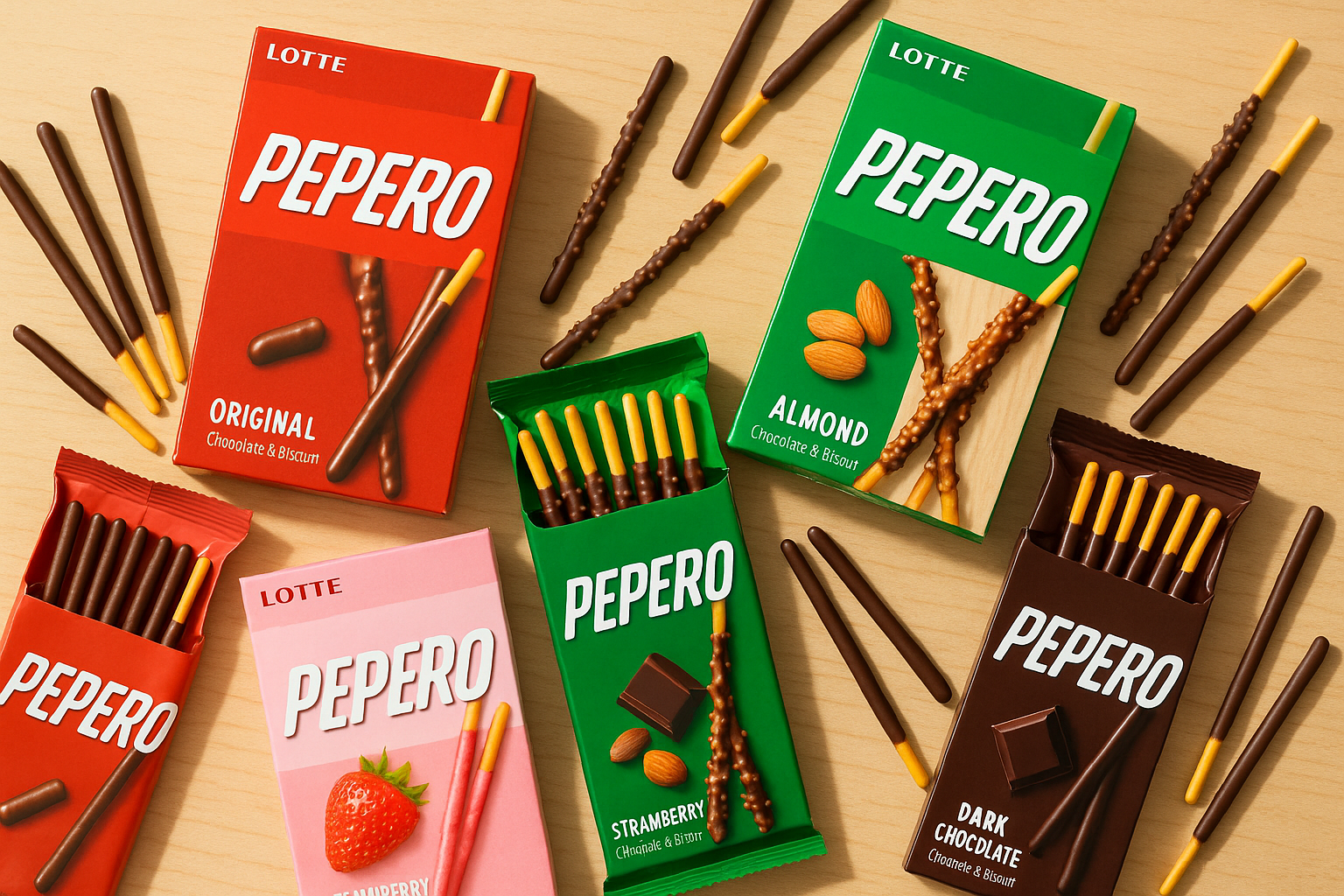
Walk down the snack aisle of any Korean grocery store and you will hit a wall of tall, narrow boxes in red, white, pink, and brown. That is pepero — thin biscuit sticks coated in chocolate or flavored cream, made by Lotte, and one of the most recognizable packaged snacks Korea exports.
This guide covers what it actually is, how it compares to Pocky, which flavors are worth buying, the November 11 holiday built around it, and what to know before you order a box online.
—
Quick Answer: What Is Pepero?
Pepero is a long, thin baked biscuit stick dipped in chocolate or a flavored coating, produced by Lotte Confectionery in South Korea since 1983. A box holds several individually wrapped bundles of sticks, which is why it survives a suitcase and a shared office desk equally well.
The short version: it is Korea’s chocolate-dipped biscuit stick, sold in a dozen-plus flavors, and the center of a national gifting day on November 11.
—
What Does Pepero Taste Like?
Less rich than a chocolate bar, and that is the point.
- Light and dry — the biscuit core is closer to a breadstick than a cookie, so the coating carries the flavor.
- Sweet but not heavy — a whole bundle goes down easily, which is either a feature or a warning.
- Snappy — the texture is the appeal. Stale sticks lose it, so check dates on discounted boxes.
- Flavor-forward — almond, strawberry, and cookies-and-cream taste distinctly like what they claim.
If you find Western chocolate biscuits too sweet or too dense, this sits in a lighter register.
—
Pepero vs. Pocky: What Is the Difference?
This is the question almost everyone arrives with.
| Pepero | Pocky | |
|---|---|---|
| Maker | Lotte (South Korea) | Ezaki Glico (Japan) |
| Launched | 1983 | 1966 |
| Format | Chocolate-dipped biscuit stick | Chocolate-dipped biscuit stick |
| Signature day | November 11 | November 11 (Pocky & Pretz Day) |
They are the same product category, and the two companies have a long-running rivalry over it. Glico’s version came first by nearly two decades. In practice the differences that matter to a shopper are flavor lineup and price at your local store — the Korean brand tends to run a wider range of cream-filled and nut-coated variants, and the almond version has no close Japanese equivalent.
—
The Flavors Worth Buying
The classic red box is the baseline, not the ceiling.
Almond — the one to buy first
Chocolate coating rolled in crushed almond. The nut adds texture the plain version does not have, and it is the flavor long-term residents name most often when asked for one pick. If you are ordering a single box to try, order this.
Original chocolate
Dark-leaning chocolate over a plain biscuit. It is the benchmark everything else is measured against, and the safest choice for a gift box going to someone with unknown tastes.
Nude
The coating is inside a hollow biscuit tube rather than outside. It does not melt onto your fingers, which makes it the practical choice for a car, a desk, or a warm climate.
White cookie
White chocolate with cookie crumble. Distinctly sweeter — popular with kids, polarizing with everyone else.
Cookies and cream
Vanilla-forward coating with dark cookie pieces. The most familiar profile for anyone raised on Western supermarket snacks, and a reliable gateway box.
Strawberry
Pink coating, candy-strawberry flavor rather than fruit. Buy it knowing that.
Seasonal and collaboration editions rotate constantly, especially in the run-up to November. They are fun but not worth hunting from abroad — the core lineup is where the quality is.
—
Pepero Day: November 11
The date is written 11/11, which looks like four thin sticks standing in a row. That visual pun is the whole origin of the holiday.
The commonly told story is that students in the early 1990s began exchanging the sticks on that date, and Lotte — which has said the custom was not its invention — leaned into it afterward with gift sets and seasonal packaging. Today it is one of the larger confectionery retail events in the Korean calendar, alongside Valentine’s Day and White Day.
What it looks like in practice: convenience stores rebuild their front displays around the boxes for the last week of October and the first half of November, gift sets appear in tins and paper bags, and friends, couples, coworkers, and students hand them to each other with no ceremony at all. It is not a public holiday — offices and banks stay open. Seoul’s official tourism site is the place to check what seasonal city events are running if you happen to travel then.
There is also a party game, familiar from Korean variety shows, where two people eat inward from opposite ends of one stick. Knowing it exists explains a surprising number of TV moments.
—
How to Buy Pepero
In Korea
Every convenience store chain carries the core pepero flavors, and large marts carry the full lineup including seasonal editions. Multipacks at a mart cost noticeably less per box than singles at a convenience store, so buy souvenirs at the mart. For how the convenience-store snack shelf works more broadly, see our Korean convenience store food guide.
Outside Korea
Korean and pan-Asian grocery chains stock the red box almost universally; the flavor range narrows to four or five. Online is where the full lineup lives, usually sold as variety packs or as multi-box cases of a single flavor.
Three things to check before ordering:
—
Is Pepero a Good Souvenir?
It is one of the better ones, for unglamorous reasons: it is light, the boxes are rigid, it is shelf-stable, and everyone recognizes it. Pack boxes upright and flat against the side of a suitcase rather than loose in the middle.
For gifting inside Korea, a mart gift tin reads as more considered than loose boxes without being a formal gift. Two or three flavors handed to a host family lands well.
If you are assembling a broader snack haul, our roundup of the best Korean snacks covers the chips, cakes, and candies worth room in a bag, and the Korean traditional snacks guide covers the older confectionery this category grew out of.
—
Storing It Once the Box Is Open
The enemy is humidity, not time. Each box holds several sealed bundles for exactly this reason — open one at a time and the rest stay snappy for weeks.
- Reseal or clip the inner bag. An open bundle left out overnight goes soft, and soft pepero is the one state nothing recovers from.
- Keep it cool, not cold. A pantry shelf away from the stove is right. The fridge works in a hot climate but can dull the chocolate’s snap and pick up fridge odors through the biscuit.
- Watch for bloom. Pale streaks on the coating are cocoa butter that melted and recrystallized. It is harmless and only a texture and appearance issue, but it means the box got warm at some point in transit.
- Trust the snap over the date. A box past its printed date that still snaps cleanly is fine; one within date that bends is already gone.
—
Which Box for Which Occasion
- Trying it for the first time: a single almond box. It is the version most likely to convert a skeptic.
- Office or classroom sharing: original chocolate, multipack. Individually wrapped bundles make it easy to pass around, and nobody objects to plain chocolate.
- Kids: white cookie or strawberry, both firmly in sweet territory.
- A gift with some thought behind it: a seasonal tin, or three boxes in three flavors. Pepero is casual by nature, so the gesture is in the variety rather than the price.
- Hot weather or a long trip home: Nude, every time. The coating is on the inside and stays there.
—
FAQ
Who makes Pepero?
Lotte Confectionery, a South Korean company, since 1983.
Is it the same as Pocky?
No — same category, different companies. Pocky is made by Japan’s Ezaki Glico and launched in 1966. The Korean version arrived in 1983 with a different flavor lineup.
What is the best flavor?
Almond, by consensus. Cookies and cream if you prefer a familiar, sweeter profile.
Why November 11?
The digits 11/11 resemble four sticks side by side. The gifting custom grew from that pun in the early 1990s.
Is it vegetarian? Vegan? Gluten-free?
The biscuit is wheat-based, so it is not gluten-free. Standard varieties contain dairy, so they are not vegan. Formulations differ by flavor and by market — read the label on the box you are actually holding.
Does pepero travel well?
Yes, as long as it stays cool. The packaging protects the sticks; heat is the real risk. The hollow-center Nude version handles warmth best.
How is it different from Korean traditional confectionery?
Entirely. It is a modern industrial snack. Traditional Korean sweets like yakgwa and hangwa are honey-, grain-, and oil-based, and taste nothing like it.
—
Building a Korean snack shelf? Start here, then work through the best Korean snacks roundup and the wider Korean food guide.
🛒 Buy Pepero Online
Can’t get to a Korean convenience store? Get Pepero shipped to your door on Amazon — compare top-rated imports, check real reviews, and stock up on the real thing without leaving home.
Disclosure: SeoulScope is a participant in the Klook and Agoda affiliate programs and the Amazon Associates Program. As an Amazon Associate we earn from qualifying purchases. We may earn a small commission when you book or buy through links in this post, at no extra cost to you. We only recommend experiences and products we believe will genuinely help your trip.
2 thoughts on “Pepero: Korea’s Chocolate Stick Snack, Explained”